


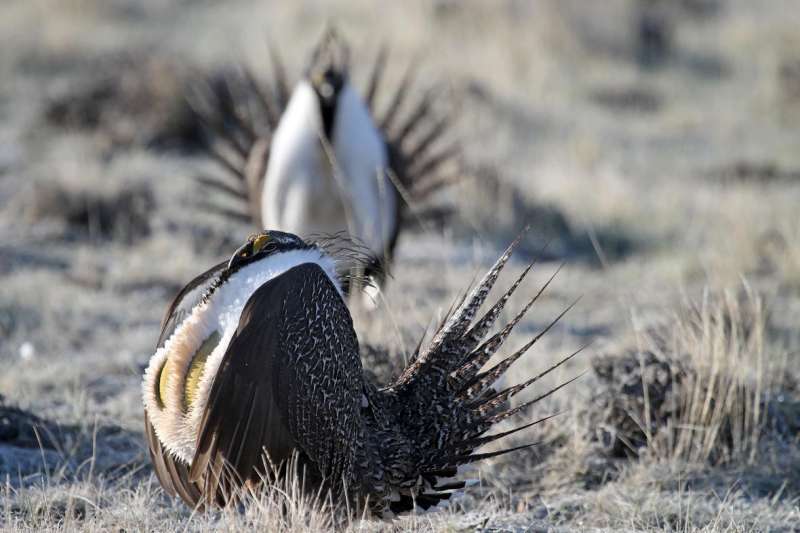
SAGE-GROUSE BEAUTY IN WYOMING
The Scottish moors are considered areas of outstanding beauty, and often assumed to be “wild” and “untamed.” However, these landscapes are the result of management techniques that are now under scrutiny by the Scottish government.
These practices include burning the moorlands (muirburn) and controlling the number of animals on the moors through trapping, snaring and poisoning. All of these measures are pursued to keep the number of red grouse artificially high so they can be shot in grouse season.
An estimated 260,000 animals are killed each year in Scotland as part of these legal “predator control” measures. Targeted animals include foxes, weasels, stoats, rats, rabbits and various types of corvid like crows, magpies, jackdaws and jays.
Many animals are also killed unintentionally. A report that was commissioned by the League Against Cruel Sports Scotland, a UK-based animal welfare charity, shows that as many as 39% of the trapped animals are not the intended target. These animals include pine martens, hedgehogs, badgers, deer and hares. But there have also been reports of endangered and protected animals, such as raptors and the capercaillie, being killed.
In a recent report, which I co-authored with Dr. Katie Javanaud and Professor Andrew Linzey from the Oxford Centre for Animal Ethics, we examined the moral basis for these practices. We found that it is impossible to overstate the severity of the suffering caused by animals caught in traps.
The Agreement on International Humane Trapping Standards, to which the UK is a signatory, is the primary measure against which the welfare of trapped animals is judged. The standards consider traps to be “sufficient” and “efficient” if the animals are killed in anywhere between 45 seconds and five minutes. In fact, the standards still consider traps efficient if 20% of animals do not die within five minutes.
Any system of killing that only causes death after 45 seconds to five minutes is unnecessarily cruel. The animals suffer an appalling range of injuries that would not be acceptable in any other context. Entrapment for free-living animals is at best a distressing experience that obviously involves psychological and emotional harm.
All forms of predator control, whether that be trapping, snaring or poisoning, are predicated on exposing animals to hours or days of prolonged suffering. And all of this supposes that these traps can practically be inspected often. This is a question in and of itself given the vast area over which the methods are used and the limited manpower available, as well as adverse weather conditions. » …
Read More rnrn