


45 who wants to be 47 got what he came for.
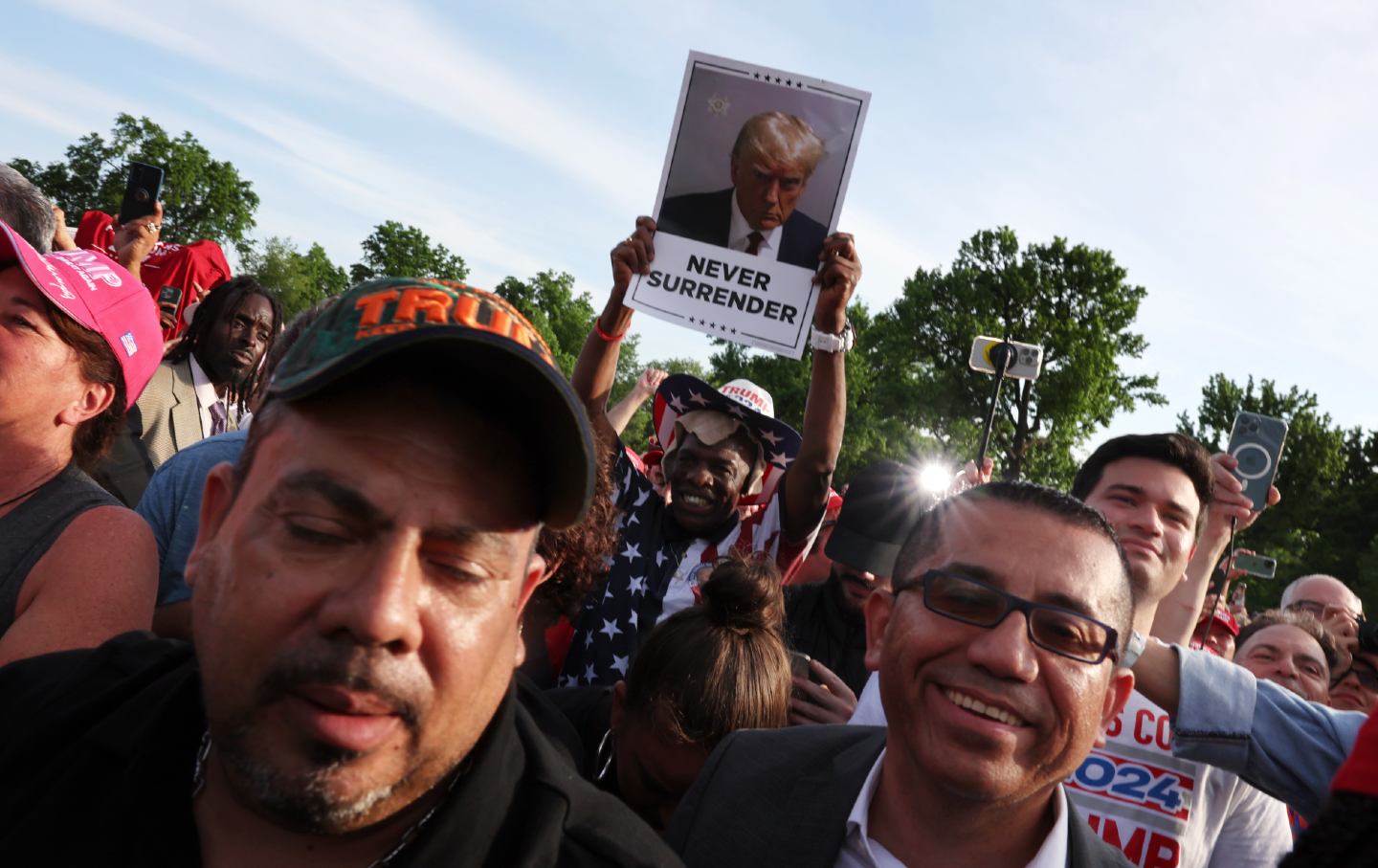
Supporters of former president Donald Trump watch as he holds a rally in the South Bronx on May 23, 2024, in New York City. The Bronx, home to a large Latino community, has been a Democratic base for generations of voters and the rally comes as Trump looks to attract more non-white voters.
(Spencer Platt / Getty Images)
Crotona Park, NY—The Donald was always more of a Queens guy. Even the two years he put in at Fordham’s Rose Hill campus here in the Bronx—before a family connection got him admitted as a transfer to the University of Pennsylvania—left little mark on either the student or the institution. No Trump Memorial Athletic Center to commemorate his time on the squash courts. No Trump Library. Not even a Trump Miniature Golf Course.
So it was a surprising, unexpectedly savvy move to make the most of his court-imposed sequestration in New York City by holding a rally amid the 125 verdant acres of this city park in the South Bronx. Like Newton, Iowa, (the former home of Maytag, where I caught a Trump rally in late 2015), or Monessen, Pennsylvania, (the hollowed-out former steel town where Trump gave a remarkably cogent speech pointing out the damage Bill Clinton’s North American Free Trade Agreement had inflicted on the American working class ), Crotona Park and Morrisania to the south are places Democrats running for president just don’t go anymore.
Current Issue

“This is so amazing,” said the young Black mother bustling her two sons up the hill that runs past the algae-clogged waters of the park’s Indian Lake (name apparently untouched by the tides of reform) to where Trump was speaking. They don’t get a lot of celebrities here. And they haven’t seen a presidential candidate since Bill Clinton in 1997. But back then, Clinton was following in the footsteps of Jimmy Carter (1977), Ronald Reagan (1980), and Jesse Jackson (1984)—though the Rev. Jackson at least spent the night in the neighborhood, as The New York Times put it “to draw attention to the plight of the poor.”
Trump had a different agenda, but the area’s history as a political prop—and the long legacy of broken promises from City Hall, Albany, and Washington—meant the candidate’s message of bad times found a receptive audience.
“They tell you just because we’re surviving, we’re doing OK,” a woman with a red MAGA had over braided hair extensions down to her waist told me. Like nearly everyone I spoke with in the crowd, she was not eager to see her name in the media. “When you’re financially OK, you’re distracted. Maybe you don’t see what’s going on. But we’re not OK. And we’re paying attention.”
One might well wish to argue with her worldview or her premises. But it would be a mistake beyond mere condescension to dismiss people like her as low-information voters.