

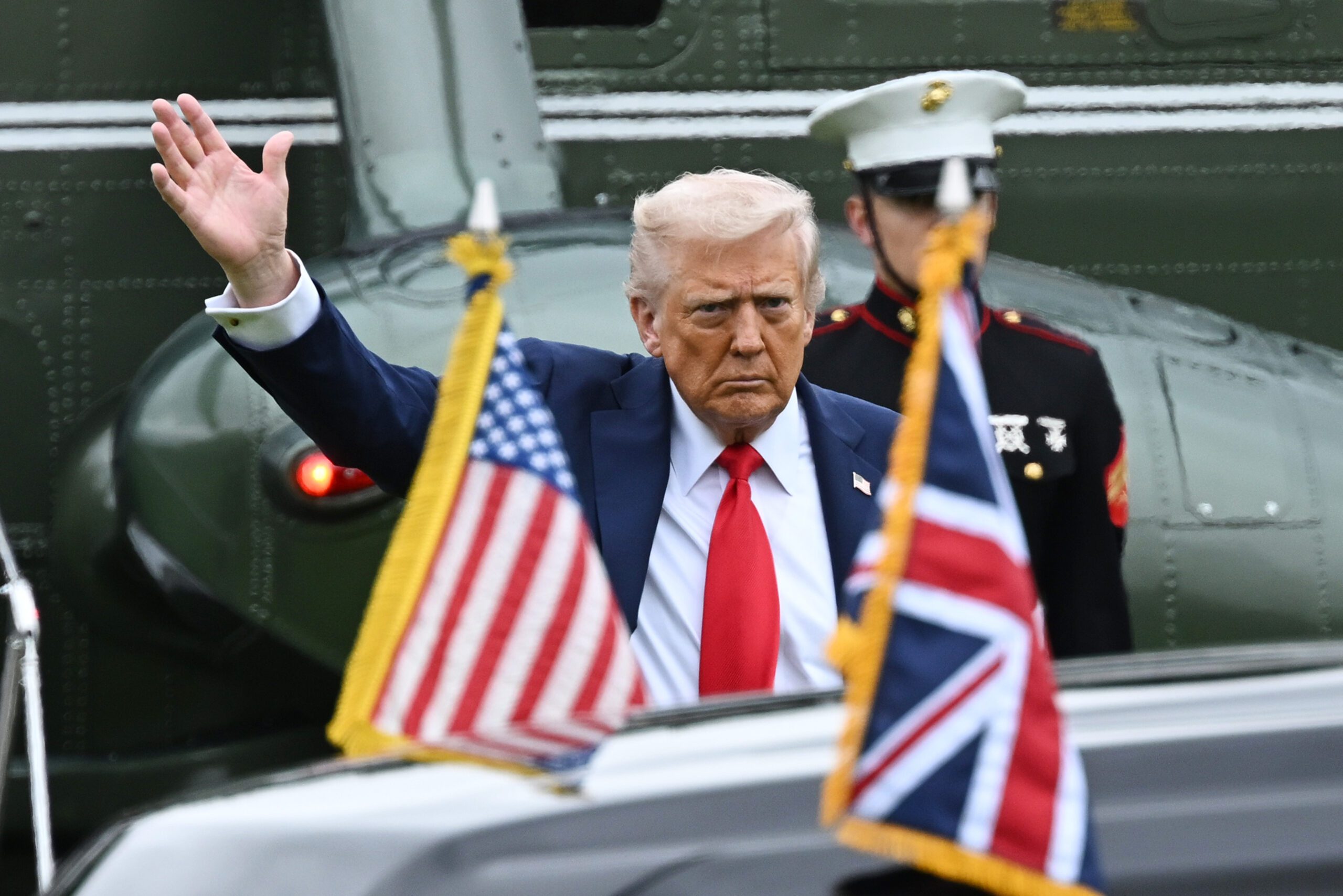


Donald Trump arrives for a meeting with British Prime Minister Kier Starmer in Aylesbury, England, on Sept. 18, 2025. Photo: Leon Neal/Getty Images
Multibillionaire investor George Soros is not funding a network of militant left-wing activists. That fact has not stopped President Donald Trump from spending the days since Charlie Kirk’s killing calling to press charges against the liberal philanthropist under the Racketeer Influenced and Corrupt Organizations, or RICO, Act for allegedly bankrolling “violent” leftist protests across the country.
This absurd idea is among an array of repressive proposals, ranging from the illegal to the unconstitutional, that Trump and his acolytes have pulled from a cartoonishly blatant playbook of fascist scapegoating — conspiracies of Jewish dark money and all. The Trump administration will likely fail to bring successful prosecutions against the disparate liberal and leftist individuals and organizations they see as a well-funded criminal network. But we are long past the point of pretending the administration will be bound by law, or tethered to factual reality, when it comes to achieving its broader authoritarian goals.
Trump announced on Wednesday night, for example, that he was designating antifa a “major terrorist organization.” The proclamation, posted on Truth Social, is senseless in a number of ways.
Firstly, as has been stated ad nauseam, there is no such organization as “antifa” — an abbreviation of “anti-fascist” — which is a set of practices and militant tactics, deployed by activists for nearly a century. There are groups who come together under the “antifa” banner, but there is zero centralized leadership or membership structure. Secondly, the U.S. has no statutes under which groups are designated domestic terror organizations.
Some might recall Trump’s very similar announcement during the 2020 George Floyd uprisings, when he took pains to target left-wing activists and discredit the Black-led movement. At the time, his tweet did not call into being a non-existent domestic terror statute against a non-existent organization.
It should not be overlooked that since Trump’s first term, all significant efforts to collectively prosecute social justice movements have failed.
On Trump’s 2017 Inauguration Day, over 200 anti-fascist “J20” protesters were mass-arrested and hit with hefty felony riot charges based on no more than presence at the protest; the charges were later dismissed or dropped en masse. Just last week, a judge in Fulton County, Georgia, announced that he was dismissing overreaching RICO charges against 61 participants in the Atlanta-based Stop Cop City movement. The prosecutors’ two-year effort to frame the protest movement as a criminal conspiracy collapsed.
Having reported directly on both the J20 and Stop Cop City cases, I saw firsthand the toll a lengthy prosecutorial process can take on defendants, their supporters, and the entire targeted movement. Prosecutions need not lead to convictions to ruin lives and decimate social movement capacities; federal investigations do not need to have factual basis for their targets to be harassed and intimidated; First Amendment-protected speech can still get you fired. Fear spreads, cowardice abounds, and the real risks of state and state-sanctioned persecution hang over targeted communities.