

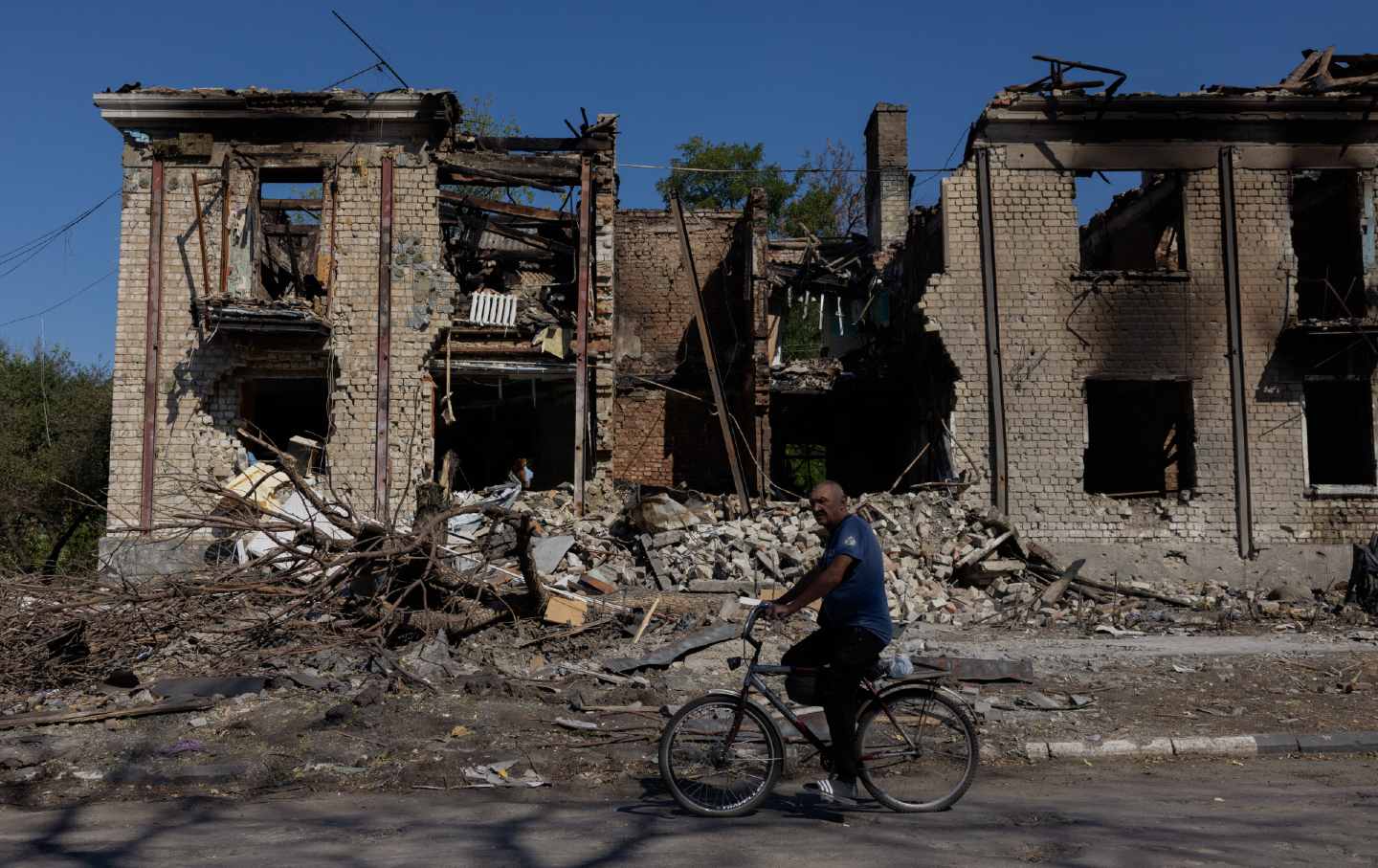

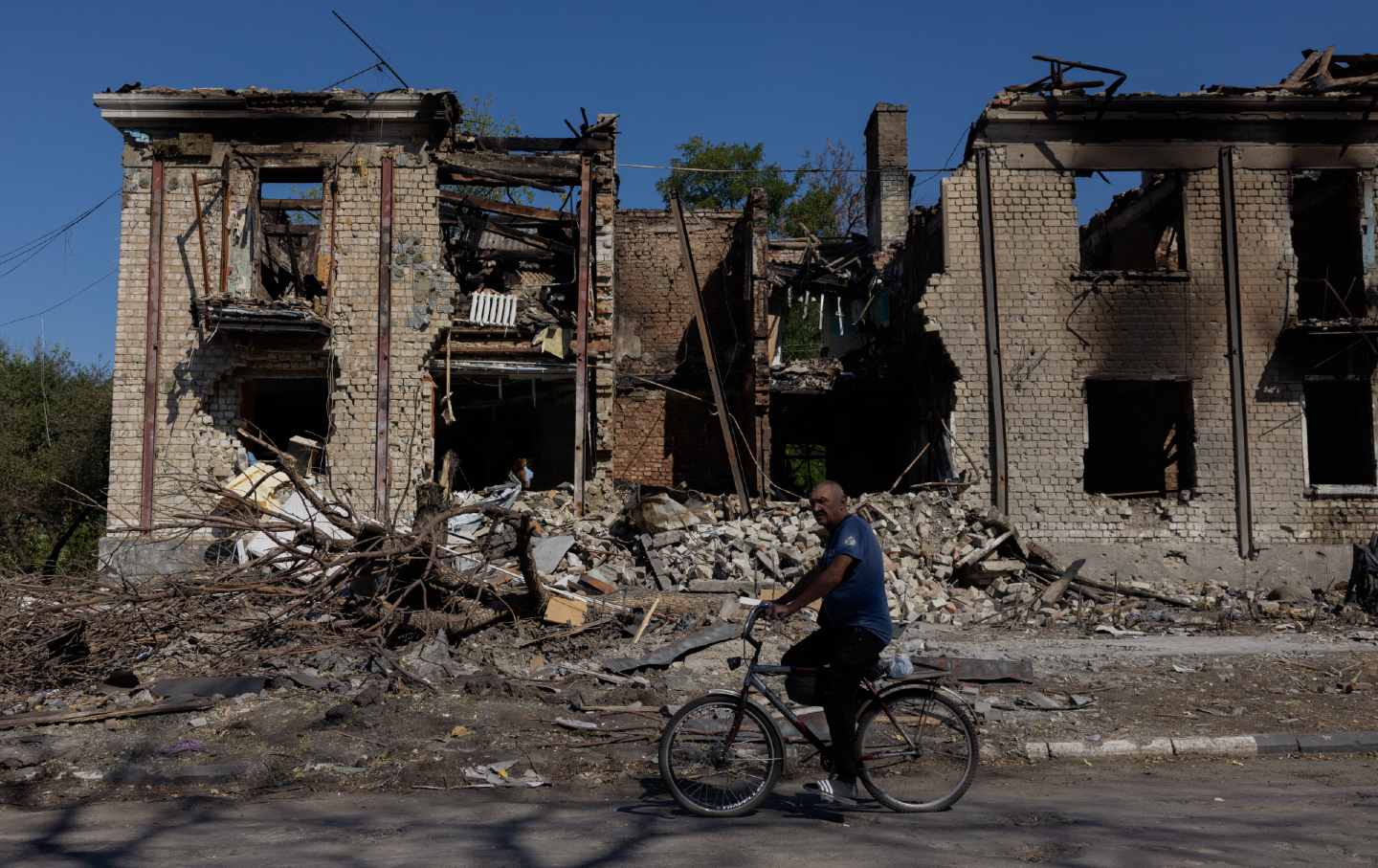
 A man rides a bicycle past a damaged residental building in Novodonets’ke, Donetsk region, on September 14, 2025. (Tetiana Dzhafarova / Getty Images)
NOTE: Since the above was written, drones were shot down over Polish airspace. This could have been a deliberate Russian provocation, or a mistake, or a deception by the Ukrainians or others. The sad fact is that in the present state of knowledge, there is no means of telling which is true. In November 2022, a suspected Russian missile killed two people in Poland. A correspondent has reminded me that it is now thought to have been a Ukrainian rather than a Russian missile.
I.
A few days ago, at dinner, the discussion turned (as it sometimes does these days) to Ukraine. The debate—because it was a debate—went on for three hours. I found myself, as I often do on this topic, in a small minority. I reproduce the gist of the discussion here, because it’s very rare, in my experience, for the two sides to engage each other directly: Each prefers to stick to its own version of the truth. Animated, but restrained, the argument circled round the two poles of Putin and Trump—their personalities, their motives, and, given these, the possibility of peace in Ukraine any time soon. For each of the two protagonists, there is a case for the prosecution and a case for the defense. At two points in the discussion below, I invite the judgment of Adam Smith’s “impartial spectator.”
To start with Putin. Why did he invade Ukraine? What was he hoping to get out of it? And what, if any, justification did he have for his actions? The prosecution’s case is straightforward: Russia’s invasion was an illegal, unprovoked attack on a sovereign state, in violation of the UN Charter. Specifically, Russia broke the Budapest Memorandum of 1994, a set of assurances it had (together with other signatories) given to respect the independence, sovereignty, and existing borders of Ukraine, as a quid pro quo for Ukraine returning to Russia the nuclear weapons stockpile it had inherited from the Soviet Union. Putin, routinely depicted as a mixture of Machiavelli and Hitler, was the sole author of the war.
But wait a minute, responds the defense. The Budapest agreement of 1994 was a memorandum of understanding, not a treaty, therefore not legally binding. And it’s absurd to claim that Ukraine surrendered its security by giving up its nuclear weapons, since their use was operationally dependent on Russia. As for Russia breaking its promise to respect Ukraine’s sovereignty, wasn’t the prosecution ignoring the effect on Russia of NATO’s Bucharest declaration of 2008 that Ukraine “will become a member of NATO”? Was not the Budapest Memorandum of 1994 based on the expectation that, as a founder member of the Commonwealth of Independent States (CIS), Ukraine would remain part of the “Russosphere”?
“Rubbish,” respond the prosecutors. Russia had no right of veto on an independent state’s joining NATO.