


Published December 18, 2023
6 min read
A bonobo named Louise, born into captivity at the San Diego Zoo, lived with her sister, Loretta, and nephew, Erin, before being transferred to the Japan’s Kumamoto Sanctuary in 1992.
In the wild, female bonobos leave their troops as they mature, striking out into neighboring communities to raise families of their own. So it was natural enough for Louise to go off and perhaps never see the bonobos she grew up with again.
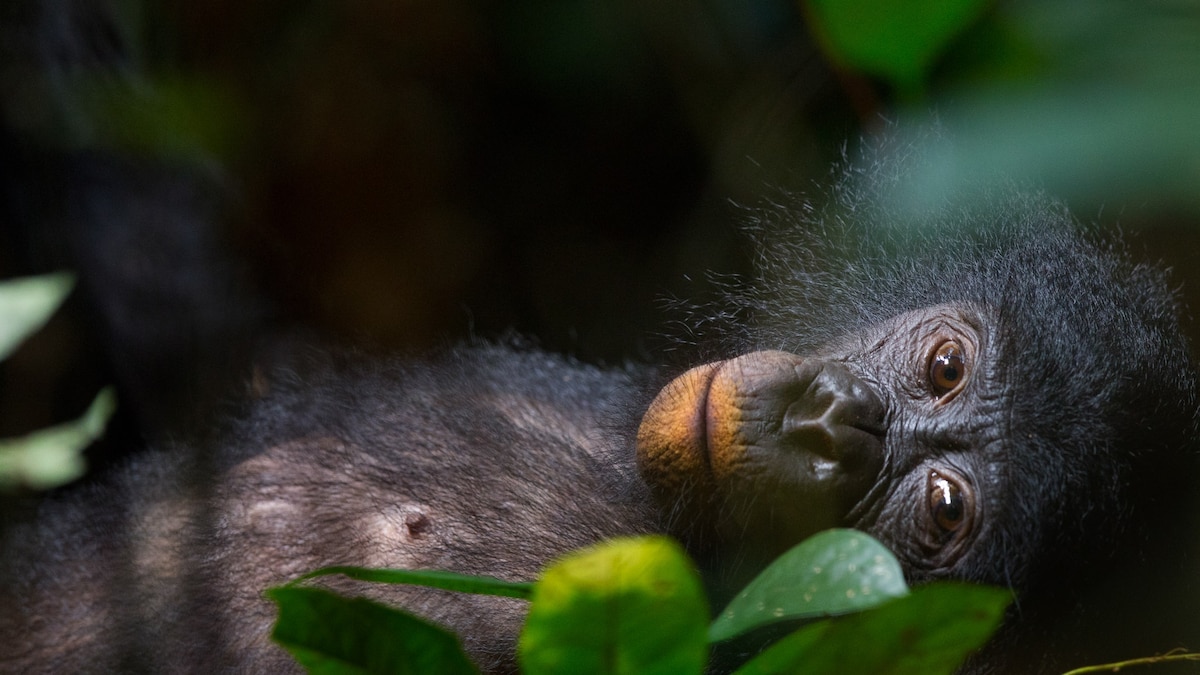
But in 2019, when researchers presented Louise with a photo of her sister, Loretta, next to an image of a bonobo she’d never met, Louise stared at the face of her kin, all but ignoring the stranger. And when shown a photo of her nephew paired with that of a stranger, data collected by an infrared camera that harmlessly tracks eye movements showed Louise had little to no interest in the stranger. Her eyes lingered over her nephew. (Read how bonobos are kind to strangers.)
To be clear, it had been 26 years since Louise had seen either of these family members. And yet, over eight trials, the 46-year-old bonobo showed a strong preference for looking at her long-lost relatives rather than other bonobos she’d never been housed with.
After nearly three decades, Louise seems to have remembered Loretta and Erin.
This marks the longest-lasting nonhuman social memory ever documented, according to a study published today in the journal Proceedings of the National Academy of Sciences. The previous record belonged to bottlenose dolphins, which have been shown to recognize podmates’ vocalizations after 20 years.
Sharp memories
The idea for this research came from about 15 years of working with captive great ape populations.
“We typically travel to zoos around the world to work with these animals, and we’ve often had the experience that you come back years later, and it seems like they distinctly remember you,” says senior author Christopher Krupenye, a comparative psychologist at Johns Hopkins University in Baltimore, Maryland.
To conduct the research, the scientists collected eye-tracking data from 26 bonobos and chimpanzees housed at facilities in Japan, the United Kingdom, and Belgium. Each animal was presented with an image of another animal of the same species and sex whom they hadn’t seen for at least nine months, but in some cases years or decades. (The test subjects were between the age of four and 46 years old, with an average age of nearly 26.)
Interestingly, the scientists also discovered the great apes, which can live up to about 50 years in the wild, had a small but statistically significant bias toward looking at animals they liked—rather than those with whom they’d had neutral or negative interactions. This suggests that Louise didn’t just remember Loretta and Erin’s faces, but that she recalled the quality of the relationships she’d had with the pair.