


Credit: NASA
For decades, scientists have been perplexed by the two small moons of Mars. Phobos, which is about 22km in diameter and Deimos, about 13km in diameter, have long baffled the experts, with their origin sparking a lively debate among researchers. While some have suggested that they may consist of residual debris produced from a planet or large asteroid smashing into the surface of Mars (#TeamImpact), others point to the possibility that the moons are asteroids that were captured by Mars’s gravitational pull and were trapped in orbit (#TeamCapture).
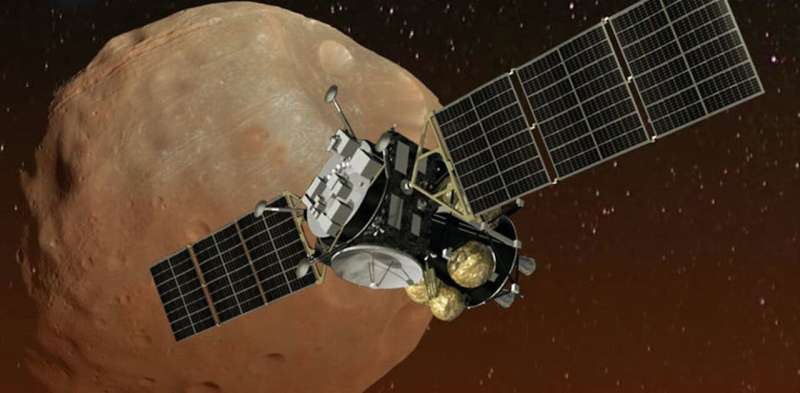
A new space mission named “Martian Moon eXploration” (MMX) which will be carried by a newly designed rocket, the H-3, is set to launch to Phobos and Deimos in September 2024. The spacecraft is expected to orbit Phobos and collect material from its surface, providing material for analytical analyses on Earth which would help to determine the origin of the moons. With the mission bringing material back to Earth, much wealth of knowledge is expected to be unlocked regarding the origin of Phobos and Deimos.
If an impact origin occurred, we would expect similar material found on Phobos that is found on Mars. While direct material from Mars has yet to be returned, it is fortunate that we have rock ejected off this surface located on Earth which might bear similarity to the material returned from Phobos. On the other hand, if the moons originated from captured asteroids, we can expect to find material on Phobos that is found on other asteroids in our solar system. The case for collecting material from Phobos is its potential to solidify which hemisphere better explains the origin of the two moons which will be a major step forward in space research and exploration. This mission is expected to make a significant mark following previous successful missions and bringing material from space back to Earth.