


Climate Action, Climate Change, Climate Change Finance, Climate Change Justice, COP30, Global, Headlines, Humanitarian Emergencies, Latin America & the Caribbean, Sustainable Development Goals, TerraViva United Nations
COP30

Despite nearly 80 developed and developing countries standing firm demanding an end to the use of planet-warming fossil fuels, there is no mention of fossil fuels in the final COP30 agreement, only an oblique reference to the ‘UAE consensus.’

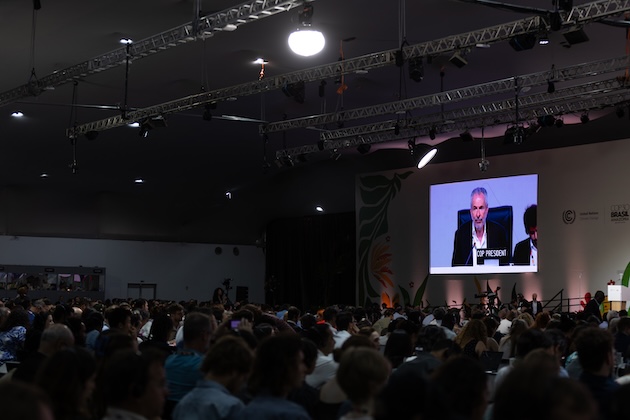
André Corrêa do Lago, COP30 President of Brazil, during a highly charged closing plenary. Credit: UN Climate Change/Kiara Worth
BELÉM, Brazil, Nov 23 2025 (IPS) – Following tense, nightlong negotiations and bitter rows between more than 190 country delegations, a “politically charged Belém package” was finally forged at COP30—so named because of the highly contentious and difficult-to-negotiate issues within the climate talks. Belém was supposed to be ‘a how’ climate conference. Decisions made at the 30th Conference of the Parties to the United Nations Framework Convention on Climate Change would shape how the Paris Agreement moves from word to action and to what extent global climate actions can be reached. In this COP of “implementation and multilateralism in action,” politics carried the day in more ways than one.
Observers, such as Wesley Githaiga from the Civil Society, told IPS that issues touching on trade, climate finance, and fossil fuels are politically charged because of competing and conflicting national interests.

Gavel came out without a roadmap for ending fossil fuels. Credit: UN Climate Change/Kiara Worth
“Some countries bear more responsibility for the climate crises than others and have a higher financial responsibility to address climate change,” Githaiga said. “Striking a balance between the needs of vulnerable developing nations and the economic priorities of developed wealthy countries is difficult.”
Conflicting national interests escalated when COP30 was suspended for additional side consultations just one hour before the final outcome on Saturday, following an argument that broke out over procedural issues.
The Elephant in the Room: Fossil Fuels
On one hand, a few highly organized petrostates from the Arab Group of nations, including Saudi Arabia, were opposed to Colombia, which was supported by the European Union and other Latin American countries like Panama and Uruguay regarding fossil fuels. Fossil fuels are by far the largest contributors to global warming. Scientists have warned of catastrophic temperature rises of up to 2.5°C by mid-century.
Githaiga says the issue was procedural because Colombia was objecting to an already-approved text. The main point of contention was the transition away from fossil fuels. COP28 achieved a historic breakthrough by advocating for a global shift away from fossil fuels. How to transition had been the most highly contentious issue at Belém.
So contentious that COP30 ultimately decided to sidestep ‘fossil fuels’ altogether.
Despite nearly 80 developed and developing countries standing firm demanding an end to the use of planet-warming fossil fuels,