


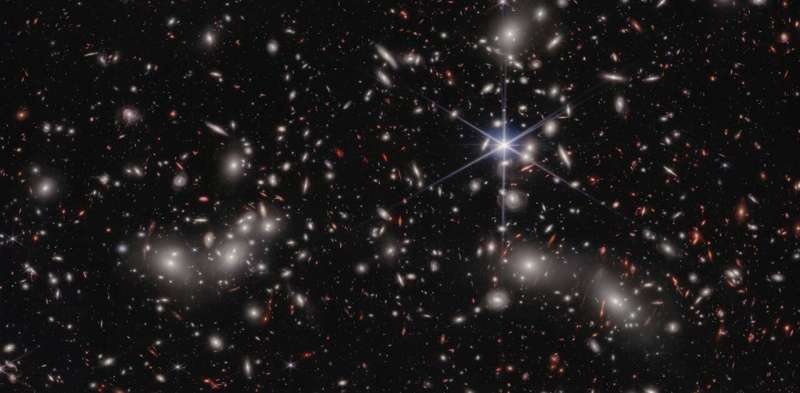
In the aftermath of the Big Bang, approximately 400,000 years later, the universe existed in darkness. The initial burst of the universe’s creation had faded, leaving behind a dense hydrogen-filled space without any sources of light.
Gradually over millions of years, gravity caused the gas to clump together, eventually forming structures large enough to spark into the first stars in the universe.
Initially, the light from these stars was limited, as most of it was absorbed by a hydrogen gas fog surrounding them. However, as more stars emerged, they collectively generated enough light to dissipate the fog through the process of “reionization,” leading to the formation of a transparent universe adorned with brilliant celestial entities we observe today.
The breakthrough discovery about the end of the dark ages came from an extensive study published in Nature, where researchers utilized a massive galaxy cluster as a tool to investigate ancient remnants, revealing that small, faint dwarf galaxies played a critical role in transitioning the universe from darkness to light.
Galactic Contributions to Reionization
While the majority of astronomers concurred on the importance of galaxies in reionizing the universe, the exact method remained ambiguous. The consensus was that stars within galaxies emitted ionizing photons necessary for the process, yet the challenge lay in ensuring these photons escape the confines of dust and gas within the galaxy to interact with hydrogen atoms between galaxies.
Debate arose between two factions within the galaxy theory proponents. The first camp believed that immense, massive galaxies were the primary source of ionizing photons, despite their rarity, as they emitted substantial amounts of light. Alternatively, the opposing viewpoint favored focusing on numerous smaller galaxies in the early universe, each emitting lesser ionizing light but collectively contributing significantly to the epoch of reionization.
Utilizing Nature’s Magnifying Glass
Observing the early universe posed immense challenges due to the scarcity of massive galaxies and the faintness of smaller galaxies, complicating data collection. To address this, researchers leveraged the immense Pandora’s Cluster, a group of galaxies acting as a natural magnifying glass, allowing for the study of some of the faintest galaxies existing.
By unraveling these mysteries, scientists are gradually piecing together the puzzle of the universe’s evolution, shedding light on the pivotal role played by diverse galaxies in transitioning from the dark ages to a universe teeming with light.