

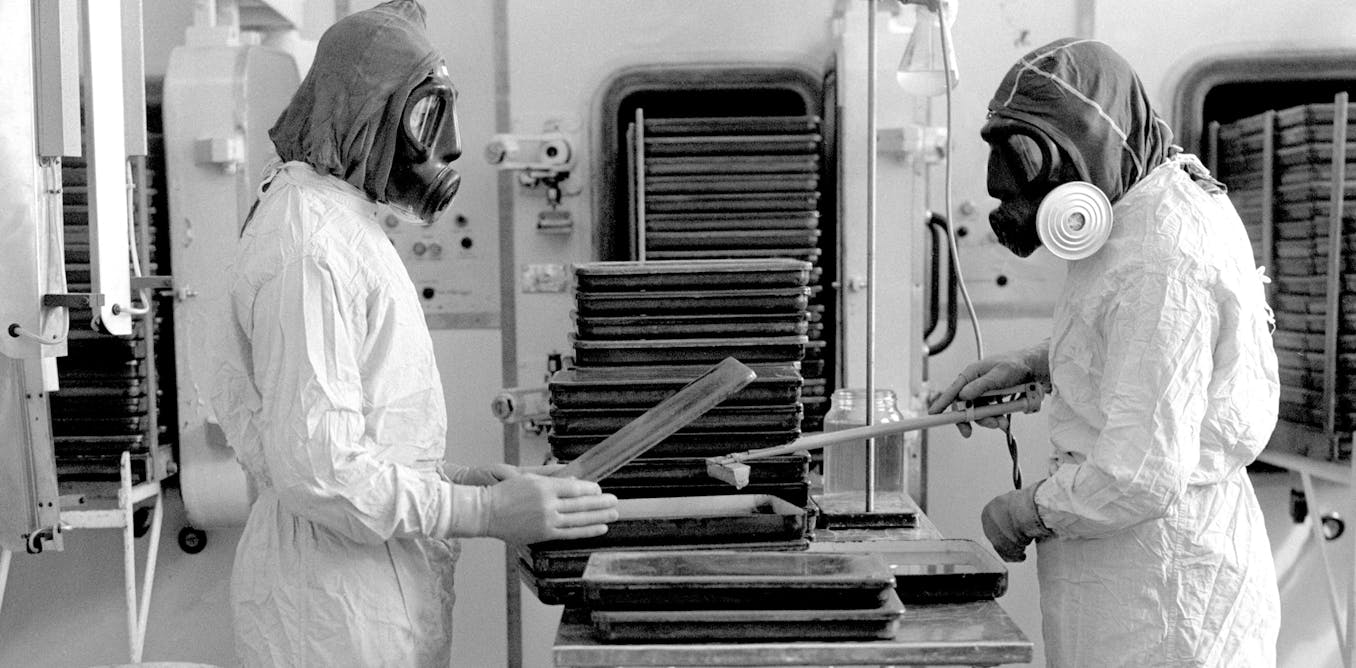

When the UK’s offensive chemical and biological weapons programmes were terminated in the 1950s, work at the high-security military research centre in Porton Down, Wiltshire switched to defensive strategies. These included developing chemicals for use in riot control and countermeasures to the evolving threat of chemical and biological weapons.
Before being tested on military personnel, potential riot control compounds had to go through an informal preliminary screening. According to a 2006 history of Porton Down published by the Ministry of Defence (MoD), this would sometimes involve laboratory staff “cautiously sniffing” new compounds in order to “eliminate the less promising ones”.
Today’s scientists working inside the Defence Science and Technology Laboratory (DSTL), which is headquartered at Porton Down, won’t be doing any sniff tests. But according to an anonymous whistleblower, Porton’s CEO, Paul Hollinshead, has warned that the laboratory needs to improve its health and safety record, or risk losing its operating licence.
The Guardian reported that an internal survey had raised widespread concerns about staff lacking the “resources to work safely”. The facility is now undergoing a major reorganisation, but a Porton spokesperson stressed to me that “any changes will protect and enhance its critical functions” – including working with government departments beyond the MoD.
Inside Porton Down. Video: ITV News.
A history of staff self-testing
My research with colleagues inside Porton Down found that between 1941 and 1989, staff took part in more than 1,300 tests of 78 different chemical and biological substances.
These included highly toxic nerve agents such as Tabun, vomiting agents including diphenylchlorarsine, and the blister-forming agent sulphur mustard. In the later decades, staff self-testing focused on pre-emptive therapies for nerve agent attacks, using drugs such as Pralidoxime.
Other historical accounts suggest Porton scientists were given great latitude to develop experiments – and join in with them too. One long-term staff member, Mark Ainsworth, described testing a new piece of equipment in the wound ballistics laboratory. Working in it was “heroic”, he wrote in 1976, as the machine would “charge itself up to 300,000 volts, then discharge itself randomly, turning [the testers] into nervous wrecks”.
In an echo of the recent whistleblower complaints, Ainsworth also revealed that he “swore at the management for not being more generous with staff deployment”.
Read more:
Inside Porton Down: what I learned during three years at the UK’s most secretive chemical weapons laboratory
During the cold war era, Porton scientists developed troop protection including nuclear, biological and chemical (NBC) suits, respirators, and the triple-therapy “combo pen” for treating exposure to potentially deadly nerve agents.
These scientists would have been shocked to find products stemming from their research being used decades later, in March 2018, on civilian shoppers just a few miles down the road. Porton Down was a key part of the emergency response to a chemical weapons attack on UK soil when Novichok was used to try to kill former Russian intelligence officer Sergei Skripal and his daughter at their home in Salisbury.