


When a crisis hits, the first question shouldn’t be “what do we do?” It should be “who does what?” Clear crisis roles &responsibilities are the difference between a coordinated response and catastrophic chaos.
This isn’t about theory, it’s about practical survival. Without a pre-assigned team, you waste precious minutes in debate while the situation spirals.
We’re breaking down the exact duties that turn a group of panicked individuals into an effective Crisis Management Team. Keep reading to learn how to build your own defense system, before you need it.
Key Takeaways
- A single, pre-designated Crisis Leader must have ultimate authority to make decisions and allocate resources from the first minute.
- The Communications Officer owns all messaging, acting as the sole voice to prevent contradictory statements that damage credibility.
- Operational and support roles, from Legal to HR, execute specific, practiced tasks to ensure safety, continuity, and compliance.
When No One Is in Charge, Everyone Loses
We once watched a competitor’s stock collapse after a data breach, not because of the hack itself, but because of the response.
The CEO went silent for over an hour. Different executives gave conflicting explanations. It was obvious no one had decided who was supposed to act or speak.
That moment cemented a hard truth: a crisis plan without named people is just paper. It’s the crisis management team, defined roles, real authority, zero ambiguity, that is the plan.
Why Crisis Roles Must Be Decided Before the Crisis

Think of crisis roles like a fire drill. You don’t stop to vote on who opens the door. Everyone already knows their job.
Corporate crises demand the same clarity, just with higher stakes and more complexity. Who shuts down servers? Who contacts regulators? Who speaks to employees, customers, and the press?
If you’re assigning these roles in real time, you’ve already lost control. We define roles not out of fear, but to create calm, because clarity is what allows smart decisions under pressure.
The Command Triad: Who’s In Charge Here?
Every crisis response needs leadership alignment. We structure this around a Command Triad, three distinct authorities working in lockstep.
The Crisis Leader: Final Authority Under Pressure
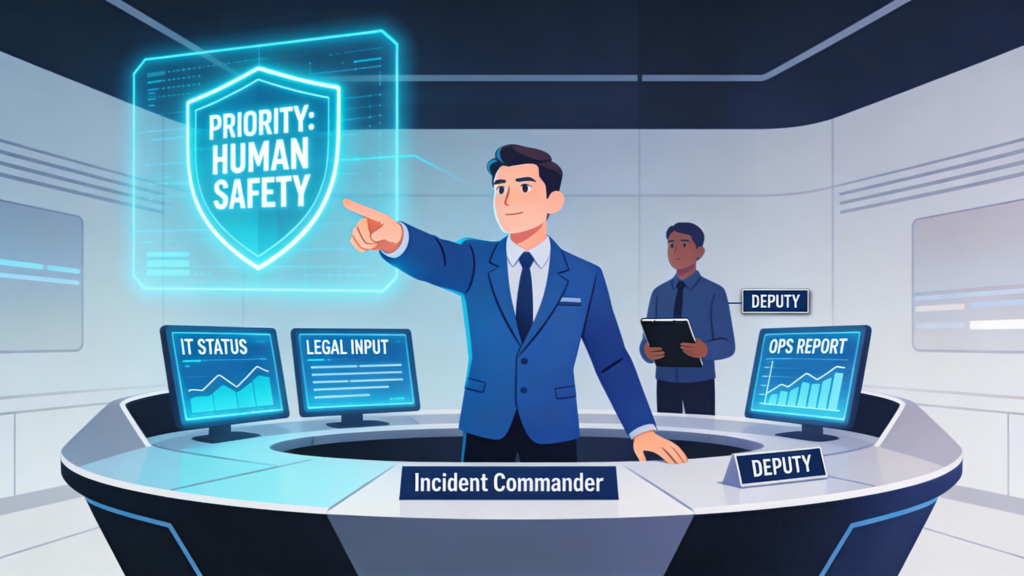
The Crisis Leader, often called the Incident Commander, holds ultimate decision-making authority. They activate the plan, assess the situation quickly, and prioritize human safety above all else.
Research on incident commander decision-making shows that experienced leaders rely on recognition-primed decision strategies, allowing them to detect critical cues rapidly under pressure. [1]
They don’t draft messages or manage logistics. They synthesize input from IT, Legal, and Operations, then make the call. We always assign a deputy, because redundancy in crisis roles isn’t optional.
Executive Oversight: Managing the Fallout
While the Crisis Leader manages the incident, executive oversight, usually the CEO, manages the consequences. They secure board support,