


Since the dawn of the automobile, hustlers and bad actors have tried separating enthusiasts from their money by debuting flashy concepts, then soft-pedaling their release indefinitely. That trend has only accelerated in the last decade with the advancement of digital design tools, AI, and social media.
These days, all it takes to collect orders for a new hypercar is a set of convincing renders and an Instagram handle, with companies you’ve never heard of peddling GTA-looking cars that may never see a road not made of pixels.
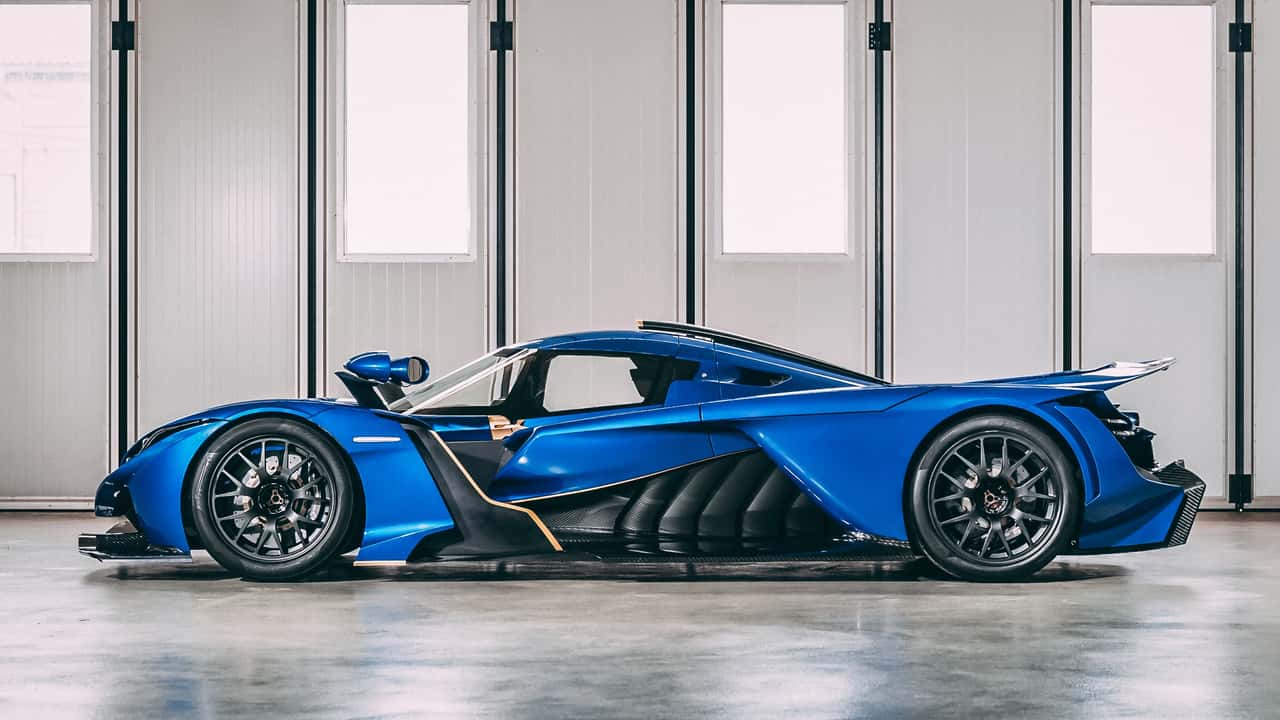
That’s not Praga’s MO. The Czech company behind the 2,200-pound, 700-horsepower Bohema may not be well known, but with over a decade of racing and development under its belt, it’s adamant that its first production hypercar is as ready for prime time as anything from Ferrari, McLaren, or Lamborghini.

Photo by: Praga
Speaking with Motor1 at the Goodwood Festival of Speed, both the company’s chief engineer and its head of marketing shared the Bohema’s development history and explained how it ended up being the first non-Nissan to use the GT-R’s lauded twin-turbo V-6.
Though you probably haven’t heard of it, Praga has been around in one form or another since 1908. During the Czech socialist period lasting from the 1940s through 1989, it produced agricultural vehicles and light trucks along with gearboxes and other components under government orders. Since the early 2010s, though, its ambitions have focused squarely on the racetrack.
Jan Martinek, Praga’s Chief Engineer, joined the team in 2013 with the assignment of making the single-seat, carbon-tub R1 race car road-legal. The company saw a market niche in an ultra-light track day supercar, so Martinek built a prototype called R1R and started taking it to circuits across Europe. As he tells it, people loved the car’s 700-kilogram weight, but were skeptical of its cramped cabin, lack of air conditioning, and four-cylinder engine.
Praga made its first PR splash back in 2016, courtesy of Swedish skier Jon Olsson. The company was looking for investors, and Jon was a car enthusiast with money and a reputation for daily-driving sports cars in all conditions.
“I texted Jon like, ‘Hey, would you be willing to test drive the car for a little bit in Monaco?’” Martinek recalled. Olsson did him one better, asking to borrow the R1R to drive from Monaco to his home in Marbella, Spain—a distance of over 1,200 miles in a full-blown race car.

Olsson featured the car in his vlog, apparently enjoying it so much he asked to borrow it again—this time for an ice race in Northern Sweden, another 1,200 miles from home in minus-24-degree weather. The prototype’s ECU froze once in the cold and had to be warmed up, but apart from that hiccup, the R1R performed flawlessly.
Around that time, Praga came under new ownership again, and the company changed directions with its roadgoing concept.