


This article was originally featured on The Conversation.
Fountains of lava erupted from the Sundhnúkur volcanic system in southwest Iceland on Jan. 14, 2024. As the world watched on webcams and social media, lava flows cut off roads and bubbled from a new fissure that invaded the outskirts of the coastal town of Grindavík, burning down at least three houses in their path.
Nearby, construction vehicles that had been working for weeks to build large earthen dams and berms in an attempt to divert the lava’s flow had to pull back.
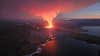 The lava flow on Jan. 14, 2024, with Grindavík in the foreground. Iceland Department of Civil Protection
Humans have tried many ways to stop lava in the past, from attempting to freeze it in place by cooling it with sea water, to using explosives to disrupt its supply, to building earthen barriers.
It’s too soon to say if Iceland’s earthworks will succeed in saving Grindavík, a town of about 3,500 residents, and a nearby geothermal power plant. As a volcanologist, I follow these methods. The most successful attempts to stop or reroute lava have involved diversions like Iceland’s.
Why lava is so hard to stop
Lava is a sluggish, viscous fluid that behaves somewhat like tar. It is subject to gravity, so like other fluids, it will flow downslope along a path of steepest descent.
With the temperature of its molten rock often well above 2,000 degrees Fahrenheit (1,000 Celsius), not much can stand in its way.
Freezing lava in its tracks
In 1973, Icelanders attempted the most famous “lava freezing” experiment. They used water hoses from a flotilla of small boats and fishing vessels to protect the small island community of Heimaey from the Eldfell volcano’s lava.
The lava flows were threatening to close off the harbor, which is critical to the region’s fishing industry and a lifeline to the Icelandic mainland. The eruption ended before the success of the strategy could be properly evaluated, but the harbor survived.
Fighting lava with explosives
Hawaiians used explosives dropped from planes in 1935 and 1942 to try to disrupt lava flows from Mauna Loa volcano that were threatening the town of Hilo on the Big Island.
The idea was to disrupt the channels or lava tubes in the volcano that were supplying lava to the surface. Neither attempt was successful. The explosions created new channels, but the newly formed lava flows soon rejoined the original lava channel.
Lava barriers and diversions
Most recent efforts have focused instead on a third strategy: building dams or ditches in an attempt to divert the lava’s flow toward a different path of steepest descent,