


If 2022 was the year OpenAI knocked our world off course with the launch of ChatGPT, 2025 will be remembered for the frenzied embrace of AI as the solution to everything. And, yes, this includes teaching and schoolwork.
In today’s breakneck AI innovation race, the Organization for Economic Co-operation and Development (OECD), along with the European Commission, have called for the development of unified AI literacy strategies in kindergarten to Grade 12 education.
They have done this through an AI Literacy Framework developed with Code.org, and a range of experts in computational thinking, neuroscience, AI, educational technology and innovation — and with “valuable insights” from the “TeachAI community.”
The “TeachAI community” refers to a larger umbrella project providing web resources targeting teachers, education leaders and “solution providers”. Its advisory committee includes companies like Meta, OpenAI, Amazon and Microsoft and other for-profit ed tech providers, international organizations and government educational agencies and not-for-profit groups.
The rush to establish global standards for AI literacy has been further energized by a recent OECD program announcement.
The Programme for International Student Assessment (PISA) — which tests 15-year-old students of member nations in literacy, numeracy and science every three years — is introducing a media and AI literacy assessment in 2029. This is related to what it calls an “innovation domain” of learning.
There have been consultations about the AI literacy framework, but it’s misguided to think that educators and the general public at large would be able to comment on this in an informed way before AI has been widely accessible to the public.
The OECD’s hasty push for PISA 2029 threatens to obscure essential questions about the political economy that is enabling the marketing and popularization of AI, including relationships between business markets and states.
Marketing, popularizing AI
Essential questions include: Who stands to benefit most and profit from proliferating AI in education? And what are the implications for young people when national governments and international organizations appear to be actively promoting the interests of private tech companies?
We agree with a growing community of researchers that regard calls for AI literacy as being based on ill-defined and preliminary concepts: for example, the draft framework speaks about four areas of AI literacy competency that involve: engaging with AI, creating with AI, managing AI and designing AI.
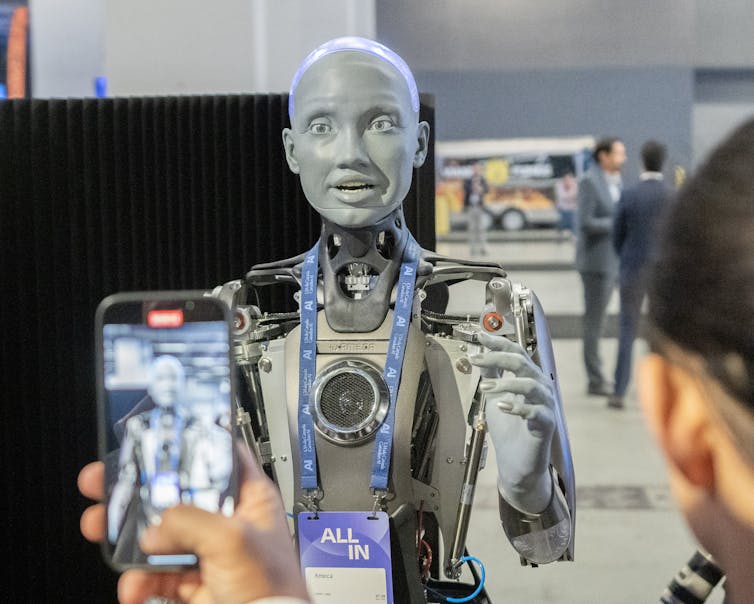
People take photos of an AI robot at the All In artificial intelligence, in 2023 in Montréal.
THE CANADIAN PRESS/Ryan Remiorz
As we try to grasp the meaning of terms such as “AI skills” and “AI knowledge,” the educational landscape becomes both vague and confounding.
Educators are all too familiar with the legacy, often related to commercialization, of attaching various modifiers to notions of literacy — digital literacy, financial literacy, the list goes on.
‘The future’
By framing AI as a distinct, readily measurable capability, the OECD has signalled that it can impose its own understanding onto AI,