




Alex Kimani
Alex Kimani is a veteran finance writer, investor, engineer and researcher for Safehaven.com.
More Info
Premium Content
By Alex Kimani – Aug 19, 2025, 7:00 PM CDT
- According to WoodMac, the power sector currently faces a capacity gap of 1,400 GW for battery installations to achieve grid stability by 2034.
- Falling costs improve the bullish thesis for battery storage, with WoodMac revealing that battery energy storage prices declined by an average of 10% to 40% across global markets over the past year alone.
- The United States’ battery production sector is facing an uncertain future after President Donald Trump’s ‘One Big Beautiful Bill Act’ rolled back many clean energy credits.

A couple of years ago, Bloomberg New Energy Finance (BNEF) made a bold prediction that wind and solar energy will make up half of the planet’s electricity generation by the middle of the century, thanks to the rapid transition to low-carbon energy. However, the intermittent nature of these sources makes large-scale storage critical as renewable energy becomes the dominant power source, with the experts predicting that battery storage is set to boom in the coming years. And now experts at Wood Mackenzie have put a number on it, saying the world will require a staggering $1.2 trillion in battery storage investments to support over 5,900 GW (Gigawatt) in new wind and solar installations over the next decade.
“Grid-forming battery energy storage systems represent a critical breakthrough for renewable energy integration,” said Robert Liew, research director at Wood Mackenzie. “As global power demand is projected to surge 55% by 2034, with variable renewable energy comprising over 80% of new capacity additions, GFM BESS provides the technological bridge between renewable abundance and grid stability requirements.”
According to WoodMac, the power sector currently faces a capacity gap of 1,400 GW for battery installations to achieve grid stability by 2034. This represents a huge market opportunity with more countries focusing on battery investments as renewable generation continues growing. Falling costs improves the bullish thesis for battery storage, with WoodMac revealing that battery energy storage prices declined by an average of 10% to 40% across global markets over the past year alone.
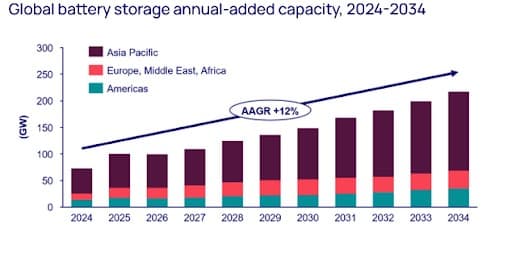
Source: Wood MacKenzie
U.S. Battery Production Set To Decline
Previously, we reported that the United States has witnessed a 15-fold increase in utility-scale battery storage capacity over the past five years to nearly 30,000 megawatts (30 GW), largely driven largely by falling battery costs. A total of 19 states have installed at least 100 MW in utility-scale battery storage over the period.
Unfortunately, the United States’ battery production sector is facing an uncertain future after President Donald Trump’s ‘One Big Beautiful Bill Act’ rolled back many clean energy credits.
The OBBBA will significantly alter the landscape of battery manufacturing in the United States by phasing out many tax credits and funding for clean energy and EV production,