

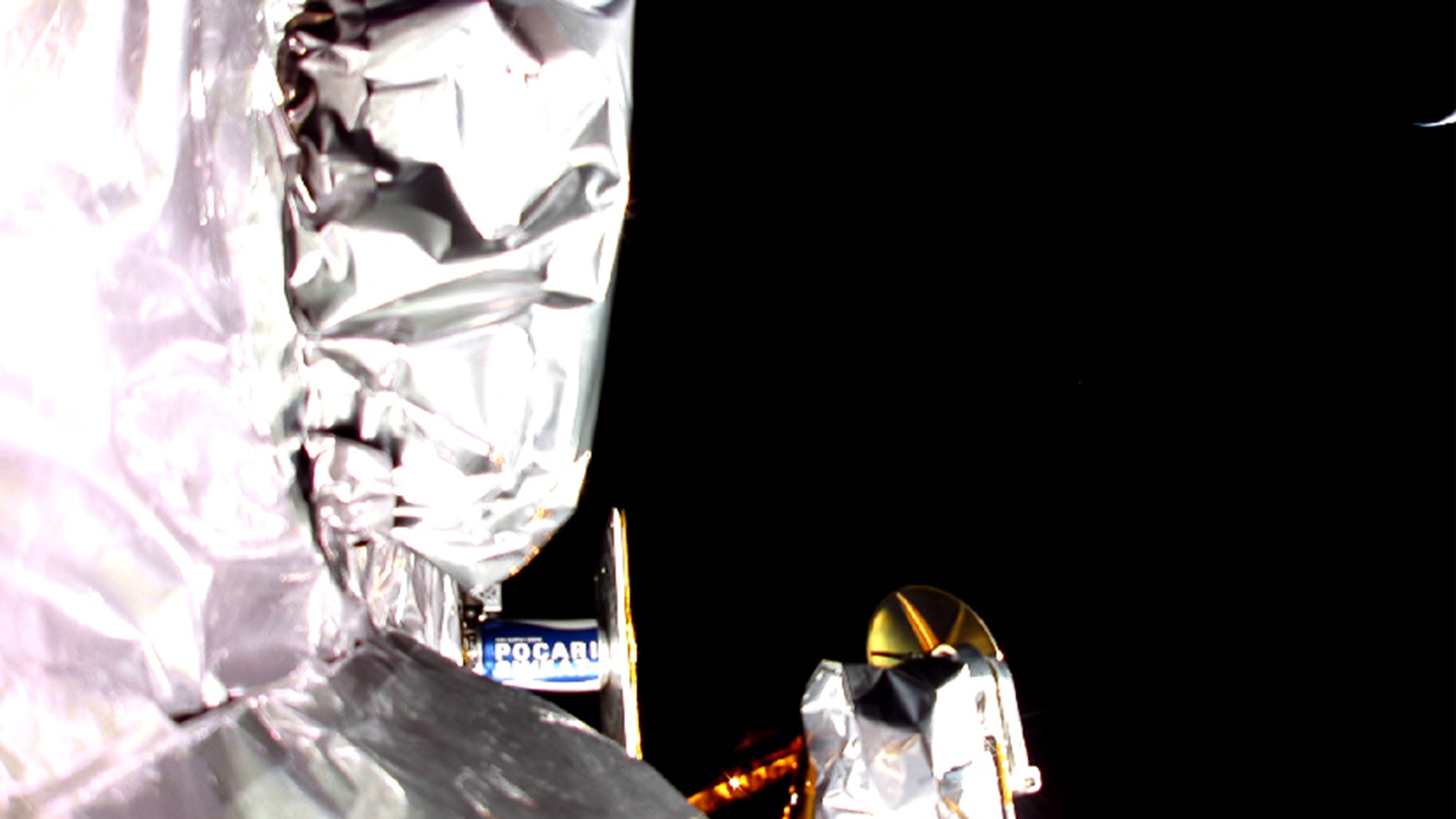

Following a successful launch aboard a Vulcan Centaur Rocket on Monday January 8, private space company Astrobotic has abandoned its attempt to land its Peregrine spacecraft on the moon. In an update from the Pittsburgh-based company, Astrobotic reported that Peregrine sent back a few images from the earlier parts of its journey. One of the images showed what Astrobotic described as a “curved sliver” that appears to be Earth.
[Related: Peregrine lunar lander experiences ‘critical loss of propellant’ following successful launch.]
“Our flight dynamics team has confirmed that the curved sliver in this image taken on our first day of operations is, in fact, Earth! This image from our spacecraft simulator shows the camera’s view of Earth at the time the photo was taken,” the company wrote in the January 10 update.
Astrobotic also has gathered data from the payloads that were designed to communicate with the lander. “All 10 payloads requiring power have received it, while the remaining 10 payloads aboard the spacecraft are passive,” Astrobotic wrote in a January 11 update. “These payloads have now been able to prove operational capability in space and payload teams are analyzing the impact of this development now.”
What went wrong?
About seven hours after launch, Peregrine was unable to shift its solar panels towards the sun so that its batteries could charge. While the engineering team was able to turn the panels, more problems developed.
Astrobotic believed that the root of the problem was a failure in the vehicle’s propulsion system that was causing a critical loss of propellant. The company shared the first image of the lander in space, with its outer insulation appearing very crinkled.
 The first image from Peregrine in space. The camera is mounted atop a payload deck and shows Multi-Layer Insulation (MLI) in the foreground. CREDIT: Astrobotic.
By Monday evening, Astrobotic announced that this fuel leak was causing the thrusters in the spacecraft’s attitude control system to “operate well beyond their expected service life cycles to keep the lander from an uncontrollable tumble.” The mission’s priority also became maximizing the data and scientific information that Peregrine could capture and send back to Earth.
On Tuesday January 9 Astrobotic said that the leak meant that “there is, unfortunately, no chance of a soft landing on the moon. By January 10, Peregrine was roughly 192,000 miles from Earth. The spacecraft was “stable and fully charged” and gathering “valuable data.” They estimated that it will likely shut down at around sometime on Friday January 12.
[Related: Inside NASA’s messy plan to return to the moon by 2024.]
What will happen to Peregrine?
Peregrine will join the estimated 29,000 pieces of space debris larger than 10 centimeters (3.9 inches). The spacecraft will also be a floating gravesite. Its payload contained DNA samples and portions of cremated remains of three former United States presidents,