

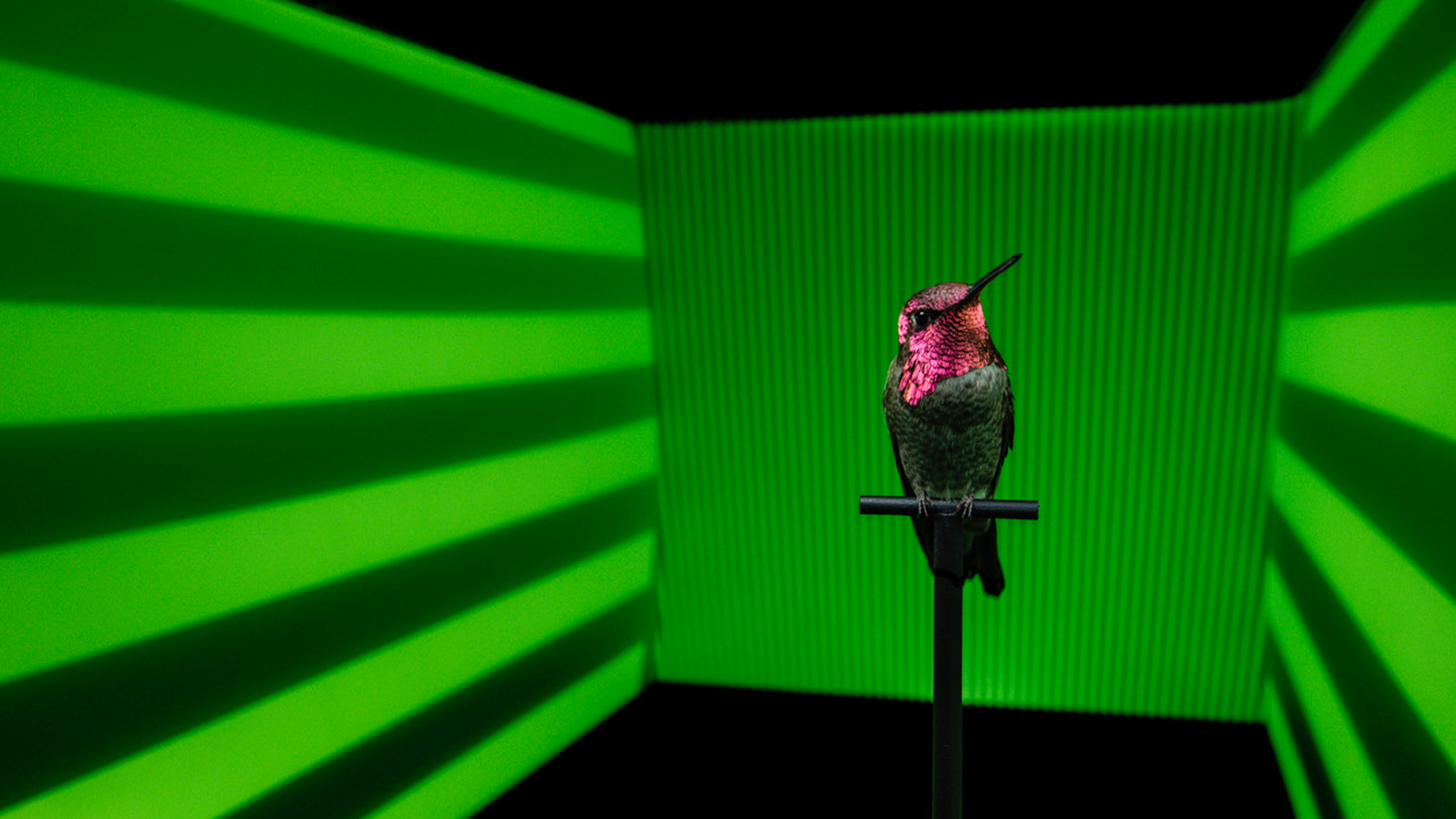

The agile avians rely on sensory strategies that change based on their flight method.
Author: Laura Baisas | Published Jan 11, 2024 3:00 PM EST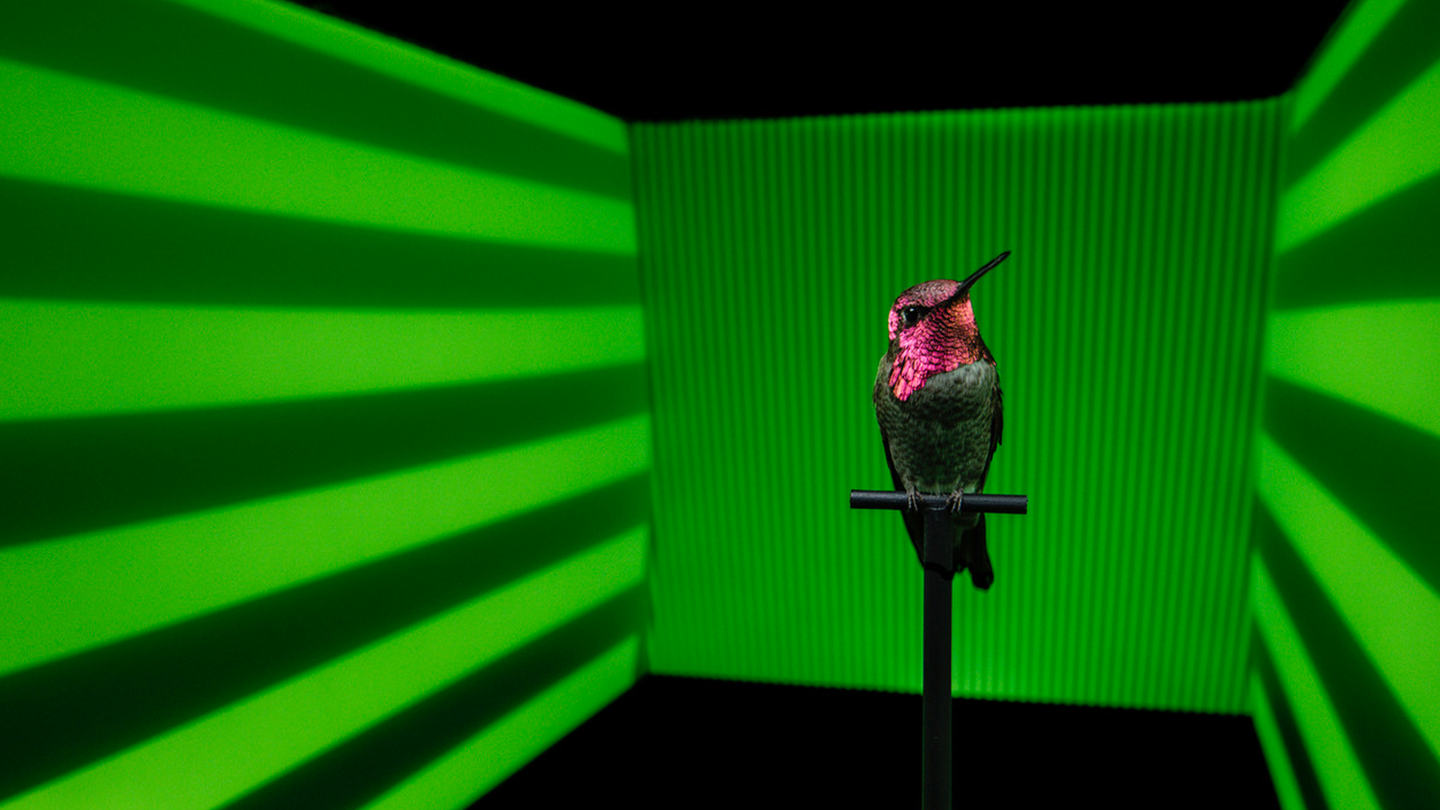
An experiment using a tunnel and various projections revealed that hummingbirds used two distinct strategies to control hovering and forward flight. Anand Varma
SHARE
Hummingbirds are some of the fastest and most agile birds on Earth. They can squeeze into incredibly small spaces to get nectar and hit flight speeds as high as 9Gs while courting without getting physically hurt. They also appear to have very controlled methods of flight. Hummingbirds use two distinct sensory strategies to control how they fly, depending on whether they are moving forward or hovering. The findings are described in a study published January 10 in the journal Proceedings of the Royal Society B.
[Related: Hummingbirds have two creative strategies for flying through tight spaces.]
When flying forward, hummingbirds rely on an “internal forward model.” This model is an ingrained and intuitive autopilot that allows them to gauge speed while experiencing multiple visual stimuli.
“There’s just too much information coming in to rely directly on every visual cue from your surroundings,” study co-author and University of British Columbia zoologist and comparative physiologist Vikram B. Baliga said in a statement.
However, when the birds are hovering or handling cues that may require them to change their altitude, the team found that they use more real-time, direct visuals from their environment.
To study these flight patterns, the team brought 11 wild adult male Anna’s hummingbirds (Calypte anna) into the lab. They prompted the birds to repeatedly fly from a perch to a feeder in a tunnel about 13 feet long and recorded videos of each flight. The team also projected patterns on the front and side walls of the tunnel to test how the hummingbirds reacted to this variety of visual stimuli.
University of British Columbia zoologists observed how hummingbirds reacted to a variety of visual stimuli in a tunnel they built in a lab. CREDIT: Roslyn Dakin.
In some flight scenarios, the researchers projected vertical stripes that were moving along at various speeds on the side of the tunnel to mimic forward motion. Other times, they used horizontal stripes on the side to mimic a change in altitude. On the front wall, the team projected rotating swirls. These circular patterns were designed to create the illusion of a change in position.
“If the birds were taking their cues directly from visual stimuli, we’d expect them to adjust their forward velocity to the speed of vertical stripes on the side walls,” said Baliga. “But while the birds did change velocity or stop altogether depending on the patterns,
More to learn about the findings in the journal Proceedings of the Royal Society B
Read More rnrn