

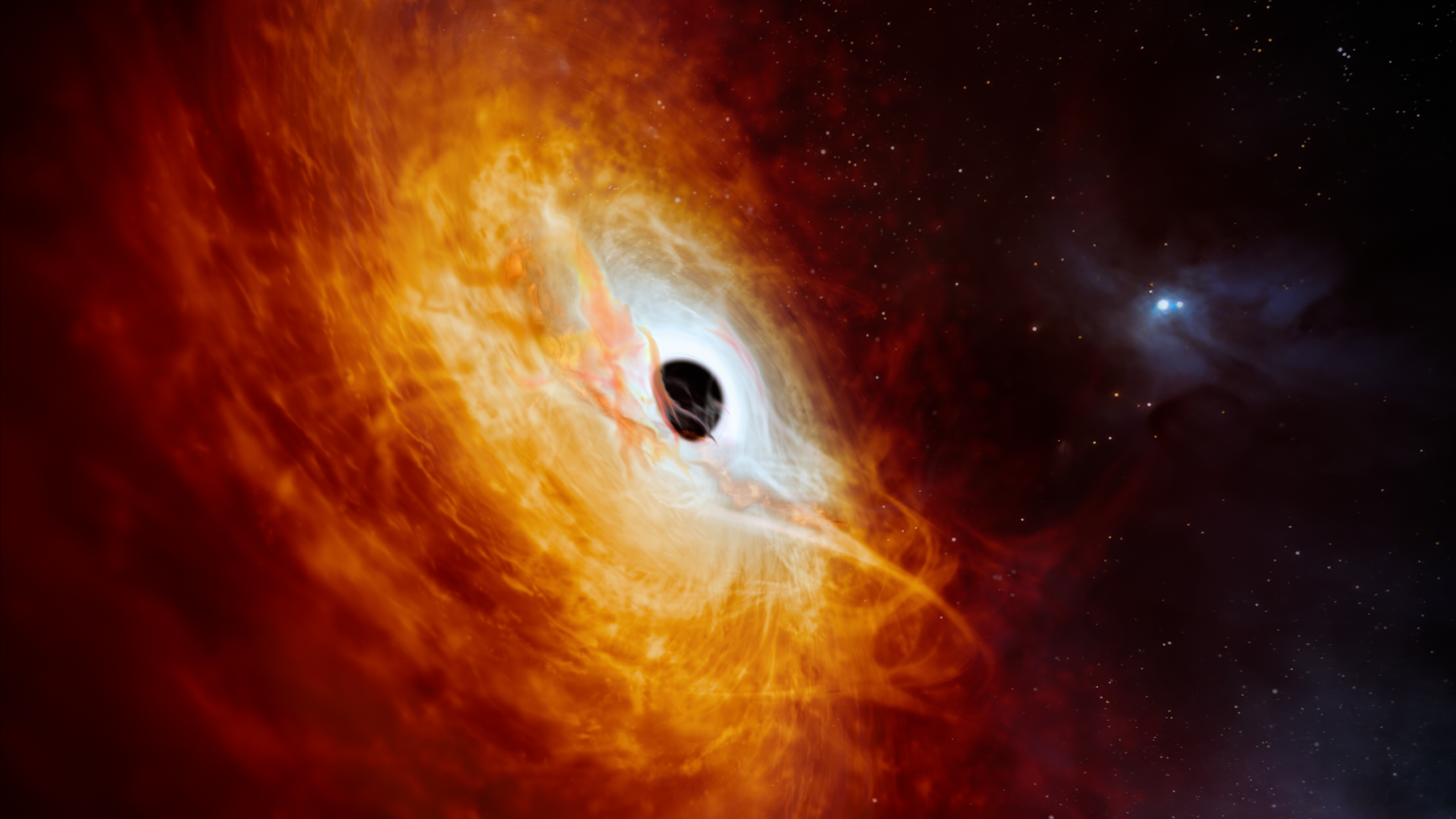

The Most Rapidly Expanding Black Hole Ever Recorded
Quasar J0529-4351, an incredibly voracious cosmic entity, devours energy equivalent to that of our sun on a daily basis. With a size roughly 17 billion times greater than our sun, this mammoth black hole has been detailed in a recent study published on February 19 in the journal Nature Astronomy. Its immense size not only astounds but also provides insights into the history of the universe.
Unveiling Quasars: A Glimpse into the Universe’s Past
Quasars, galaxies housing highly active and energetic cores fueled by black holes, offer astronomers a unique perspective on these cosmic phenomena. Quasars, with their energetic jets beaming from both sides, represent a different facet of black holes. By consuming nearby matter and compressing it into a scorching hot disc before ejecting it over vast distances, a quasar’s central black hole forms a potent source of light. However, due to the immense time it takes for their light to reach Earth, astronomers are able to observe these ancient cosmic giants as they were billions of years ago.
The Enigmatic Nature of Quasars: Shedding Light on Cosmic History
Although quasars remain shrouded in mystery, recent studies suggest that their consistent brightness could serve as a valuable tool for astronomers to fill in the gaps in cosmic history. The extraordinary brilliance and size of J0529-4351 have the potential to advance our understanding of the early days of the universe.
Unveiling the Mighty J0529-4351 with the Very Large Telescope
With a mass approximately 17 billion times greater than that of our sun, the detection of J0529-4351 took place at ANU’s Siding Spring Observatory using a telescope. However, confirming the existence of such a colossal black hole necessitated the assistance of an even more powerful instrument, the European Southern Observatory’s Very Large Telescope in Chile. Equipped with four telescopes boasting a diameter of 27 feet each, the VLT stands as one of Earth’s most formidable observational tools. The team utilized this advanced technology to verify the true nature of the black hole and accurately measure its mass.
“The light emitted by this black hole has traveled for over 12 billion years to reach us,” stated University of Melbourne astrophysicist Rachel Webster, emphasizing the profound implications of this remarkable discovery.