


The Enigmatic Spin of Betelgeuse: A Result of Violently Boiling Surface Activity
A recent study on Betelgeuse, a prominent star in the Orion constellation, has uncovered a puzzling mystery surrounding this red supergiant. Researchers have observed that Betelgeuse appears to be rotating at an unexpectedly rapid pace, defying conventional expectations.
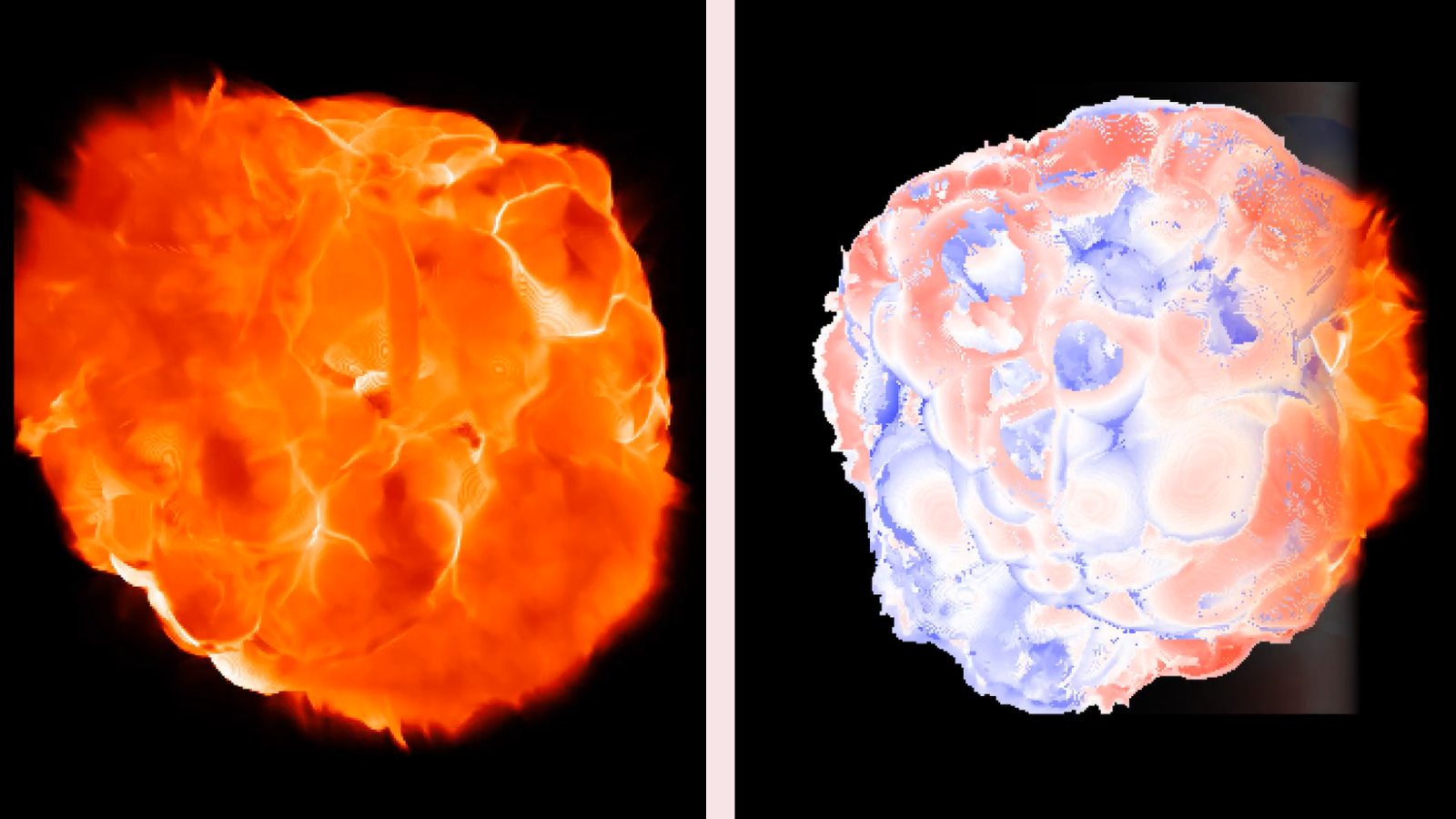
An investigative team hailing from the Max Planck Institute for Astrophysics, spearheaded by Ph.D. candidate Jing-Ze Ma, proposes a groundbreaking theory to address this celestial anomaly. The team posits that the star’s remarkably turbulent and convective surface could be misleading observers into perceiving rotation where there is none.
Ma and his colleagues speculate that the intense bubbling activity on Betelgeuse’s surface may create an optical illusion of rapid rotation, even when scrutinized through cutting-edge telescopes. This optical illusion could give the impression that Betelgeuse, positioned approximately 500 to 600 light-years away from Earth, is spinning at an impossibly swift rate for a star of its magnitude.
“For most stargazers, celestial bodies are nothing more than distant points of light in the night sky. Our findings underscore the dynamic surface conditions of stars like Betelgeuse, which manifest intense boiling motions that are observable through telescopes,” remarked Ma in an interview with Space.com. “The ability to predict and validate these observations based on our simulations represents a significant milestone for theorists.”
Betelgeuse, a renowned red supergiant, captured widespread attention due to its recent dimming episodes that sparked speculation among astronomers. Selma de Mink, a research collaborator and director at the Max Planck Institute for Astrophysics, emphasized the unparalleled opportunity to study Betelgeuse’s roiling surface in detail, which remains a rare occurrence in stellar observations.
Despite its prominent status as one of the brightest stars visible in the Northern Hemisphere, Betelgeuse continues to astound scientists with its enigmatic behavior. With a colossal diameter exceeding 620 million miles (1 billion kilometers), Betelgeuse outshines the sun by over 1,000 times, solidifying its status as one of the largest stars in the observable universe. Remarkably, if Betelgeuse were positioned at the center of our solar system, its vast expanse would encompass the inner planets, extending beyond the orbit of Jupiter.
The sheer size and magnitude of Betelgeuse suggest that it should exhibit relatively placid rotation speeds. However, the recent revelations hint at a deeper complexity underlying this celestial giant, shedding light on the dynamic interplay between surface activity and rotational behavior.
The evolving narrative surrounding Betelgeuse’s mysterious spin underscores the inherent unpredictability of the cosmos, emphasizing the need for continued exploration and inquiry into the enigmatic realms of stellar phenomena.