

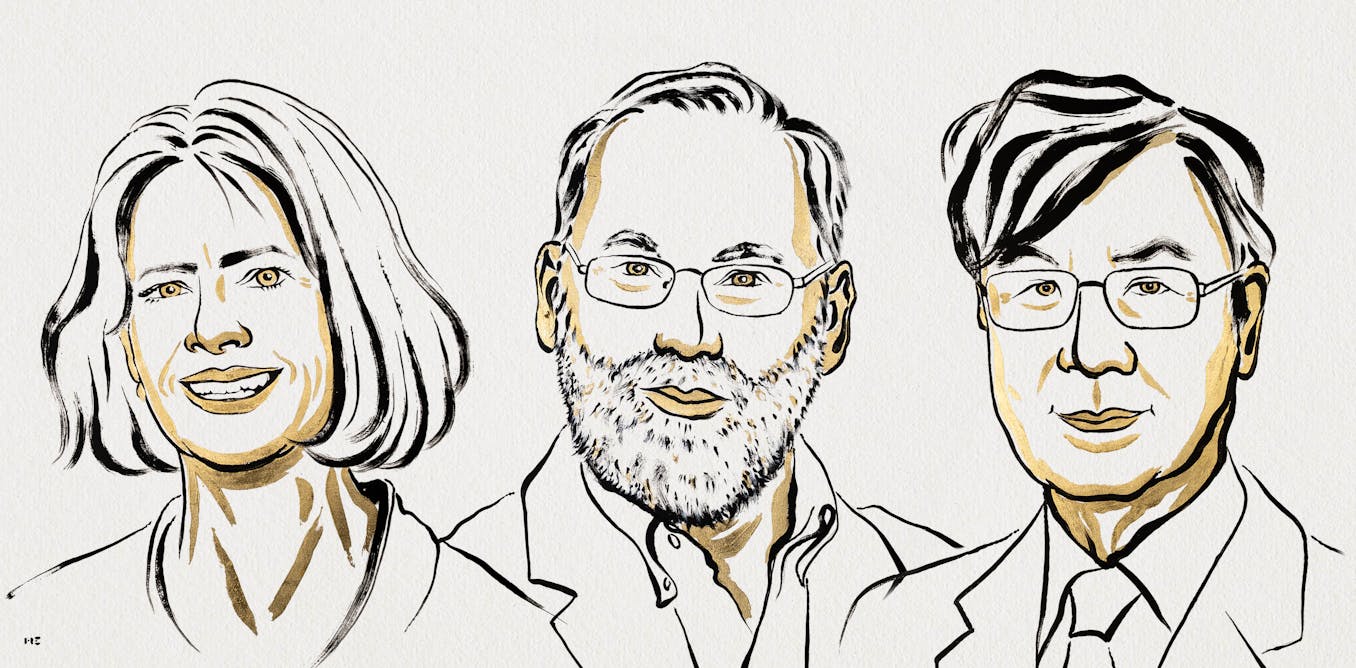

Three scientists have been awarded the 2025 Nobel prize in physiology or medicine for discovering how the body stops its own immune system from turning against itself.
Shimon Sakaguchi from Osaka University in Japan, Mary E. Brunkow from the Institute for System Biology and Fred Ramsdell from Sonoma Biotherapeutics, both in the USA, identified specialised “security guard” cells that keep our immune system in check. These discoveries have been important for understanding how to treat and prevent autoimmune conditions. The trio will share a prize sum of 11 million Swedish Kronor (£870,000).
An effective immune system is critical. It sculpts tissues as they grow and clears away old cells and debris. It also eliminates dangerous viruses, bacteria and fungi, keeping us healthy.
But the immune system faces a delicate challenge: it must attack thousands of different invading microbes each day, many of which have evolved to look remarkably similar to our own cells – yet it must never mistake our own tissue for the enemy.
So how does the immune system know what cells it should attack and which ones it shouldn’t?
This question has been studied by immunologists for decades. But it was the groundbreaking work by this year’s Nobel laureates that led to the discovery of the specialised immune cells – called regulatory T cells – which prevent immune cells from attacking our own body and keep the immune system running as it should.
For decades, immunologists weren’t certain why some immune cells functioned as they should, and why others went rogue and attacked the body’s own tissues. When this happens, it can result in autoimmune conditions – such as type 1 diabetes, rheumatoid arthritis and multiple sclerosis.
For a long time, scientists believed the thymus – a small gland in the chest – was solely responsible for immune tolerance. Immune cells (specifically a type of cell called a T lymphocyte) that recognised the body’s own proteins too strongly were initially thought to be eliminated in the thymus in early life. Those immune cells that only showed mild reactivity were then released into the bloodstream to patrol the body.
But work conducted in the 1980s and 1990s by Sakaguchi showed that there was a specialised class of immune T cells that played a critical role in suppressing immune responses and preventing the immune system from attacking the body’s tissues.
In Sakaguchi’s first experiment, he surgically removed the thymus organ from newborn mice, then injected T cells into them from genetically similar mice. He hypothesised that the mice would have a weaker immune system and develop fewer T cells.
Instead, he discovered that there appeared to be T cells that protected the mice from developing autoimmune diseases.
Over the next decade, Sakaguchi set out to uncover whether there were different types of T cells that played different roles in immune response. In 1995, Sakaguchi published the paper that detailed a new class of T cell,