


Active Citizens, Civil Society, Climate Action, Climate Change, Climate Change Finance, Climate Change Justice, Conferences, Development & Aid, Economy & Trade, Environment, Gender, Global, Headlines, Sustainability, Sustainable Development Goals, TerraViva United Nations
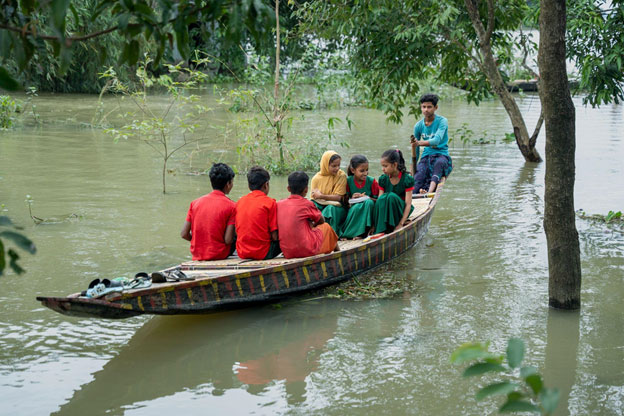
Children in Bangladesh riding a boat through a flooded river to attend school. Bangladesh is one of the most climate-sensitive regions in the world. Credit: UNICEF/Suman Paul Himu
UNITED NATIONS, Oct 8 2025 (IPS) – In recent years, international climate financing has declined sharply, leaving billions of people in developing nations increasingly vulnerable to natural disasters and unable to adapt effectively. With major cuts in foreign aid, these communities are expected to face the brunt of the climate crisis, while wealthier nations continue to reap economic benefits.
A new report from Oxfam and CARE Climate Justice Center, Climate Finance Shadow Report 2025: Analyzing Progress on Climate Finance Under the Paris Agreement, showcases the significant gaps in climate financing for developing countries in the Global South, and the far-reaching implications for climate resilience and global preparedness.
This comes ahead of the 30th United Nations (UN) Climate Change Conference (COP30), in which world leaders, diplomats, and climate finance goal at COP29″>civil society groups will converge in Belém, Brazil, from November 10–21, to discuss strategies to strengthen global cooperation, advance inclusive and sustainable development, and accelerate efforts to address the climate crisis. The United Nations Environment Programme (UNEP) states that there will be a major focus on allocating public funds for mitigation and adaptation efforts in developing countries, aiming to mobilize at least USD 300 billion annually by 2035 for developing countries and a yearly USD 1.3 trillion over the same period.
In the report, CARE and Oxfam found that developing countries are paying disproportionately high disbursements to wealthy nations in exchange for comparatively modest climate finance loans—spending about seven dollars for every five dollars they receive in return. This, compounded with “the most vicious foreign aid cuts since the 1960s”, shows a nearly 9 percent drop in climate funding in 2024, which is projected to drop by a further 9-17 percent in 2025.
“Rich countries are failing on climate finance and they have nothing like a plan to live up to their commitments to increase support. In fact, many wealthy countries are gutting aid, leaving the poorest to pay the price, sometimes with their lives” said John Norbo, Senior Climate Advisor at CARE Denmark. “COP30 must deliver justice, not another round of empty promises.”
As of 2022, developed nations reported pledging approximately USD 116 billion in climate funding for developing countries. However, the actual amount delivered is less than one-third of the pledged total — estimated at only USD 28–35 billion. Nearly 70 percent of this funding came in the form of loans, often issued at standard rates of interest without concessions. As a result, wealthy nations are driving developing countries deeper into debt, despite these nations contributing the least to the climate crisis and lacking the resources to manage its impacts.