


For over three centuries, between 1526 and 1866, at least 10.5 million Africans were forcibly trafficked to the Americas in the transatlantic slave trade. Over half of them (with known places of departure) left from a 3,000km stretch of the west African coast between what are today Senegal and Gabon.
Scholars trying to uncover the lives of these diasporic Africans are forced to work with historical records produced by their European and American enslavers. These writers mostly ignored Africans’ individual identities. They gave them western names and wrote about them as products belonging to a set of supposedly distinct “ethnic” brands.
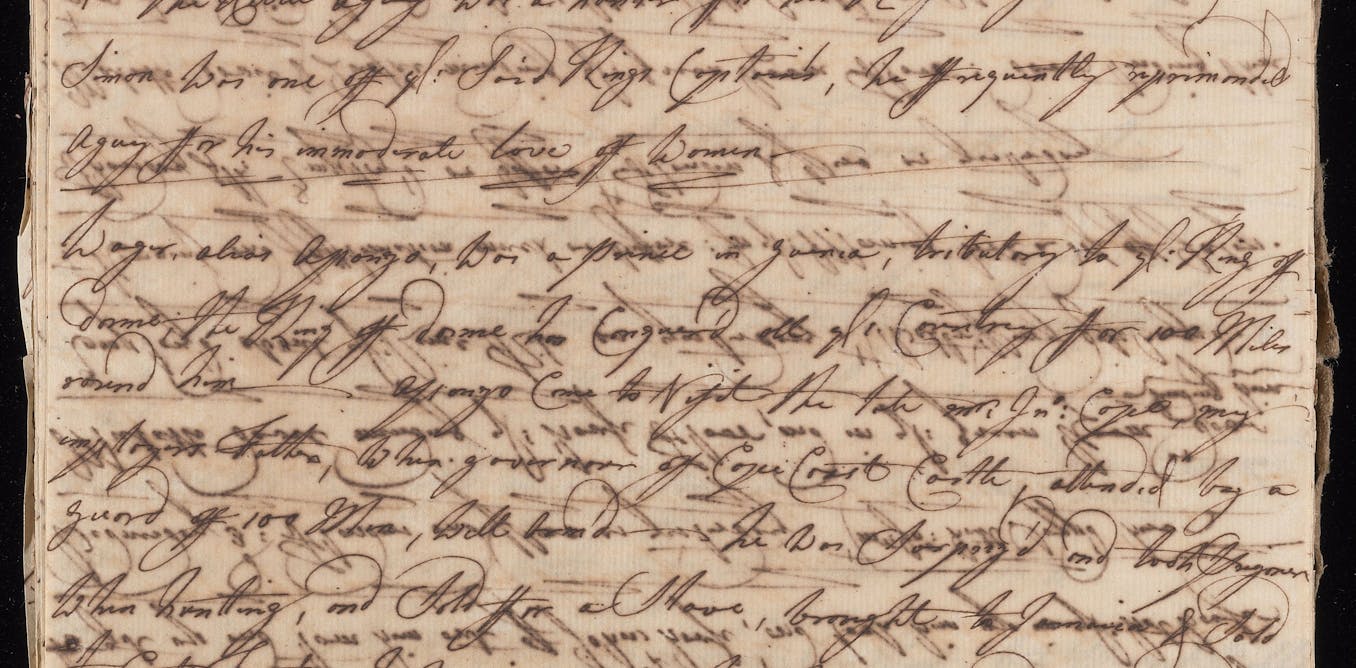
Now, however, the curious biography of an 18th-century Jamaican rebel confounds this inherited language. The rebel in question is Apongo, also known as Wager. His biography is a 134-word handwritten passage in the diary of an 18th-century enslaver named Thomas Thistlewood.
As a historian of the Atlantic World in the 1700s, I use the life stories and archives of British enslavers to better understand these times.
My recent study uses Thistlewood’s biography of Apongo as a window into the origins of enslaved west Africans, particularly those from what are today the nations of Ghana and Benin.
Apongo’s story offers an opportunity to better understand the complexities of west African identity and to put a more human face on those enslaved.
Who was Apongo, aka Wager?
Like many enslaved Africans, Apongo had two names. Unfortunately, neither of them completely unlocks his backstory. “Apongo” is probably the rendering of his African name into English script according to how it sounded to his enslavers’ ears. “Wager” is a name Apongo was given by his white “master”. It had nothing to do with his African origins. In fact, it was the name of his enslaver’s ship.
Thistlewood was an English migrant to Jamaica who thought of himself as a gentleman scholar. According to one of his diary entries, Apongo led an extraordinary life defined by twists of fate. He was the prince of a west African state that paid tribute to a larger kingdom called “Dorme”. After subjugating the peoples around him, the king of Dorme seems to have sent Apongo on a diplomatic mission to Cape Coast Castle in what is today Ghana. At the time it was the headquarters of Great Britain’s trading operations on the African coast.
While there, Apongo was apparently surprised, enslaved, and trafficked to Jamaica. At the time, Jamaica was the British Empire’s most profitable colony. This was due to its sugar plantation complex based on racial slavery.
Once in Jamaica, Apongo reunited with the governor he had visited at Cape Coast. He tried to obtain his freedom but, after failing for a number of years, led and died in an uprising called Tacky’s Revolt.
Unfolding over 18 months from 1760 and named after another one of its leaders, Tacky’s Revolt left 60 Whites and over 500 Blacks dead.