


December 9, 2023
2 minute read time
Mummies with False Heads Unearthed in Peru
By Owen Jarus & LiveScience
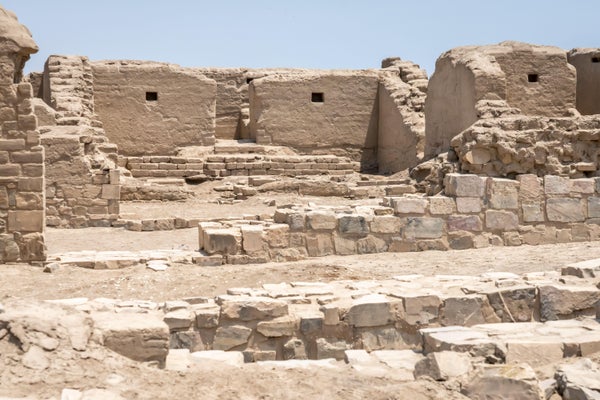
The ruins of Pachacamac, an ancient archaeological site on the Pacific coast just south of Lima, Peru.
Bundles of at least 73 well-preserved mummies, dating around 1,000 years ago, have been discovered in Peru. This took place several hundred years before the Inca’s reign over parts of western South America.
Each of the 73 individuals was bundled in fabric — some of it colorful — and rope. Some of the male and female bodies were buried wearing masks of carved wood and ceramic, which are known as “false heads,” Krzysztof Makowski, head of archaeological research at the site and an archaeologist at the Pontifical Catholic University of Peru, said in a post on Archeowieści blog, which is managed by the Faculty of Archaeology of the University of Warsaw. Colorful ceramics were also found in some of the graves.
These burials date back to between 800 and 1100 AD and were found near Lima at the archaeological site of Pachacámac, which belonged to the Wari culture. The Wari Empire was expanding during this time in the region, according to the post.
The Wari are known for their well-preserved mummies and elaborate art, including intricately designed ceramics, and fabrics. They also practiced human sacrifice and made use of hallucinogens during religious rituals.
Newfound wooden staffs
In addition, archaeologists found two wooden staffs near the cemetery in the remains of the nearby settlement. They were found in a deposit of “thorny oyster” (Spondylus princeps) shells that would have been imported from what is now Ecuador, to the north of the Wari Empire, as stated in the blog post.
Each of the staffs has a carving depicting a dignitary wearing headgear similar to what people wore in the Tiwanaku kingdom, south of the Wari Empire in what is now part of Peru, Bolivia, and Chile.
Archaeological research suggests that Pachacámac was a relatively modest settlement during the time of the Wari Empire but then it grew substantially during the time of the Inca, who was prominent during the 15th century. According to the blog post, the site became a major location of religious worship during the Incan times.
Copyright 2023 LiveScience,