

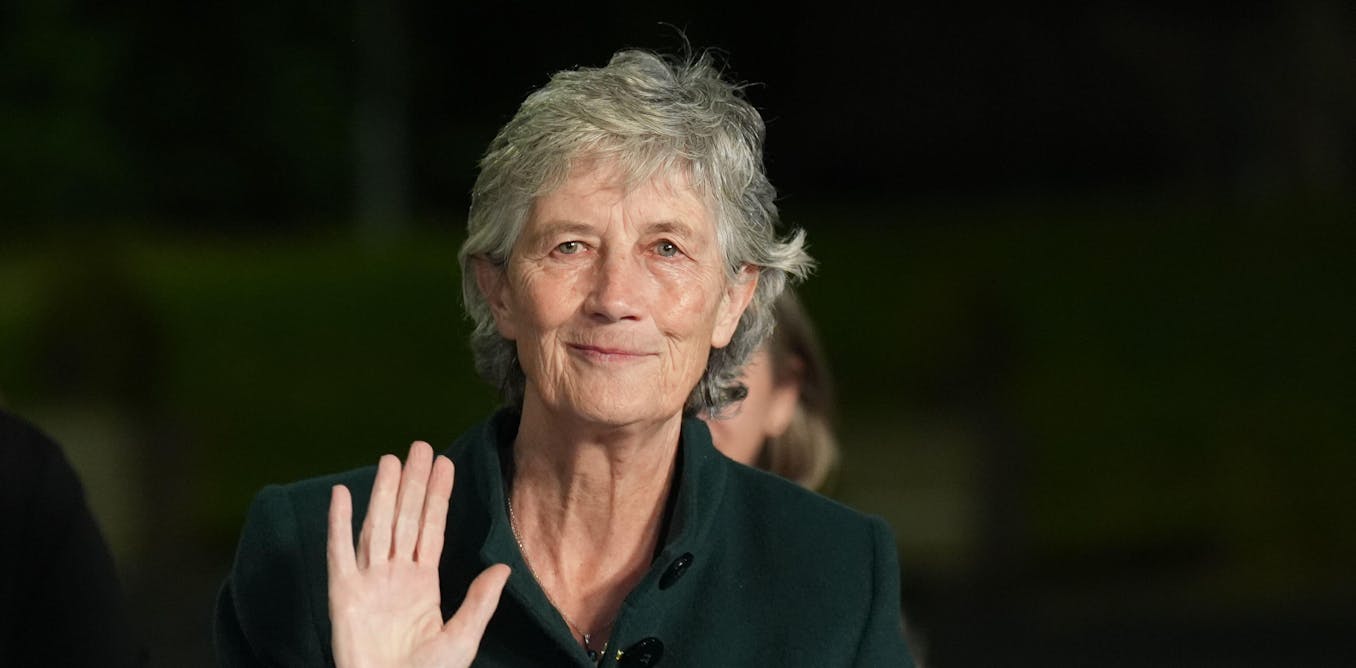

Ireland is set to have a new president in the form of Catherine Connolly, an independent leftwing TD for Galway, and former deputy speaker of the Dáil.
The presidential election campaign was a colourful and eccentric spectacle. Since the Irish president isn’t an executive office with power over policy, the campaign focused on obscure ethical scandals around the two candidates, Connolly and Fine Gael candidate Heather Humphreys.
At times, though, the debate strayed into various policy issues despite the president having no power over these. The candidates’ views on everything from housing, disability, military neutrality and even foxhunting came under scrutiny.
For many, the campaign will have seemed awkward and profoundly odd. Ireland went through the rigmarole of a national election but for something for which the political stakes are undeniably low. This, in turn, reflects certain anomalies of the Irish presidency as a political institution.
The president of Ireland, a role created by the 1937 constitution, is the only national office elected directly by the people. The president will, therefore, have a very significant democratic mandate, and will tend to be a popular figure.
But this mandate is not matched by very much power. A president must campaign for a mandate from the people, yet once in office, finds no real conduit, other than speech itself, through which to make good on that mandate.
Presidential powers
In a parliamentary democracy such as the UK or Ireland – where the executive government is formed from within the parliament – the head of state will tend to have quite modest constitutional functions. Even where the head of state is a president, they will tend to have powers quite similar to those of a hereditary monarch. They formally sign bills into law and perform certain other strictly ceremonial constitutional functions, while serving as a symbol of continuity, national unity and so on.
One of the advantages of having an elective head of state, however, is that it becomes politically feasible to grant them more extensive powers of the sort that would be difficult to envisage for a monarch.
What exactly these powers are varies across parliamentary republics such as Germany, Italy or Greece. While Ireland’s post-independence constitutions mirrored many basic features of the British parliamentary system, they had elements of novelty and innovation as well. The office of the president was one of these.
Indeed, if someone were to read the constitution with no context, it makes the president seem like a potentially key player in the political system.
In particular, the constitution seems to envisage the president being a sort of arbiter in the legislative process, particularly in the event of deadlock between the two houses – the Dáil and Seanad (senate). These powers arise, for example, in the event of disputes over what counts as a “money bill”, or reducing the time the senate has to consider bills during a public emergency.