


The United States is stepping back from the global community under a president who rejected the Paris Climate Accords and denigrates NAFTA and NATO. This provides an opportunity for China to play a greater role in global affairs.
These dynamics set the stage for the 19th Party Congress, as China seeks to balance external influence with domestic economic stability. One of the areas in which China can make a bigger impact is infrastructure, a pressing issue for development. According to the OECD, supporting global development requires annual infrastructure investment of US$6.3 trillion until 2030. With a deep understanding of development strengthened through decades of rapid domestic economic growth, China is well positioned to shape global development in ways that could define the rest of the 21st century.
China has been investing in infrastructure projects across the globe since the 1970s, but a coherent policy for infrastructure investment first emerged in 2013. During a speech in Kazakhstan, Xi unveiled the Silk Road Economic Belt concept.
Shortly thereafter he proposed the Asian Infrastructure Investment Bank. Other institutions supporting China’s global infrastructure initiatives include the US$40 billion Silk Road Fund and the New Development Bank led by China, Brazil, Russia, India, and South Africa.
The most significant of these initiatives, China’s Belt and Road Initiative, is projected to attract US$1 trillion for trade, transport, and energy projects around the world.
Build at your own risk
Infrastructure is a necessity for development, but its cost presents a barrier and aid from China is appealing. More than 60 countries have signed agreements for China to fund infrastructure projects.
However, countries receiving loans should not assume that infrastructure will automatically transform their economy. Projects can drain resources and often provide little benefit to the broader society. Securing a Belt and Road Initiative project may grab headlines, but it is not a cure-all.
The economic benefits of infrastructure are often highly exaggerated. Presently, Sri Lanka is unable to repay debts to Chinese lenders for costly but largely unused ports, airports, and highways.
Designed to accommodate one million passengers per year, Mattala Rajapaksa International Airport in Southeast Sri Lanka now serves only about 12 passengers per day. This is less than 1% of initial projections, yet the airport cost the country US$209 million.
As the expected benefits of infrastructure failed to materialize, Sri Lanka’s external debt surged from US$10 billion in 2006 to US$25 billion in 2016, a large portion of which is owed to China.
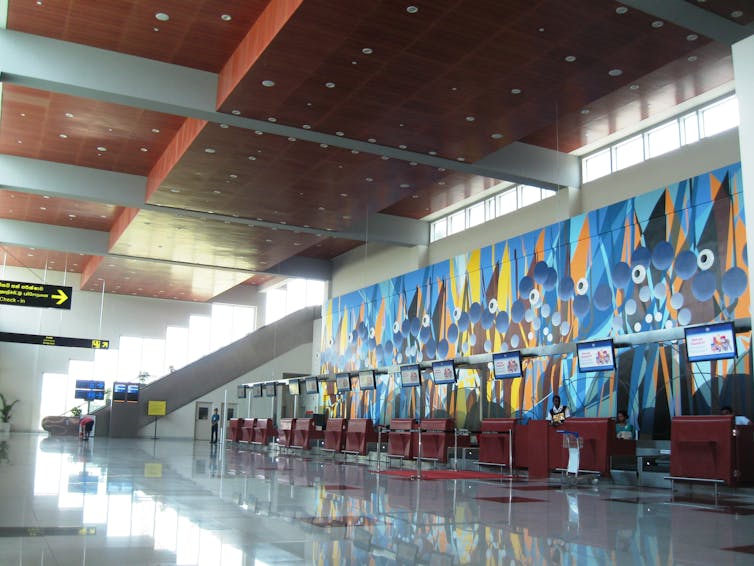
Mattala Rajapaksa International Airport, on which Sri Lanka spent US$209 millions, only receives about 12 passengers a day.
Anuradha Dullewe Wijeyeratne /Wikimedia

Faced with financial pressure, the government of Sri Lanka decided to sell 70% of Hambantota Port, located on the country’s southern coast, to a Chinese state-owned port operator in July 2017.
In 2015, Ghana turned down a second tranche of loans from the Chinese government for another energy project due to the country’s inability to handle such high capital inflows.