




New Trends in Trade: China’s Rejuvenated Exports Boost Market Sentiment
- China experienced a notable surge in both imports and exports during February, indicating a favorable demand environment.
- The Australian dollar saw a positive response to the robust trade data from China, coupled with encouraging trade figures from Australia.
- Market dynamics shifted as the Nikkei relinquished the 40,000 level, driven by wage data prompting speculation on a Bank of Japan (BoJ) pivot and consequently boosting demand for the Yen.

Exploring China’s Trade Landscape
China recently reported a remarkable 7.1% surge in exports year-on-year for February, significantly surpassing expectations. Concurrently, imports also showed a positive trajectory with a 3.5% increase year-on-year. This notable performance widened the US dollar trade surplus from $75.34 billion to $125.16 billion.
The spike in trade figures directly impacted the demand for the Australian dollar, given the substantial trade linkage between China and Australia. With China accounting for a third of Australia’s trade volume and the nation’s economy heavily reliant on international trade, an upturn in demand bodes well for both Australian economic prospects and the valuation of the Aussie dollar.
China’s Economic Influence on Monetary Policy
The recent improvements in China’s economic landscape could potentially influence the Reserve Bank of Australia’s (RBA) interest rate decisions. RBA Governor Michele Bullock acknowledged the significance of China’s economic performance in shaping Australia’s growth forecasts. A stronger economic outlook could prompt revisions in growth projections and alter the expectations surrounding RBA’s monetary policies.
Impact on AUD/USD Pairing
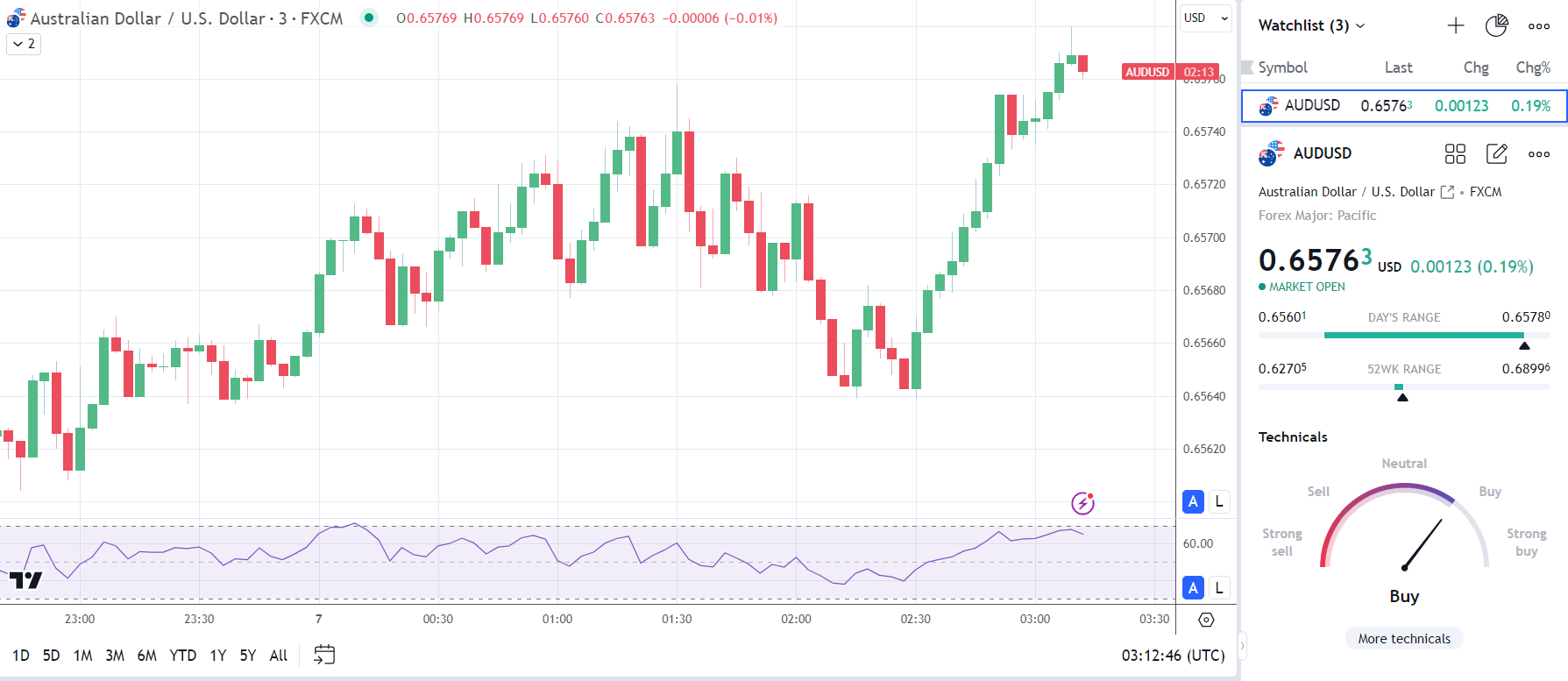
Amidst these trade dynamics, the AUD/USD pair showcased a fluctuating trend, bottoming at $0.65601 before climbing up to $0.65780. Following China’s trade data release, the Australian dollar experienced brief dips and subsequent recoveries, highlighting the currency’s sensitivity to external trade developments.
By Thursday morning, the Aussie dollar had appreciated by 0.19% to $0.65763.
Analyzing Australian Trade Performance
In January, Australia saw a notable expansion in its trade surplus, growing from A$10.959 billion to A$11.027 billion. This positive trend surpassed economist expectations of a A$11.500 billion surplus. Noteworthy highlights from the trade data include a 1.6% month-on-month rise in exports, accompanied by a surge in non-monetary gold exports and increased imports across various categories.
According to the ABS,
- The surge in non-monetary gold exports offset declines in other categories, showcasing the diversity of Australia’s export portfolio.
- The rise in imports of consumption and capital goods emphasized growing domestic demand and economic activity.
USD/JPY Dynamics and Policy Implications
Against this backdrop, USD/JPY experienced selling pressure driven by diverging monetary policy outlooks. Market participants closely monitored the evolving trade dynamics and policy responses, underpinning the shifting currency trends.
For additional insights on the trade developments and their implications, explore the full article here.