

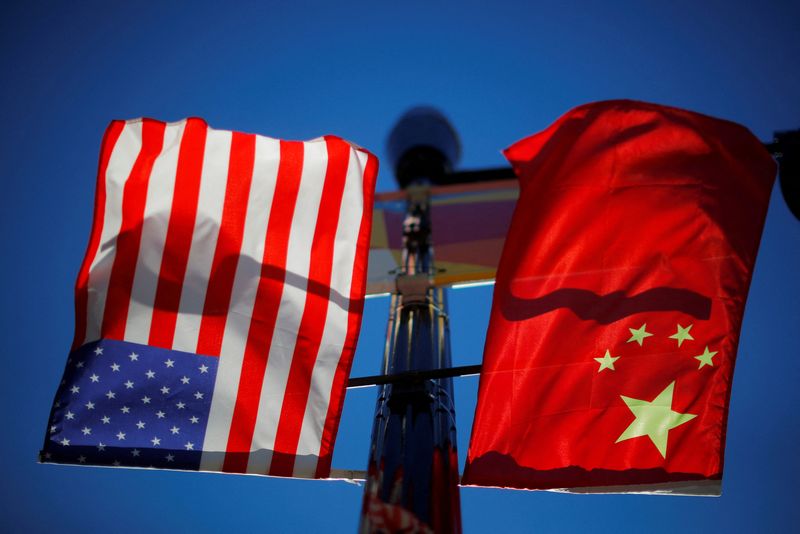

© Reuters. FILE PHOTO: The flags of the United States and China fly from a lamppost in the Chinatown neighborhood of Boston, Massachusetts, U.S., November 1, 2021. REUTERS/Brian Snyder/File Photo
By Jamie McGeever
ORLANDO, Florida (Reuters) -A gradual financial disentangling of China and the United States after decades of symbiosis may significantly reduce fears of ‘mutually assured financial destruction’ but also harden divisions in an increasingly polar global economy.
The big question is who will suffer more from this separation. But the mutual threat, especially China’s U.S. bond holdings, looks far less potent than once assumed.
Since China’s return to the global economic stage in 2000, the wave of U.S. corporate and banking investment in the country was seemingly matched by China banking windfall savings from the resulting export and growth boom back into U.S. Treasury bonds.
Some thought that any political standoff disturbing those investment flows would be so devastating to both in the highly integrated world economy that they would always step back from the brink.
But that’s not quite how it has panned out.
Following the trade wars of late 2010s, the pandemic shock, and geopolitical rifts surrounding Ukraine and Taiwan, both sides have substantially reduced their respective financial footprints in the other. “Derisking,” in Washington parlance.
China’s hold on the U.S. bond market has loosened too. The latest figures show China held $782 billion of Treasuries in November – a large amount, but also around its smallest in 15 years and down significantly from the peaks of $1.3 trillion in 2011 and 2013.
More importantly, China’s footprint in the U.S. bond market is a fraction of what it once was. China owns less than 3% of all outstanding Treasuries, the smallest share in 22 years, and again substantially down from the record 14% in 2011.
But Beijing’s influence over the U.S. bond market has waned.
“China’s holdings are large enough that selling could in theory be very disruptive, although its hold over the market is not what it was relative to the past,” notes Alan Ruskin, macro strategist at Deutsche Bank.
“But China has not shown any desire to be a disruptive force in this regard.”
DECOUPLING
China is not alone.