

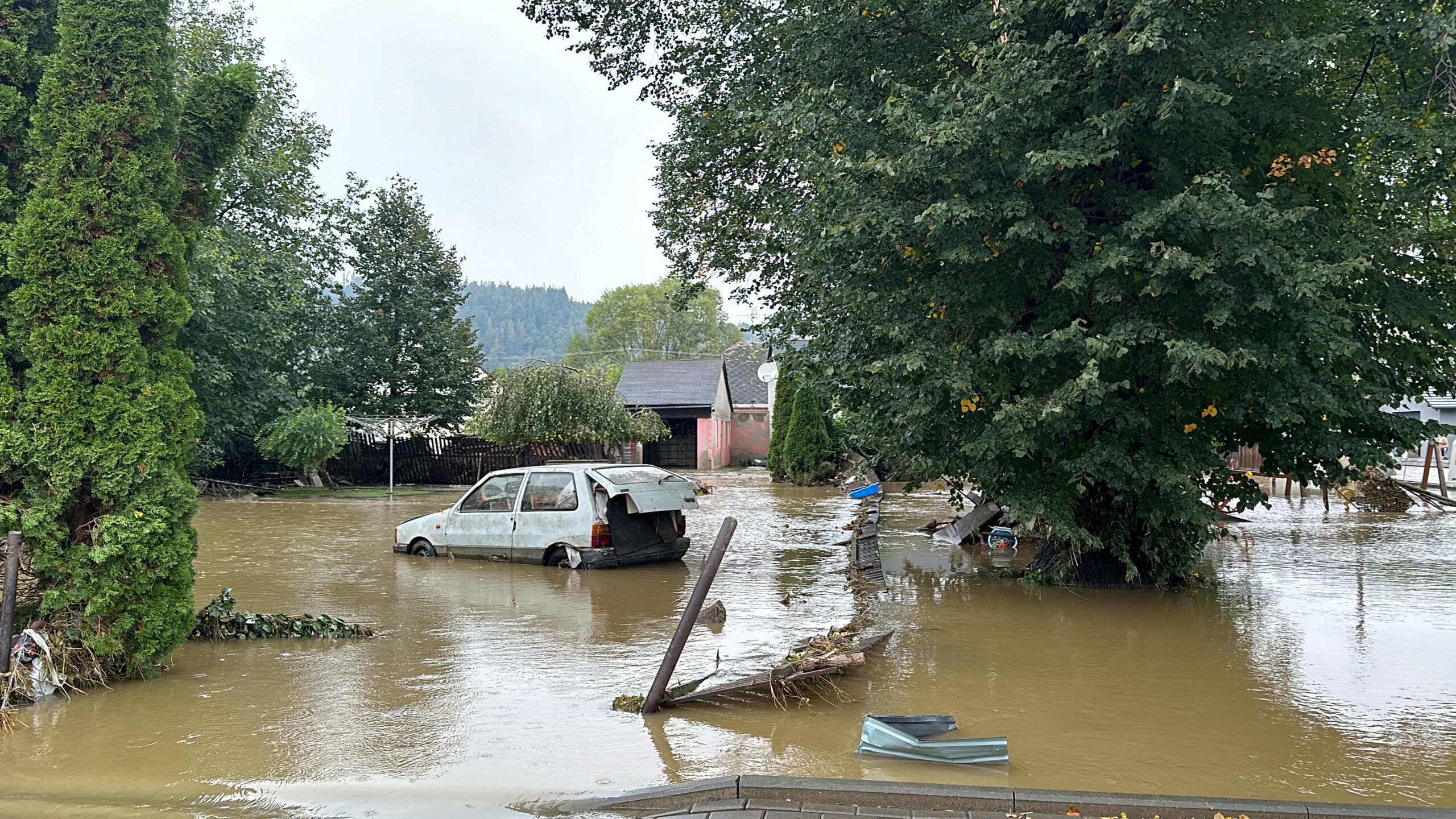
 Flooding in the Czech Republic. Photo by People in Need.
In mid September 2024 a very large region in Central Europe, including Poland, Czechia, Austria, Romania, Hungary, Germany and Slovakia experienced very heavy rainfall, breaking local and national rainfall records over the period of four days.
While the rain was extremely heavy in many locations, the extent of the event, stretching across many countries, was exceptional. Almost two million people were directly affected by the flooding caused by the extreme rainfall (blue News, 2024). The most severe impacts in urban areas were in the Polish-Czech border region and Austria (The Guardian, 2024). At the time of writing at least 24 people lost their lives (The Guardian, 2024; BNN, 2024; CBS, 2024) with several persons still missing several days after the event in Czechia (DW, 2024). All countries were affected by power cuts, leading to schools and factories closing as well as hospitals.
To assess to what extent human-induced climate change altered the likelihood and intensity of the heavy precipitation leading to the severe flooding, researchers from Czechia, Poland, Austria, the Netherlands, Sweden, France and the UK undertook an attribution study on the event.
To capture the impacts associated with the very large-scale event, we focus the main analysis on a large region (10.7°E, 24°E, 46°N, 52.3°N), encompassing Czechia, Slovakia, Austria, parts of Poland, Germany, Romania and Hungary. For the temporal extent we focus on the four most impacted days, which occurred from 12th to 15th of September, and use the maximum 4-day annual rainfall (RX4-day) as the index to analyse. We note that the results are not sensitive to the exact number of days assessed.
 Fig. 1: Average daily rainfall (shading) and sea-level pressure (contours) over central Europe from the 12th to 15th of September 2024 in ERA5.
Main findings
- The intensity and duration of the heavy rainfall put immense pressure on civil protection. Emergency management systems across Europe had been reinforced after severe flooding over the last decades and largely worked well: despite the higher intensity and larger scale, the number of fatalities is lower than in earlier floods with 24 estimated at the time of writing, compared to e.g. 232 in 2002 when flooding affected Germany, Austria, Czechia, Romania, Slovakia, and Hungary and at least 100 in 1997 when only Germany, Poland and Czechia were hit by floods. They are also much lower than in the Western European floods in 2021 when over 200 people lost their lives.
- The heavy rainfall was caused by a Vb depression, which forms when cold polar air flows from the north over the Alps, meeting very warm air in Southern Europe. Vb depressions are rare, but usually associated with heavy rain over Central Europe. Analysing analogous weather systems in the observed record suggests that there is no robust change in the number of analogous Vb depressions since the 1950s.
- The frequency is not the only characteristic of Vb depressions that could potentially change in a warming climate,