

Skip to content
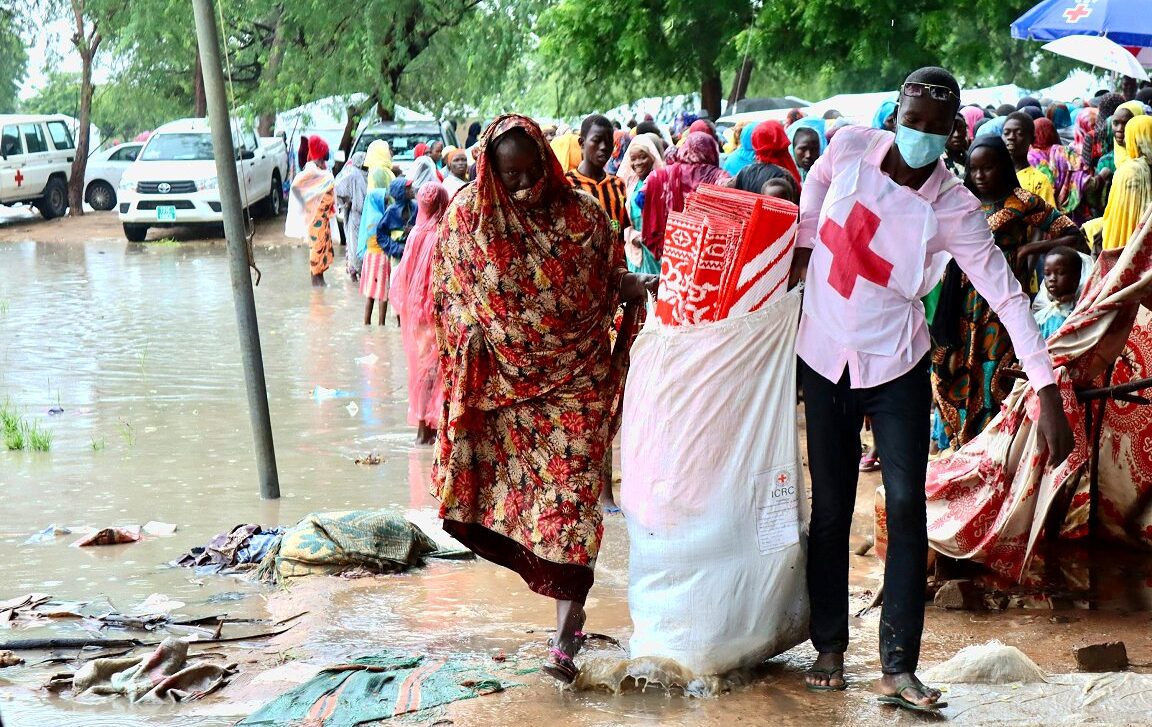 Red Cross volunteers assist people affected by floods in Kournari, Chad. Image by Red Cross Chad.
The rainy season from July to September 2024 was marked by extremely heavy and sometimes unprecedented rainfall in large parts of the Sahel region, leading to catastrophic flooding in Sudan in August and in Nigeria, Niger, Chad and Cameroon in September. In total more than 2000 people lost their lives and millions were displaced.
The floods in Nigeria, Niger and Cameroon are nearly identical in timing and spatial extent to the floods that hit the same region at the same time of the year in 2022. Figure 1 shows a comparison between the two years. The figure highlights two regions, the Lake Chad Basin and the Niger Basin, for which the World Weather Attribution initiative undertook an attribution study at the time (WWA, 2022). The study found that due to human-caused global warming, similar events are no longer rare, and are expected to become even more frequent with further warming. That study did not include Sudan, which was severely affected this year, with unprecedented amounts of rain in both the arid and semi-arid regions of the country. Repeating an analysis on the West Africa flooding would produce extremely similar results to the 2022 study, so this study focuses on Sudan.
 Figure 1: Observed average JJAS rainfall in the year a) 2022 and the year b) 2024, according to the CHIRPS gridded data product. The red boundaries show the two study regions: the Niger Basin in the west and the Lake Chad catchment in the east.
To assess to what extent human-induced climate change altered the likelihood and intensity of the heavy precipitation leading to the severe flooding, researchers from Sudan, Egypt, Kenya, the Netherlands, Sweden and the UK undertook an attribution study on the event in Sudan. We also highlight below findings from the 2022 study that are relevant for the entire region.
In Sudan, the impacted areas were affected by persistent rainfall that occurred between June and August. We therefore studied changes in the wettest 30-day period over the study region, comprising the most impacted parts of the Nile and Bar el Ghazal river basins, between June and August (outlined in red in Figure 2). The regions to the east of the study region, which also experienced very heavy rainfall, are mountainous and have a very different climatology to the study region and therefore were not included in this study.
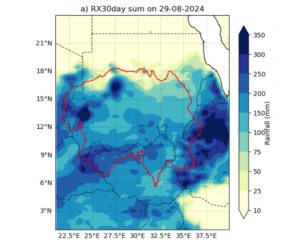 Figure 2: Accumulated precipitation from July 30th – August 29th, the wettest 30-day period during June-August 2024 according to the CHIRPS gridded data product. The study region is outlined in red.
Main findings
- The severe floods of 2024 hit an extremely vulnerable region, and have significantly deepened a complex humanitarian crisis in Sudan, straining the capabilities of aid organisations and government bodies to respond.
- Similar to the findings for the Lake Chad and Niger Basin,