

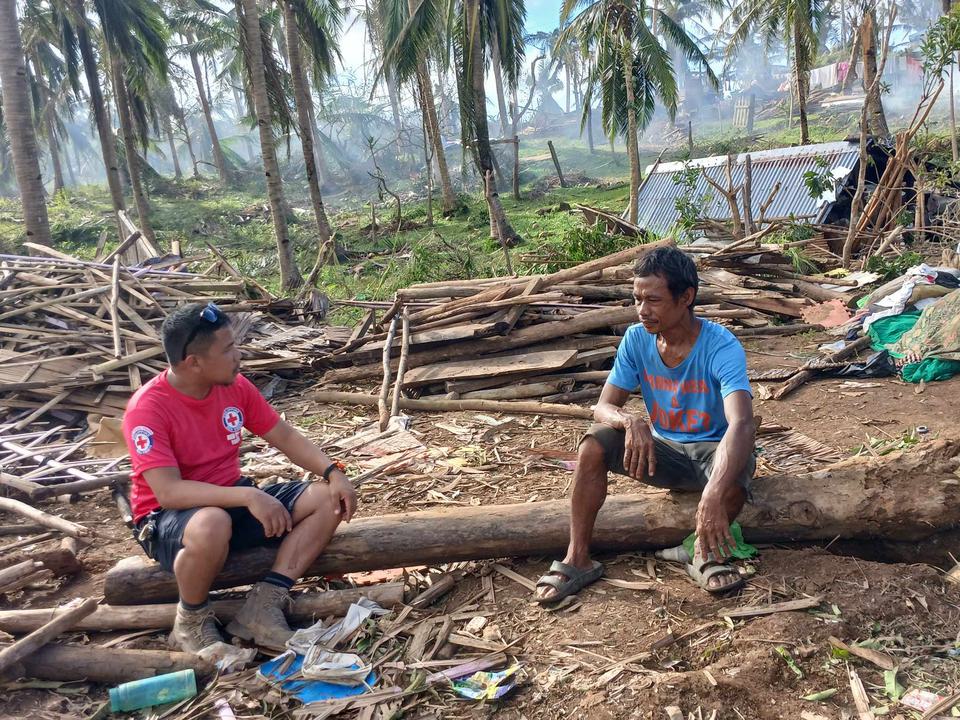
 A Red Cross volunteer speaks to a person affected by the typhoons in Marambong, Pandan, Catanduanes.
The 2024 typhoon season in the Philippines was extraordinary, with six typhoons affecting the country within just 30 days, several of them simultaneously active in the region. This clustering of storms in November, never before witnessed in the basin, affected more than 13 million people, destroying lives and livelihoods and putting enormous strain on resources and infrastructure.
On Saturday, November 16, 2024, Super Typhoon Man-Yi made landfall in the Philippines with maximum sustained winds of 195 km/h, capping an unprecedented month of extreme weather. It was the 24th named storm of the season and the sixth typhoon to strike the Philippines within just 30 days. Typically, November sees only three named storms in the entire basin, with one reaching super typhoon status, based on historical averages (NASA, 2024).
The Japan Meteorological Agency confirmed that November 2024 also set a record for the simultaneous occurrence of four named storms in the Pacific basin, the most since records began in 1951. The onslaught began with Tropical Cyclone (TC) Trami in late October, which killed more than a dozen people and unleashed a month’s worth of rain on the northern Philippines. This was followed by Super Typhoon Kong-Rey, which passed to the north of the Philippines before making landfall in Taiwan and killing at least three people. Next, Typhoon Xinying slammed Luzon with winds of 240 km/h, forcing the evacuation of 160,000 people, while Typhoons Toraji and Super Typhoon Usagi brought a three-meter storm surge and torrential rain (BBC, 2024; ACT Alliance, 2024).
The compounding effects of the series of storms caused severe damage to infrastructure, with early estimates of economic losses of nearly half a billion USD (NDRRMC, 2024). Trami and Kong-Rey alone killed more than 160 people, displaced more than 600,000, and impacted over 9 million individuals across the region (ACT Alliance, 2024).
Having assessed the role of climate change in individual tropical cyclones, such as Typhoon Geami and Hurricane Helene, scientists from the Philippines, the United Kingdom and the Netherlands have collaborated this time to assess whether and to what extent climate change influenced the sequence of TCs affecting the Northern Philippines. In order to do this we focus on two measures: (1) The potential intensity (PI, the theoretical maximum wind speed based on the atmospheric and ocean conditions relevant to TC development) during the months of September to November and (2) changes in the rate of landfalling major TCs, assessed using a stochastic model of storm tracks and intensities. Figure 1 shows the potential intensity for the September-November season, the region of analysis outlined in black and the cyclone tracks of the typhoons hitting the Philippines.
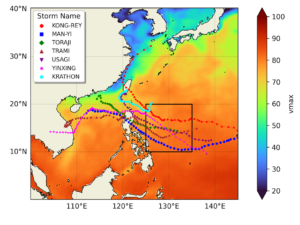 Figure 1: Mean potential intensity (m/s) in the Philippine Sea during Sep-Nov 2024. The study region is indicated by a black box and the tracks of storms during this time are shown as points in different colors. » …