


by Kat Troche of the Astronomical Society of the Pacific
Get ready for the season of Winter! In the Northern Hemisphere, the sky is clear and crisp, offering stunning views of various objects, the most famous being Orion the Hunter.
Orion is a great way to test your sky darkness. With the naked eye, you can easily spot this hourglass-shaped constellation. Known as an epic hunter in Greco-Roman antiqity, Orion and all its parts have many names and meanings across many cultures. In Egyptian mythology, this constellation represented the god Sah. The Babylonians referred to it as The Heavenly Shepard. In most cultures, it is Orion’s Belt that has many stories: Shen in Chinese folklore, or Tayamnicankhu in Lakota storytelling. But the Maya of Mesoamerica believed that part of Orion contained The Cosmic Hearth – the fire of creation.
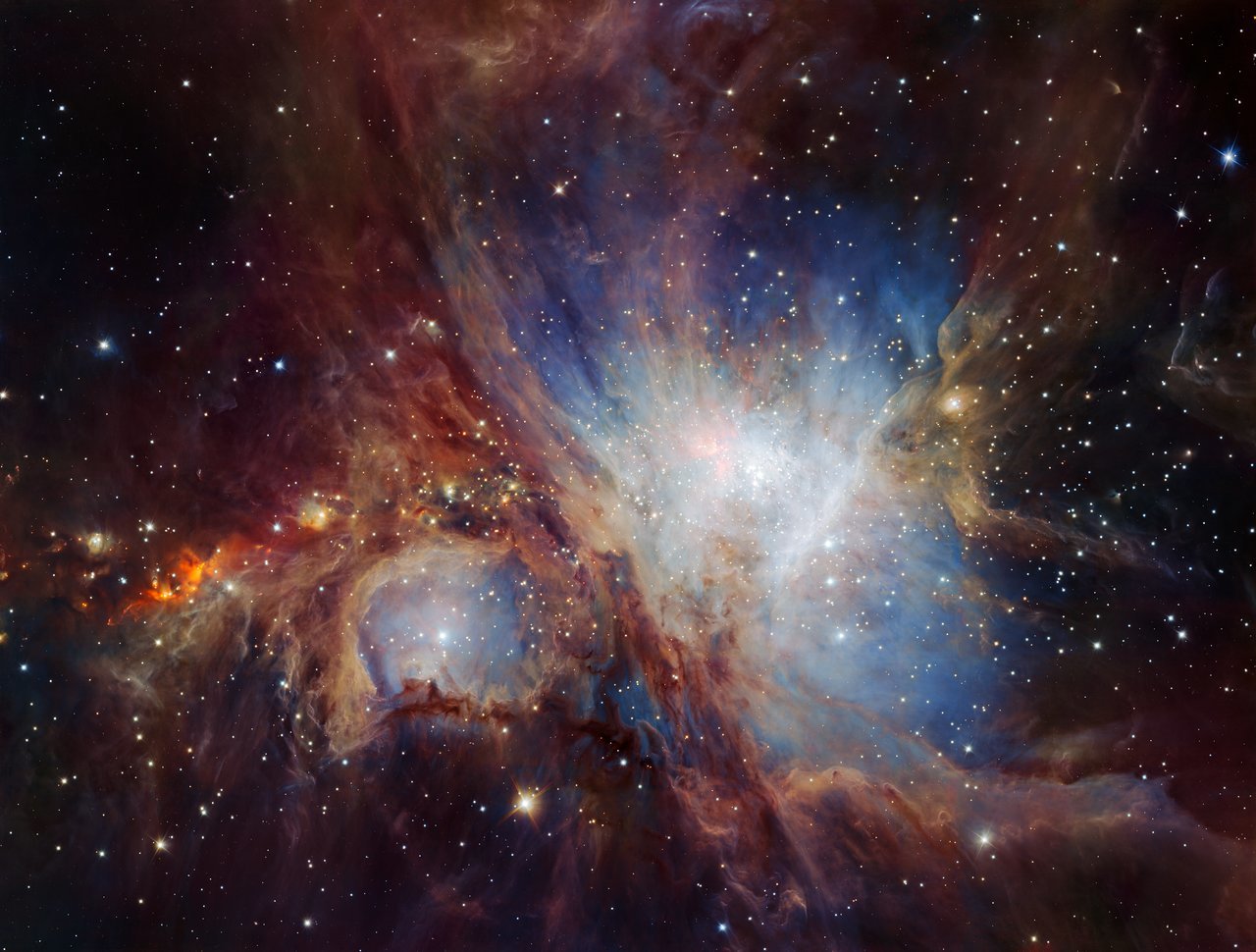
The star-forming region, and crown jewel of Orion – Messier 42 (M42), the Orion Nebula is 1,500 light years away from Earth. It is a 24 light year wide cloud of dust and gas that sits below the first star in Orion’s Belt, Alnitak, and can easily be spotted with the naked eye under moderate dark skies. You can also use binoculars or a telescope to resolve more details, such as the Trapezium: four stars in the shape of a keystone (or baseball diamond). These young stars make up the core of this magnificent object.
Not only can you see the Orion Nebula, but it is also one of the most photographed nebulae around. It has long been a place of interest for the Hubble, Spitzer, and Chandra X-ray Space Telescopes, with James Webb Space Telescope now joining the list in February 2023. Earlier this year, NASA and the European Space Agency released a new photo of the Orion Nebula taken from JWST’s NIRCam (Near-Infrared Camera), which allowed scientists to image this early star forming region in both short and long wavelengths.
Stars aren’t the only items visible here. In June 2023, JWST’s NIRCam and MIRI (mid-infrared instrument) imaged a developing star system with a protoplanetary disk forming around it within the edges of a section called the Orion Bar. Scientists have named this planet-forming disk d203-506, and you can learn more about the chemistry found here. By capturing these objects in multiple wavelengths of light, astronomers now have even greater insight into what other objects might be hiding within these hazy hydrogen regions of our night sky. This technique is called Multi-spectral Imaging, made possible by numerous new space based telescopes.
Whether you’re ready to stargaze or capture images of these celestial wonders, the Orion Nebula is a must-see for any astronomy enthusiast.