


betto rodrigues/Shutterstock
The name Grumman is rightly famous in the world of aviation. For starters, the company developed the iconic Grumman Lunar Module LM-13, one of which, proudly dubbed Eagle, performed the most astonishing duty any machine had ever performed during the first Moon landing. Now known as Northrop Grumman after a 1994 merger, the international powerhouse collaborated on the James Webb Space Telescope, and has a long history in developing aircraft that fly a little closer to home too.
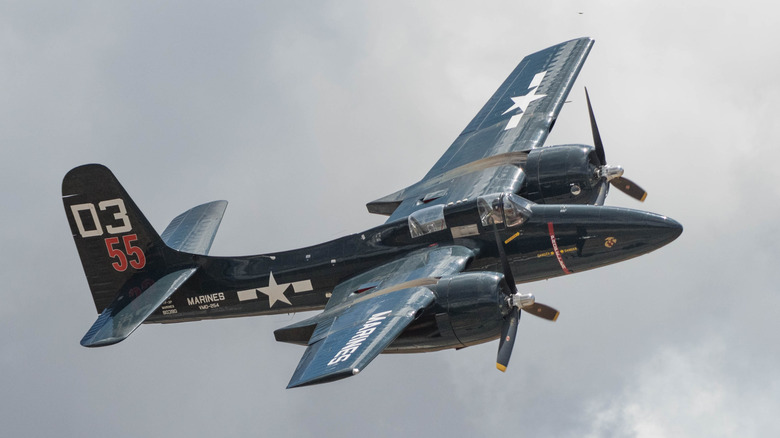
Grumman’s F7F Tigercat is one of their more notable planes. It was a potent example of the sophisticated weapons technology that the ongoing horror of World War II forced from nations worldwide. Unfortunately for the model, though, it was also a victim of the swift progress of that technology, never getting to be unleashed when it was at its most relevant and threatening.
This is the history of the F7F Hellcat, and an introduction to its strengths, weaknesses, and overall place in Grumman’s story.
betto rodrigues/Shutterstock
In June of 1941, approximately six months before the United States formally joined the Allies in World War II, the nation’s military was branching out and bolstering its defensive and offensive strength. As part of this, the U.S. Navy sought the development of an advanced fighter that could serve with its Midway-class aircraft carriers. It would be a faster, more powerful machine than previous Grumman models like the F4F Wildcat (which boasted a relatively modest ceiling of 34,700 feet and top speed of 332 mph), and would prove to be a unique aircraft in several respects.
That month, Grumman’s prototypes demonstrated the potential and versatility of the Tigercat design. Flight tests and preparations began around five months later, and in April the following year, the completed jet was received by the Navy.
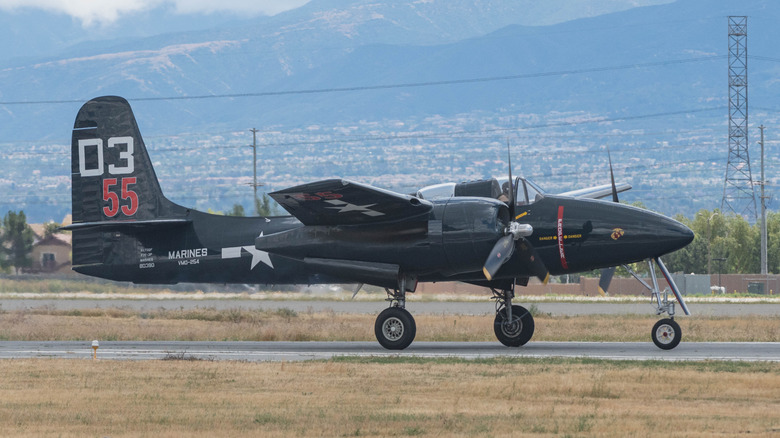
Developed in both single- and two-seat configurations, it distinguished itself as Grumman’s first successful fighter to bear a pair of engines (its twin-engine XF5F Skyrocket proved flawed the previous April and it was rendered surplus to requirements by other models by the time it had been brought up to scratch). Let’s see how the two configuration options differed, and exactly what those twin engines could do.
Lost_in_the_Midwest/Shutterstock
The Tigercat symbolized just how far aviation had come, only decades after the very first piloted powered flight (the Wright Flyer in December 1903). It was powered by a pair of R-2800-34Ws from Pratt & Whitney, which could output 2,100 hp. These engines not only boosted the service ceiling of the aircraft to 40,700 feet, but allowed it to attain speeds of up to 435 mph.
By the standards of today’s aircraft (particularly military ones), this may still seem quite the modest pace, but in the 1940s, it was all but unrivaled in the speed stakes. This was backed up by an extensive range of 1,200 miles, which meant that the aircraft was better able to serve the roles for which it was intended.