

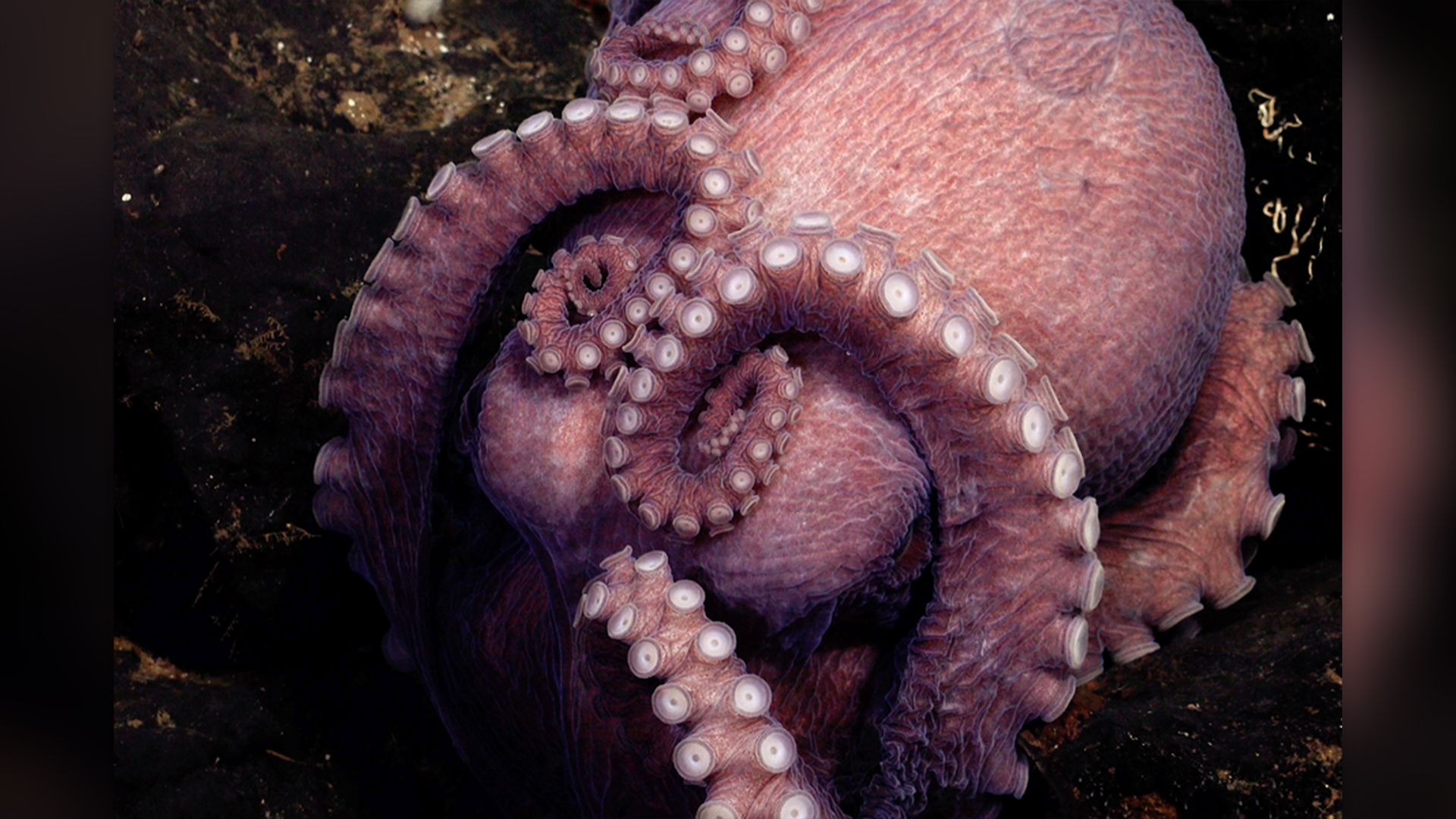

 deep sea with its arms curled, showing its suckers.” onerror=”if(this.src && this.src.indexOf(‘missing-image.svg’) !== -1){return true;};this.parentNode.replaceChild(window.missingImage(),this)” data-original-mos=”https://cdn.mos.cms.futurecdn.net/MmZxJj5huMLmc9tF2KDGvn.jpg” data-pin-media=”https://cdn.mos.cms.futurecdn.net/MmZxJj5huMLmc9tF2KDGvn.jpg”/>
The Dorado octopus broods her eggs near a small outcrop of rock unofficially named El Dorado Hill. When a female octopus broods (which can be a time span of multiple years), she does not eat and dies around the same time that her eggs hatch. (Image credit: ROV SuBastian/Schmidt Ocean Institute (CC BY-NC-SA))
Last month a team of scientists visited an ethereal nursery on the seafloor off Costa Rica, where they watched in awe as a new generation of deep-sea octopuses gently emerged from a quivering cluster of oblong, semitranslucent eggs.
Now the researchers have confirmed these deep-sea dwellers are members of an entirely new, yet-to-be-named species, nicknamed the “Dorado octopus.” And they have announced they’ve discovered three more new deep-sea octopus species on top of that.
“Finding four new species of octopuses on just two expeditions is exciting, revealing some of the rich biodiversity of the deep sea and hinting at how much more waits to be discovered,” says Jim Barry, a deep-sea ecologist at the Monterey Bay Aquarium Research Institute, who was not involved in the expeditions.
The nursery visit last December was part two of a Schmidt Ocean Institute expedition that took place six months earlier. Then, too, researchers witnessed baby deep-sea octopuses emerge from eggs that their respective mothers were brooding near hydrothermal vents. The octopuses’ proximity to the vents suggests these creatures may have evolved to use warmth from the seeping hydrothermal fluid to accelerate the incubation process—which is notoriously long for many deep-sea creatures, leaving their offspring vulnerable to predators for extended periods.
The team collected some octopus specimens near the vents and others farther away and brought them to the Zoology Museum at the University of Costa Rica. Fiorella Vásquez, a research assistant at the Zoology Museum, and Janet Voight, associate curator of invertebrate zoology at the Field Museum of Natural History in Chicago, then set out to classify the creatures.
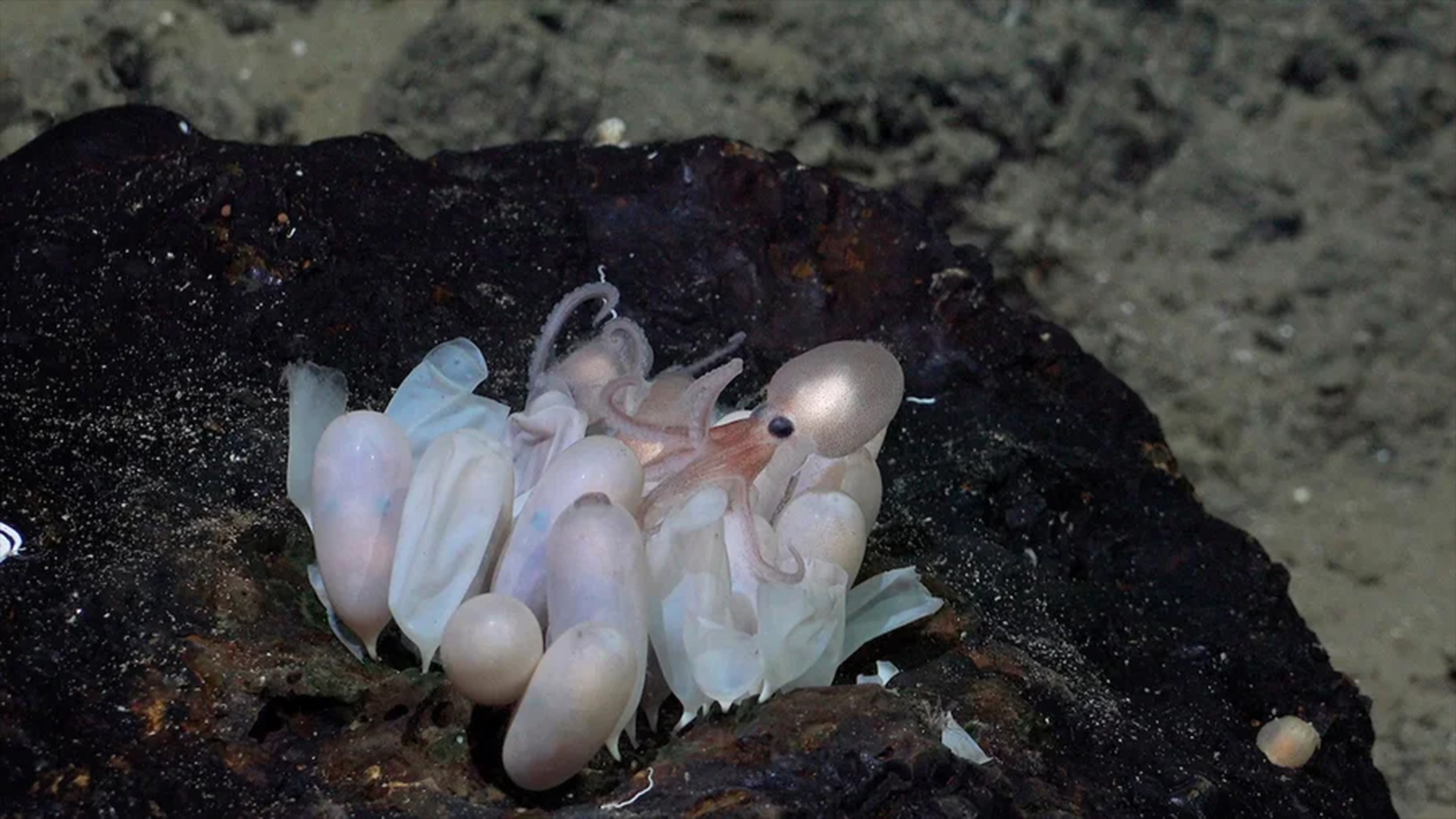
An octopus hatchling emerges from a group of eggs at a new nursery, first discovered by the same team in June, at Tengosed Seamount off Costa Rica. (Image credit: ROV SuBastian/Schmidt Ocean Institute (CC BY-NC-SA))
The Dorado octopus is remarkably similar to the pearl octopus (Muusoctopus robustus), which a separate team of researchers previously found brooding eggs near hydrothermal vents off central California. To distinguish the Dorado octopus as a separate species in the recent investigation, the scientists made careful observations and descriptions of the different octopuses, such as measuring their arms and enumerating their suckers. “The two species share an unusual morphology, having smallish eyes, a robust body and fairly short arms,” Voight explains. “It’s the details that separate them.”
Of the three additional species the team identified farther from the hydrothermal vents, two are also members of the genus