

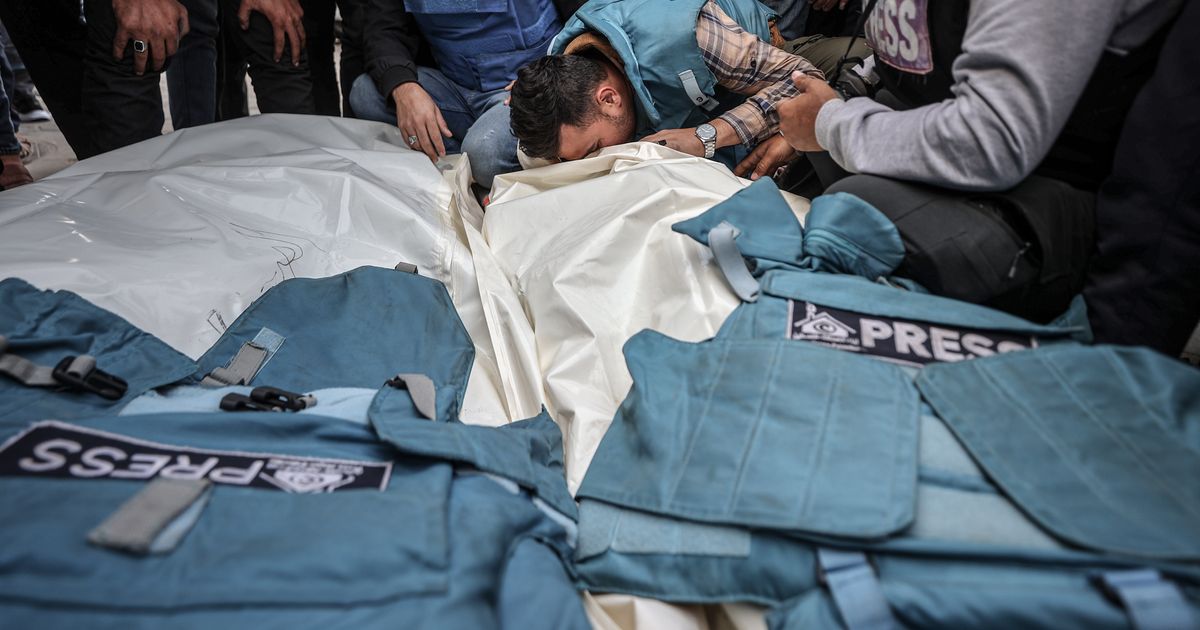

Several Palestinian journalists who have amassed millions of followers on social media for their on-the-ground coverage of Gaza are struggling to maintain hope while having to balance survival and their reporting amid Israel’s continued bombardment.
Sunday marks 58 days since Hamas launched a deadly attack on Israel, leading to an escalation of violence in Gaza from Israel. The massacre, which human rights groups say amounts to ethnic cleansing, has resulted in at least 15,500 Palestinians killed since Oct. 7 — the majority of whom are women and children — according to the Gaza Health Ministry.
Amid the slew of online disinformation and government propaganda that has unfolded since Oct. 7, journalists who call Gaza their home have become the world’s way of seeing the harsh realities Palestinians face in the enclave. Every day, followers from all over the world carefully watch the Instagram accounts of 21-year-old Plestia Alaqad, 24-year-old Motaz Azaiza, 25-year-old Bisan Owda, 28-year-old Hind Khoudary and 35-year-old Ali Jadallah; not just to receive updates on Gaza, but to make sure these journalists are safe and alive.
“I traveled yesterday, and this was literally one of the hardest decisions that I took,” Alaqad said in a Nov. 22 video after evacuating Gaza, a decision she made due to fears that her role as a journalist was threatening her family’s safety. Even though the purpose of press gear is to protect journalists, Alaqad said that she had stopped wearing her vest and helmet due to feeling like they put a target on her back.
The violence in the region has become the deadliest conflict for journalists since the Committee to Protect Journalists started gathering data three decades ago. As of Friday, 61 journalists and media workers have died since Oct. 7 — 54 Palestinian, four Israeli and one Lebanese.
According to Khoudary, Palestinian journalist Montaser Al-Sawaf was killed over the weekend by an Israeli airstrike while standing in front of his house with his brother and cousins. Al-Sawaf had bled for 30 minutes, and because there were no ambulances in the area, “no one was able to save him.”
“We, his colleagues, were obligated to write breaking news on his killing. We reported his killing with our tears. We have been reporting on the killing of our beloved ones since day one,” Khoudary wrote on Saturday.
“Montaser chose to stay in Gaza. He was one of the few colleagues that stayed and risked his life to report on what was happening in the north. Before we evacuated we spent three weeks in the office living together, we cried, we laughed,” she continued. “We were scared — we strengthened each other.”
For journalists who are still alive in Gaza, it has been 58 days of documenting the violence against their people,