


- Science
A towering cliff in the Japan Trench of the Pacific Ocean “is unlike anything that’s been observed by science before.”
Published January 22, 2024
They were enveloped in an oppressive darkness. The sun, miles above, had vanished long ago. Through tiny windows, they could see the seafloor’s sediments glimmering in the submersible’s headlights. Curious fish flitted around their vessel.
Carefully navigating the inky-black waters was a little like “driving in a car at midnight along a mountain road,” says Hayato Ueda, a geoscientist at Niigata University in Japan and one of the sub’s two occupants.
Ueda and pilot Chris May searched the darkness in their claustrophobic vessel, and eventually a lofty geologic monument emerged from the shadows: an 85-foot-tall cliff climbing into the ocean above. The exposed crest of a cataclysmic rift in Earth’s crust, exactly where Ueda predicted it would be, was part of one of the worst disasters in modern history.
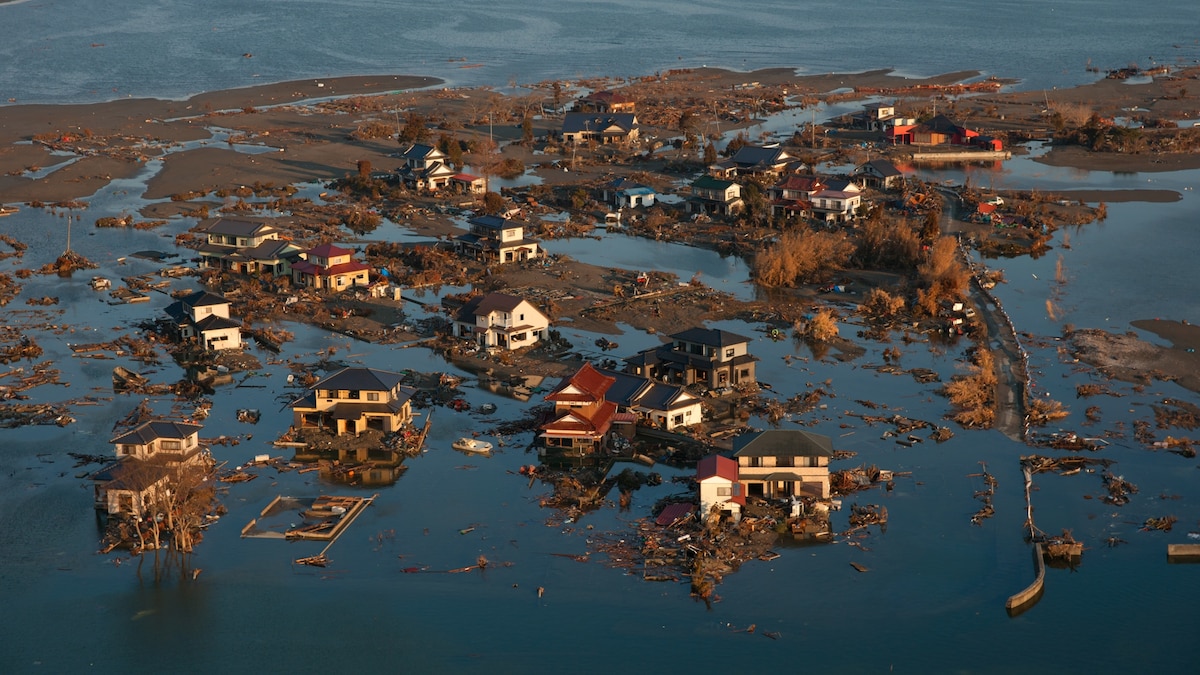
This cliff is a scar of the 2011 Tōhoku earthquake that struck off Japan’s eastern shores. That year, on March 11, the magnitude 9.1 temblor deep within the Pacific Ocean unleashed a catastrophic tsunami that hit Japan, killing around 20,000 people and leaving half a million homeless.
In the past decade, scientists have studied the quake by decoding its seismic waves and scanning the depths with sonar. But getting a detailed understanding of what caused the seafloor to convulse required something that initially seemed impossible: examining part of the rupture site in person, within the Japan Trench, almost five miles below the waves.
In 2022 scientists made that ambitious mission a reality. They secured a privately owned deep-sea vessel, the DSV Limiting Factor—a submersible cleared to safely take people down to the crushing, benighted seafloor.
Plunging into the Japan Trench, the divers eventually came upon the incongruous cliff. As reported in a study the journal Communications Earth and Environment, the team determined that this cliff represented the top of a section of a chunk of crust that jumped up by over 190 feet during the 2011 earthquake.
This appears to be “the very absolute tip of the fault that generated that massive earthquake,” says Harold Tobin, director of the Pacific Northwest Seismic Network at the University of Washington, who wasn’t involved in the study. “In this one place, the tip came all the way to the surface and pushed everything up. And they tagged it, they identified it directly in the field. And that’s incredible.”
Uplift features like this have been observed on land, but this is the first time one has been glimpsed by humans in a deep-sea subduction zone trench. This “is unlike anything that’s been observed by science before,” says Christie Rowe, an earthquake geologist at McGill University who was also not involved with the study.