


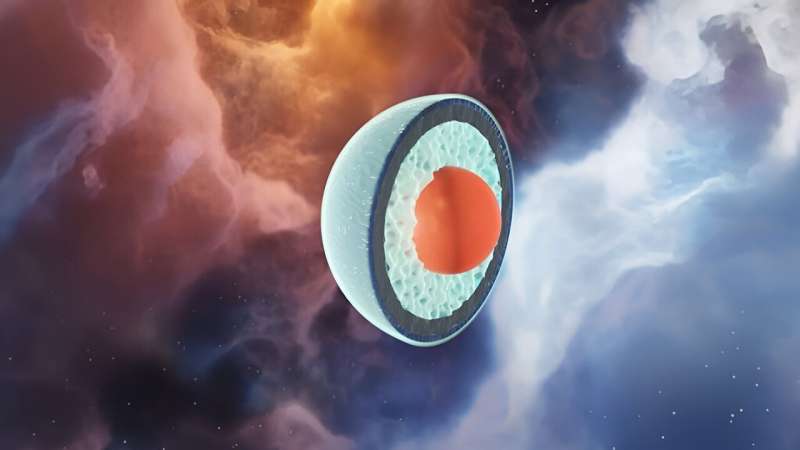
 neutron stars probably have cores of quark matter” title=”Illustration of a quark core in a neutron star. Credit: Jyrki Hokkanen, CSC – IT Center for Science” width=”800″ height=”450″/>
Illustration of a quark core in a neutron star. Credit: Jyrki Hokkanen, CSC – IT Center for Science
Do you know what atoms are made of? Protons, neutrons, and electrons. But what’s really fascinating is that protons and neutrons are composite particles made of up and down quarks. Neutrons have 2 downs and 1 up, while protons have 2 ups and 1 down. These quarks are always bound to each other because of the strong force, never to be as free as electrons. However, according to a new study in Nature Communications, they can liberate themselves within the hearts of neutron stars.
Neutron stars are the remnants of large stars and are the last attempts to prevent a stellar core from collapsing into a black hole. It’s like their final resistance against gravity. The core, in the case of a neutron star, is filled with neutrons on the edge of collapsing in on themselves. The key is that these neutrons might loosen up at this gravitational edge, allowing their quarks to flow into a quark soup, creating a dense quark core.
Running experiments on neutron stars is not an option but what we do know is that the equation of state for neutron stars is known as the Tolman-Oppenheimer-Volkoff (TOV) equation. This equation is complex and calculating whether neutron stars have a quark core results in a “maybe”.
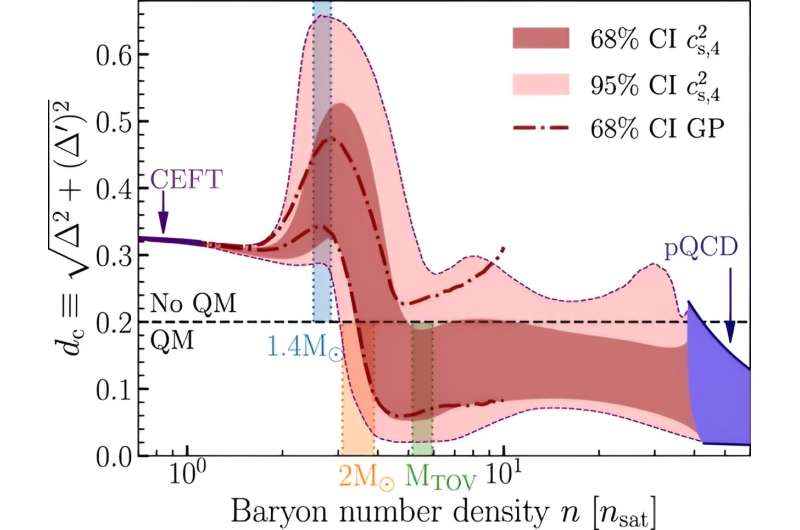
Analysis shows massive neutron stars likely have quark cores. Credit: Annala et al, Nature Communications (2023). DOI: 10.1038/s41467-023-44051-y
In this new study, the team took observational data on the mass and size of neutron stars and applied Bayesian statistics. This statistical method applied to the likely scenarios showed that neutron stars with a quark core are slightly denser than those without one. Consequently, small neutron stars are likely not to have quark cores, while the most massive ones possibly do, leading to a shift in the mass-density relation in Bayesian analysis.