


- News
- Science & Astronomy
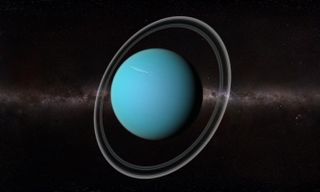
Uranus is a strange ringed-planet that sits on its side.
(Image credit: SCIEPRO via Getty Images)
Uranus, the seventh planet from the Sun, orbits in the outer solar system, about two billion miles (3.2 billion kilometers) from Earth. It is an enormous world – quadruple the diameter of Earth, with 15 times the mass and 63 times the volume.
Unvisited by spacecraft for more than 35 years, Uranus inhabits one of the least explored regions of our solar system. Although scientists have learned some things about it from telescopic observations and theoretical work since the Voyager 2 flyby in 1986, the planet remains an enigma.
It’s easy to divide the solar system into two large groups: an inner zone with four rocky planets and an outer zone with four giant planets. But nature is, as usual, more complicated. Uranus and Neptune, the eighth planet from the Sun, are vastly different from the others. Both are ice giants, composed largely of compounds such as water, ice, ammonia and methane; they are places where the average temperature is minus 320 to minus 350 degrees Fahrenheit (minus 212 Celsius).
Related: Uranus up close: What proposed NASA ‘ice giant’ mission could teach us
Through recent discoveries of exoplanets – worlds outside our solar system that are trillions of miles away – astronomers have learned that ice giants are common throughout the galaxy. They challenge our understanding of planetary formation and evolution. Uranus, comparatively close to us, is our cornerstone for learning about them.
A new mission
Many in the space community – like me – are urging NASA to launch a robotic spacecraft to explore Uranus. Indeed, the 2023 decadal survey of planetary scientists ranked such a journey as the single highest priority for a new NASA flagship mission.
This time, the spacecraft would not simply fly by Uranus on its way somewhere else, as Voyager 2 did. Instead, the probe would spend years orbiting and studying the planet, its 27 moons and its 13 rings.
You may wonder, why send a spacecraft to Uranus and not Neptune. It’s a matter of orbital architecture. Because of the positions of both planets over the next two decades, a spacecraft from Earth will have an easier trajectory to follow to reach Uranus than Neptune. Launched at the right time, the orbiter would arrive at Uranus in about 12 years.
Here are just a few of the basic questions a Uranus orbiter would help answer: What, exactly, is Uranus made of? Why is Uranus tilted on its side, with its poles pointed almost directly toward the Sun during summer – which is different from all the other planets in the solar system?