

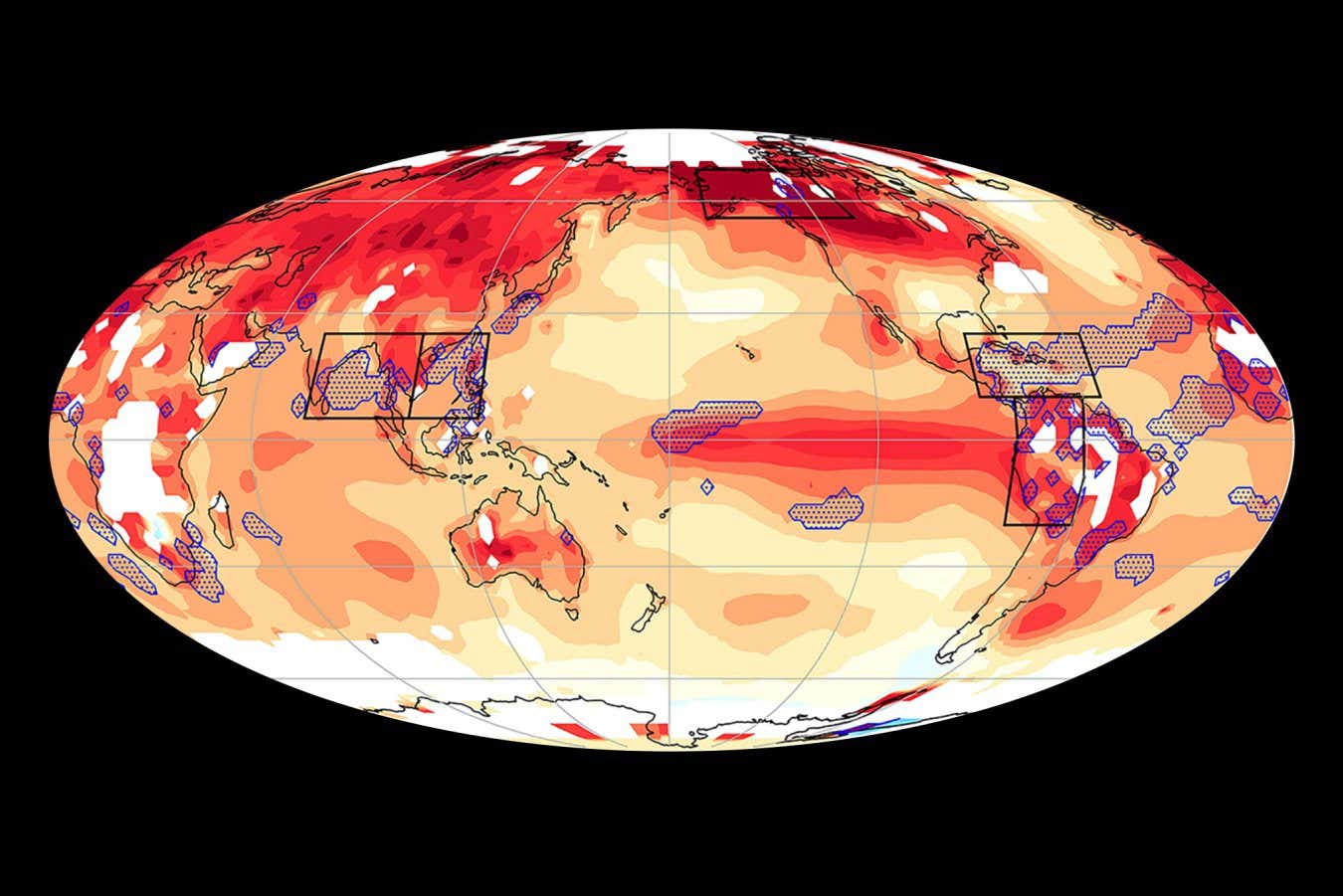


Map illustrating projected surface temperature anomalies in 2024 during a potent El Niño event. Regions highlighted with blue dots indicate where unprecedented heat is anticipated.
Study conducted by experts from Scientific Reports and led by Ning Jiang.
Anticipated Temperature Anomalies
This year, the Caribbean, the Bay of Bengal, the South China Sea, and specific areas of Alaska and the Amazon are expected to experience their warmest 12-month period on record as a result of the ongoing El Niño weather phenomenon, as projected by a climate model.
According to Michael McPhaden, a member of the team at the NOAA Pacific Marine Environment Laboratory in Seattle, Washington, these regions are at heightened risk of extreme weather events that can have detrimental impacts.
Impact of Extreme Heat
Extreme heat events pose significant threats to human health, increase the likelihood of wildfires, and elevate the risk of marine heatwaves that can be detrimental to marine ecosystems, fisheries, and coral reefs.
Factors Driving Temperature Rise
Global surface temperatures are currently soaring, primarily due to the warming effects of carbon emissions resulting from the burning of fossil fuels. The exacerbation of this warming trend is attributed to a robust El Niño phase that commenced in the middle of 2023.
During El Niño, warm water extends across the surface of the Pacific Ocean towards South America, leading to a transfer of ocean heat into the atmosphere, resulting in elevated surface temperatures.
Role of El Niño and La Niña
In contrast, during La Niña phases, the cooling phenomenon occurs, with cold water spreading across the Pacific surface away from South America, absorbing atmospheric heat and causing surface temperatures to decrease.
Historically, global average surface temperatures tend to peak during El Niño phases and decline during La Niña events.
Forecasting Record Heat
Utilizing a computer model that factors in aerosol pollution, volcanic eruptions, and El Niño, McPhaden and his team generated forecasts to pinpoint regions where record heat is likely to occur during the period from July 2023 to June 2024.
These forecasts provide advance warning, enabling better preparation to safeguard lives, property, marine resources, and economic development from the impacts of extreme heat.
Strong El Niño Scenario
The team’s analysis considered two scenarios: a strong El Niño and a more moderate one. Current observations indicate a strong El Niño event, ranking among the top five strongest since 1950, according to McPhaden.
For the robust El Niño scenario, the team projects that the global average surface temperature from July 2023 to June 2024 will be 1.1 to 1.2°C higher than the 1951 to 1980 average.
This translates to an increase of 1.4 to 1.5°C above the 1850 to 1900 average.
For more information, you can access the full article here.