

Skip to content
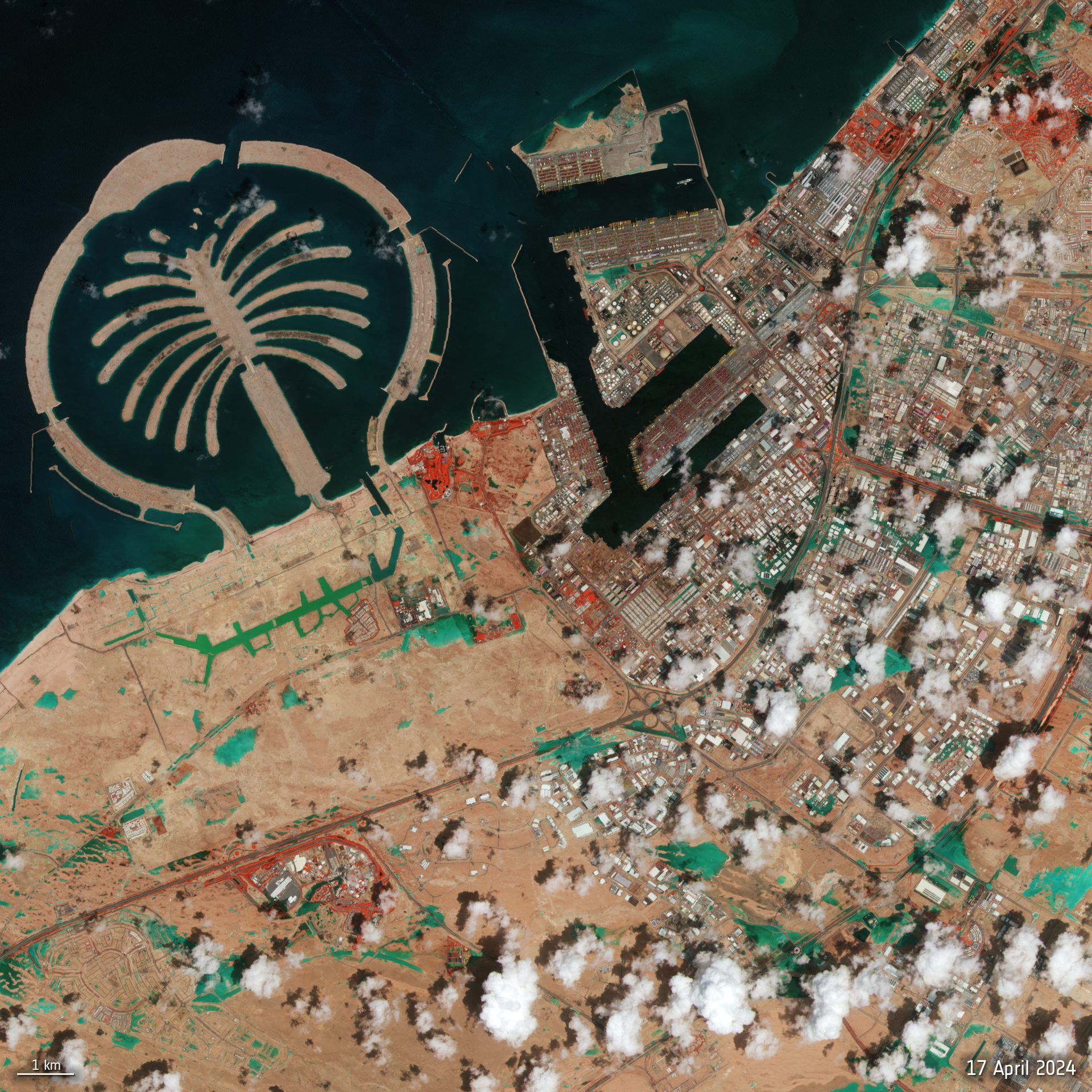 Dubai on Wednesday 17 April. Areas of flooding are highlighted in turquoise. Image taken by Copernicus Sentinel-2.
From April 14 to15 2024, the United Arab Emirates (UAE) and the northern parts of Oman were hit by exceptionally heavy rainfall causing massive disruption in infrastructure and public life in the area and leading to at least 20 fatalities in Oman and four in the UAE.
The extreme rainfall event was associated with a low-pressure system, initially originating from mid latitude Eastern Europe, that induced violent storms, also bringing heavy rainfall to other parts of Asia.
In Dubai, most of the rain fell on Monday 15th of April and exceeded all previous records of daily rainfall in the last 75 years, when records began (UAE government, 2024).
Researchers from Saudi Arabia, Pakistan, Switzerland, the Netherlands, Sweden, the United States, Canada, France and the United Kingdom collaborated to assess to what extent human-induced climate change altered the likelihood and intensity of the weather conditions at the time of the most impactful floods.
To characterise the event we focus on daily maximum precipitation (RX1day). As this event was the highest on record we also looked at the annual maximum, which usually falls within this season. Using this RX1day variable has the additional advantage that it is one of the routinely calculated indices in most climate projections, thus making it easy to compare our analysis with published literature.
For the spatial definition of the event we analysed the region that saw the biggest impacts during the 1-day heavy rainfall event, indicated by the red box in Figure 1. The region includes the UAE, the northern part of Oman, Bahrain and a small part of Saudi Arabia.
 Figure 1: 24 hour rainfall on 15 April in MSWEP observational data product. The red box indicates the study region.
Main Findings
- The UAE, Oman and the wider analysed region are located in a so-called hyper-arid region, with on average very little rainfall but with very high variability from year to year. Thus heavy rainfall events such as the one analysed here occur very rarely, leading to short records of similar events which results in high uncertainty in the assessment.
- The El Niño Southern Oscillation, a naturally occurring climate phenomenon, was found to be important to explain the variability in the observed rainfall. Most previous heavy rainfall events in the area occurred during El Niño years.
- To assess the role of human-induced climate change we first estimate if there is a trend in the observations associated with the warming up until today of 1.2°C and find that there is a trend, making heavy rainfall such as observed more likely. Based on the observations, the event was 10-40% more intense than it would have been had it occurred in an El Nino year in a 1.2°C cooler climate.
- To further characterise and quantify the role of human-induced climate change we then also look at climate models with high enough resolution to capture precipitation over the comparably small study region.