

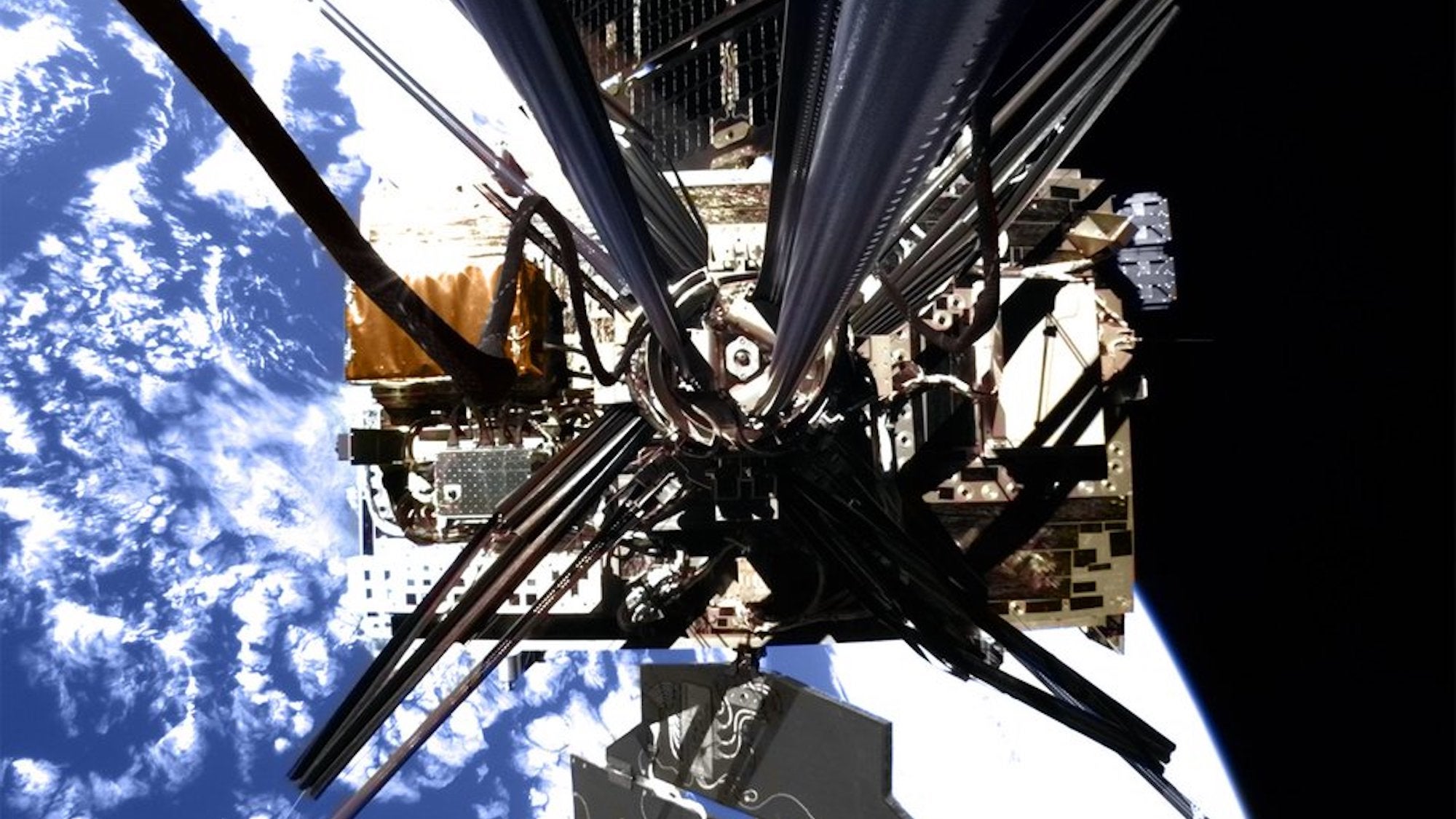

An orbital satellite that has completed the first year of a mission to test the technological potential of harvesting and transmitting solar energy down to Earth has researchers excited to dive into the results. According to Caltech’s mission recap released today, the Solar Space Power Demonstrator (SSPD-1) has been a success with all three of the 110-pound prototype’s onboard tools being considered successful by the engineers behind the project. They believe that this project “will help chart the future of space solar power.” The future, however, is still potentially decades away, if funding for such projects is secured.
Launched aboard a SpaceX Falcon 9 rocket in early January 2023, the SSPD-1 contained a trio of experiments: First, its Deployable on-Orbit ultraLight Composite Experiment (DOLCE) investigated the durability and efficacy lightweight, origami-inspired solar panel structures, while ALBA (Italian for “dawn”) tested 32 different photovoltaic cell designs to determine which may best be suited for space. At the same time, the Microwave Array for Power-transfer Low-orbit Experiment (MAPLE) tested microwave transmitters meant to convey solar power harvested in orbit back to Earth.
[Related: A potentially revolutionary solar harvester just left the planet.]
There is a report about MAPLE successfully demonstrating for the first time ever that solar power can be collected by photovoltaic cells and transmitted down to Earth via a microwave beam. Over the course of eight more months, SSPD-1 team members purposefully ramped up MAPLE’s stress tests, eventually leading to a drop in transmission capabilities. Researchers then reproduced the issue in a laboratory setting, eventually determining that complex electrical-thermal interactions and the wear-down of individual array components were to blame.
Caltech’s co-director of Space Solar Power Project (SSPP), Ali Hajimiri, has announced today that the results “have already led to revisions in the design of various elements of MAPLE to maximize its performance over extended periods of time.”
“Testing in space with SSPD-1 has given us more visibility into our blind spots and more confidence in our abilities,” Hajimiri added.
Today’s solar cells used in satellites and other space technologies are as much as 100 times more expensive to manufacture than their terrestrial counterparts. Caltech explains this is largely due to the cost of adding protective crystal films known as epitaxial growth. ALMA determined that perovskite solar cells, although a promising design here on Earth, showed major performance variabilities in space. At the same time, gallium arsenide cells worked consistently well over a large period of time—but without the need for including epitaxial growth.
As for DOLCE, researchers readily admitted on Monday that “not everything went according to plan.” Although originally meant to deploy over three-to-four-days, DOLCE encountered multiple engineering issues, such as snagged wiring and jammed mechanical components. Thankfully, the team managed to sort out the issues by referencing onboard cameras to mimic the problems on a full-scale lab replica. Despite the headaches, DOLCE’s space test “demonstrated the robustness of the basic concept,” according to SSPP co-director and Joyce and Kent Kresa Professor of Aerospace and Civil Engineering,