


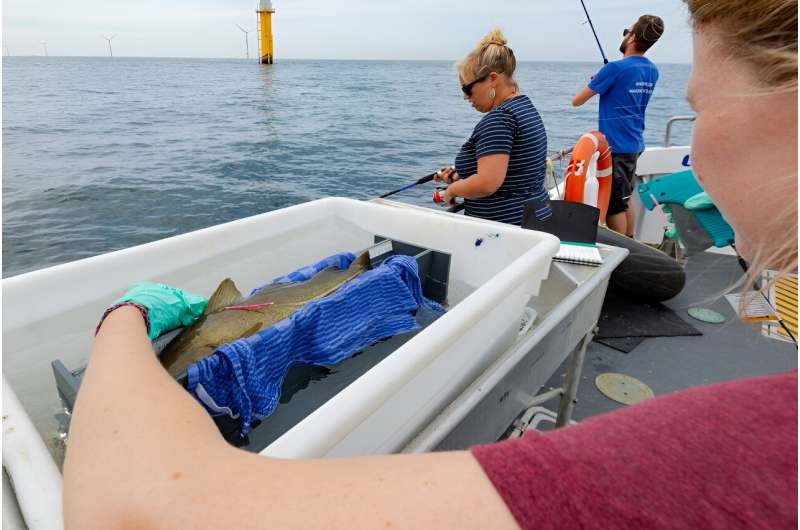
Credit: Inge van der Knaap
She narrowly defied bureaucracy and spent days angling for cod. In the North Sea, marine biologist Inge van der Knaap discovered that noise significantly disturbs fish behavior. “There is now a lot of attention for underwater noise.”
Every day, seismic surveys take place at sea somewhere in the world. After a loud bang, the echo from the seabed reveals whether there is oil or gas, or whether rocks are in the way of installing wind turbines. Such research requires a marine mammal observer to accompany it, to check that no seals or other mammals are nearby that would be disturbed by it. If so, the survey must wait.
Whether the fish present are also bothered by underwater noise does not yet play enough of a role in seismic research, Van der Knaap believes. “There is now a lot of attention for underwater noise. It is part of the EU Marine Strategy Framework Directive to protect the marine environment and biodiversity.” Offshore companies are obliged to conduct research into this, and they therefore contributed to Van der Knaap’s research.
The key question—does noise threaten fish populations—is very difficult to answer. Van der Knaap got very close. During the disturbance, the fish are less active than usual, their day-and-night rhythm is disturbed, and shortly after the noise they seem to leave the area faster than they would otherwise. “We cannot yet prove that the fish eat less and are less active under these conditions, although that seems plausible. But we do have a lot of new information.”
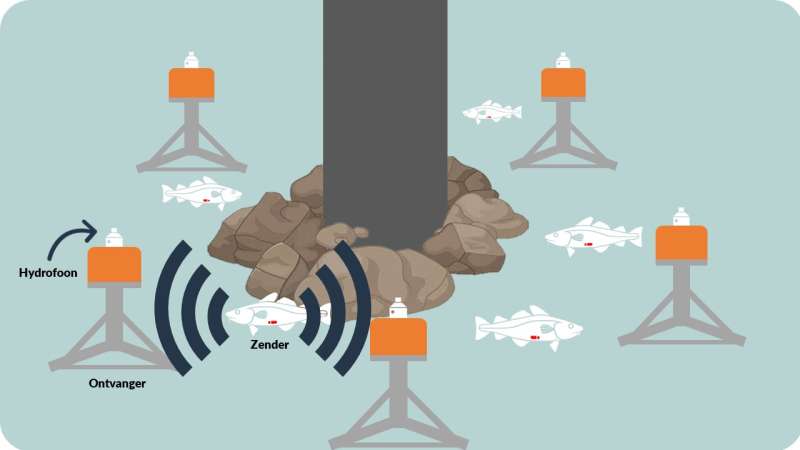
For that new information, Van der Knaap had to overcome many obstacles. “You can’t track fish with GPS, that doesn’t work under water. Our system had a range of about a kilometer. If the fish would swim away immediately, we would have no data.” But she could only start catching those fish if she was allowed to sail between wind turbines prior to a seismic survey.
Credit: Leiden University
The perfect spot: A wind farm
“Wind farms in the North Sea turn a sandy bottom into a rich environment where there are plenty of crabs and other food for cod between boulder piles.” It is the perfect place for Van der Knaap’s research. “It was very difficult to get permission, because of all the legislation. A few times I was on the verge of calling it off.” Eventually, she was allowed to accompany the ship the MV Geo Caribbean into the Belgian North Sea, where it would simulate a seismic survey especially for the project.
Van der Knaap fished for days until she had 40 cod—using a net would damage their scales too much. “The hook in their lip injures them less. We anesthetized them, placed a transmitter and threw them back. After a few days recovery time, our experiment began.” The transmitters reflected both the position and activity of the fish.