

Politics
It’s time to prepare for the worst-case scenario under Trump.
Anna Moneymaker/Getty Images
Sign up for the Slatest to get the most insightful analysis, criticism, and advice out there, delivered to your inbox daily.
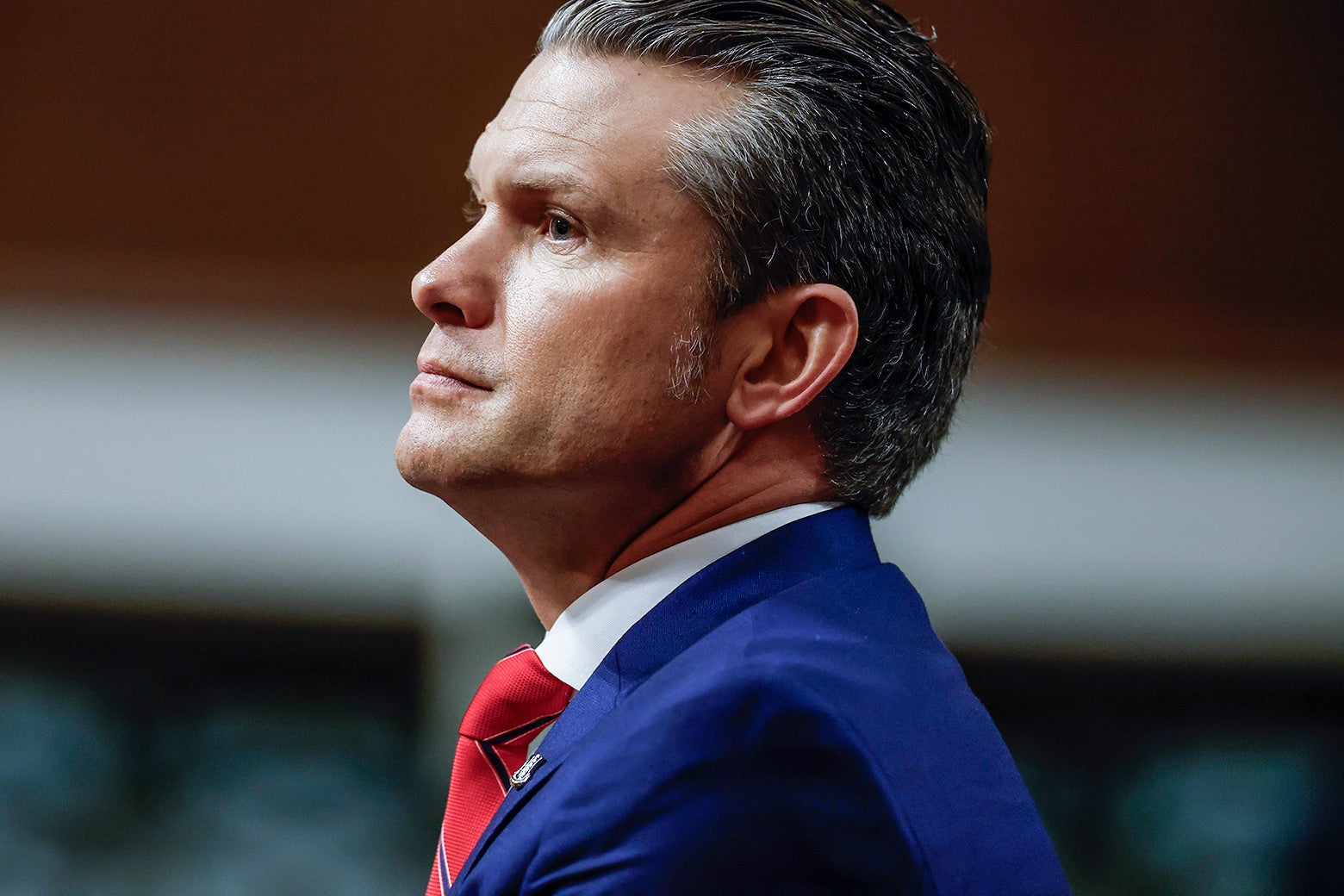
At his Senate confirmation hearing yesterday, Secretary of Defense nominee Pete Hegseth refused to state whether he would follow an unlawful order given by President-elect Donald Trump. During the nationwide protests after George Floyd’s murder in 2020, Trump asked the then chairman of the Joint Chiefs of Staff, “Can’t you just shoot them, just shoot them in the legs or something?” It is entirely conceivable that during his second term, what was previously a question becomes an order.
Everyone in the military chain of command swears an oath to the Constitution that requires them to disobey unlawful orders—and to be very clear, a mass shooting conducted by the government against its own citizens is definitely that. If the secretary of defense is unwilling to fulfill that oath in contradiction of a commander in chief who demands absolute fealty from his subordinates, it will fall on the uniformed career service members to uphold the Constitution and ensure that the military is not unleashed on American civilians. Although individual service members are legally authorized to use force in acts of self-defense against an imminent threat, an order to fire on civilians would be not just unlawful—a violation of the rules for the use of force—but a war crime under the laws of armed conflict.
An order by Trump to deploy the military and have it open fire on protesters would be catastrophic in a way few Americans who haven’t served in uniform realize. Unlike the National Guard at Kent State, today’s military is significantly more lethal. In 1970 the Ohio National Guard killed four protesters and wounded nine at Kent State University, firing bolt-action M1 Garand rifles, which held an eight-round magazine and could fire 40 to 50 rounds a minute. As one National Guard member there that day recalled: “I distinctly heard one shot fired; then all hell broke loose when 28 men fired a total of 67 shots over a period of 13 seconds.”
A modern military squad operates with roughly nine M16s loaded with 30-round magazines and three squad automatic weapons that each contain 200-round belts of ammunition. If today the same number of soldiers were firing for 13 seconds, as they did at Kent State, they could easily unleash several hundred rounds. Additionally, contemporary crowd-control tactics often result in “kettling,” in which protesters are pushed into densely confined areas, where individual bullets are likely to penetrate multiple people before stopping.
This has nearly happened before. When the Insurrection Act was most recently invoked, it was by President George H.W. Bush, who deployed elements from the 1st Marine Division to Los Angeles in 1992, after the Rodney King verdict. After taking fire while responding to a domestic disturbance with the city’s police department,