


Skip to content
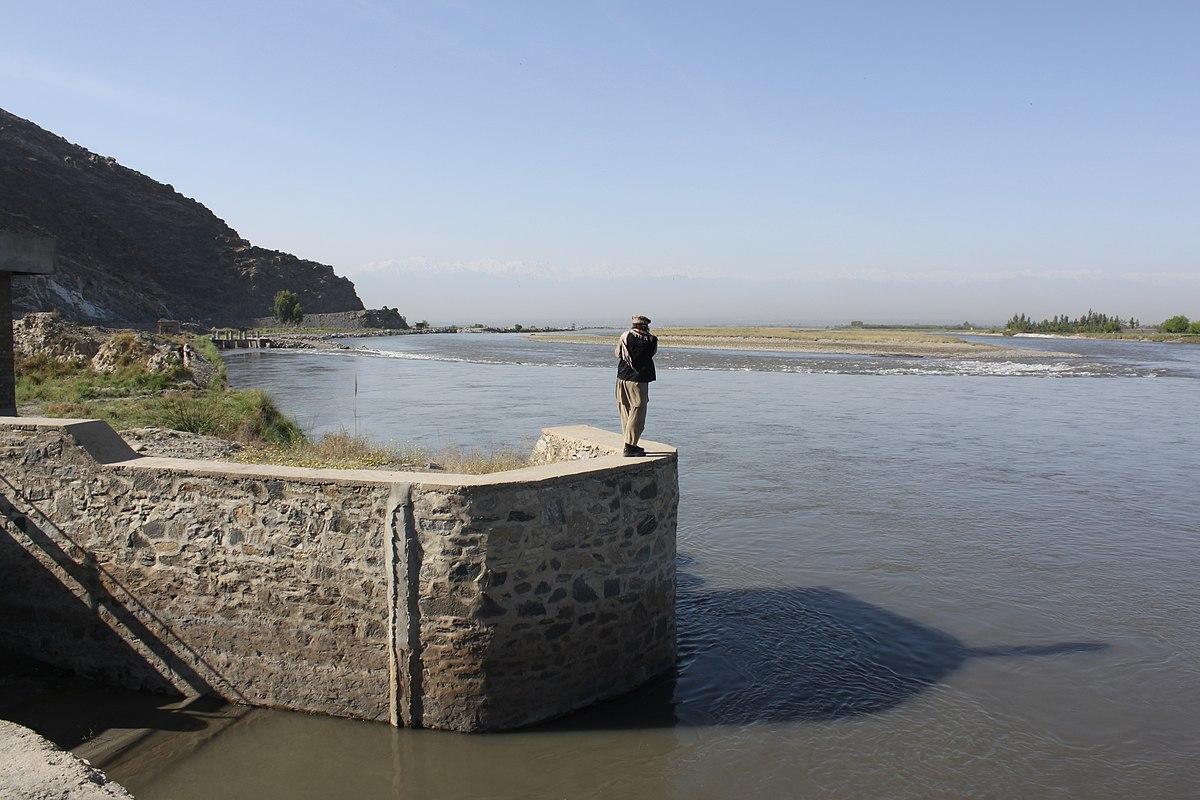 Flood prevention in Afghanistan. Image by Todd Huffman.
This April and May, large regions of central Asia were hit by a series of storms resulting in heavy downpours and flash flooding.
The worst affected country was Afghanistan, where 540 fatalities have been reported since March (WFP, 2024). In Pakistan, at least 124 people died in severe flooding in Pakistan in April (OCHA, 2024), while 18 people died in Iran in May (Iran International Newsroom, 2024). In addition, the heavy rainfall damaged thousands of homes and submerged agricultural lands.
These episodes occurred just outside of the region’s main winter rainfall season, which runs from November to early April. The unusually high rains and subsequent floods in April and May followed a three-month dry period from December to March
Researchers from Pakistan, the Netherlands, Sweden, the United States, Canada, France, Germany, and the United Kingdom collaborated to assess to what extent human-induced climate change altered the likelihood and intensity of the weather conditions at the time of the most impactful floods.
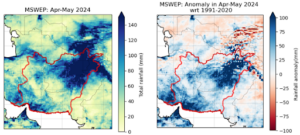
To analyse the event, we focus on a region centred on Afghanistan, bounded on the west by the Iranian provinces of Razavi Khorasan, Sistan and Baluchestan, Hormozgan, Kerman, and South Khorasan, and on the east by Balochistan and Khyber Pakhtunkhwa provinces of Pakistan. This area covers the flood-impacted regions through April and May 2024. Due to the atypicality of this season, occurring outside of the usual rainfall period and featuring an unusual number of storms that made it wetter than normal, we choose the seasonal accumulated precipitation during April and May for the temporal definition. Fig. 1 shows the total rainfall during April-May 2024 and the anomaly with respect to 1991-2020 average, over the region.
![A figure showing Observed total accumulated precipitation during April-May 2024. A red highlight shows the study region comprising the most impacted regions. (right) same as (left) showing the anomaly w.r.t 1991-2020 period. [Data source: MSWEP]](https://www.worldweatherattribution.org/wp-content/uploads/unnamed-5-300x135.png) Figure 1: (left) Observed total accumulated precipitation during April-May 2024. The red highlight shows the study region comprising the most impacted regions. (right) same as (left) showing the anomaly w.r.t 1991-2020 period. [Data source: MSWEP]
Figure 1: (left) Observed total accumulated precipitation during April-May 2024. The red highlight shows the study region comprising the most impacted regions. (right) same as (left) showing the anomaly w.r.t 1991-2020 period. [Data source: MSWEP]
Main findings
- Afghanistan and Pakistan are highly vulnerable to flooding due to factors such as limited transboundary water management, unplanned urban expansion, and deforestation which are contributing to increased flood risks, in combination with socio-economic conditions and compounding natural hazards, e.g. earthquakes, landslides, and drought. While Iran is less vulnerable than the other countries studied, urban infrastructure-related vulnerabilities in some cities in the northeast contributed to the impacts.
- The floods also occurred on top of existing vulnerabilities linked to complex crises. Displaced populations were particularly impacted, especially as limited essential infrastructure was destroyed and already vulnerable populations were exposed to more waterborne diseases.
- The event, despite occurring outside the usual rainy season, is not a particularly rare event in today’s climate that has been warmed by 1.2°C with a return time of about ten years under the current El Niño Southern Oscillation (ENSO) conditions.
- The declining El Niño Southern Oscillation, a naturally occurring climate phenomenon,