


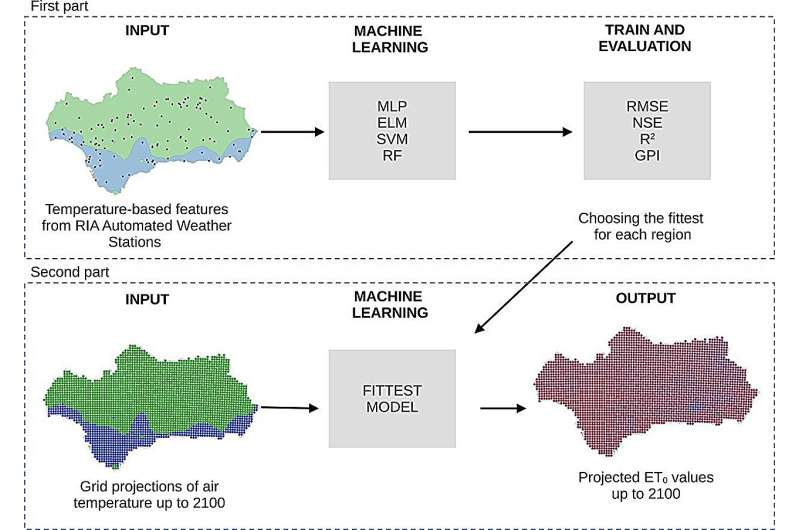
Credit: Computers and Electronics in Agriculture (2023). DOI: 10.1016/j.compag.2023.108327
A team from the University of Cordoba has published evapotranspiration projections for Andalusia through 2100, using a machine learning model that allows this data to be obtained based on the air temperature
In a context of the climate crisis, in which temperatures are rising (July 2023 was the hottest month since 1880) and precipitation patterns are changing, leading to torrential rainfall events, on the one hand, and droughts, on the other, it is essential to predict future scenarios to plan adaptation and mitigation actions.
One of the areas where the impact of the climate will be most important is agriculture. Reference evapotranspiration, a hydrological parameter that quantifies water loss from soils and cover through evaporation, and a reference crop (grass), via transpiration, is key to calculating crops water needs, as it serves to accurately quantify the ‘evaporating power’ of the atmosphere only taking into account climatic parameters.
With the aim of estimating this parameter in the future and its effect on the water needs of fields, a team from the Department of Rural Engineering, Civil Constructions, and Engineering Projects at the University of Cordoba, formed by researchers Juan Antonio Bellido, Javier Estévez and Amanda García, have generated a series of maps featuring reference evapotranspiration projections until 2100 in Andalusia.
In the future shown by the maps, we see an increase in reference evapotranspiration, going from the current data of between 1,300mm and 1,600mm to 1,9000mm in 2100. By 2100 more water will be needed to alleviate evaporation and transpiration losses from cultivated areas.
“With this work, we see a significant growth in reference evapotranspiration and, despite the uncertainties that may surround the models generated, an upward trend in this variable is shown in a robust way,” explains Javier Estévez.
How is the future calculated?
To produce these projections, the team developed several predictive models based on machine learning, making it possible to predict reference evapotranspiration using just one very simple and inexpensive-to-measure variable: air temperature.
Normally, to estimate reference evapotranspiration, complete stations are needed, which are more expensive and have greater maintenance needs, since it is necessary to measure solar radiation, relative humidity, air temperature, and wind speed at one point, but a high density of stations is not feasible.
Thus, with these new models, “by having a variable that is very economical to measure quite accurately and reliably, such as air temperature, we can ascertain the reference evapotranspiration,” thereby facilitating the process.
For these models to be valid for future scenarios, they were trained with data from 122 weather stations spread over Andalusia, from 1999—2022. Once their performance was evaluated, the models were validated and applied to obtain reference evapotranspiration predictions using only air temperature, generating maps from 2023 to 2100, which augur an increase throughout the southern region of Spain.
The air temperature data that serve as model inputs for the 2023—2100 period are predictions based on the RCP scenarios of greenhouse gas emissions and concentrations adopted by the IPCC (Intergovernmental Panel on Climate Change).