


This is a rush transcript. Copy may not be in its final form.
AMY GOODMAN: This is Democracy Now!, democracynow.org. We’re broadcasting from the U.N. climate summit, COP30, from the Brazilian city of Belém, the gateway to the Amazon. I’m Amy Goodman.
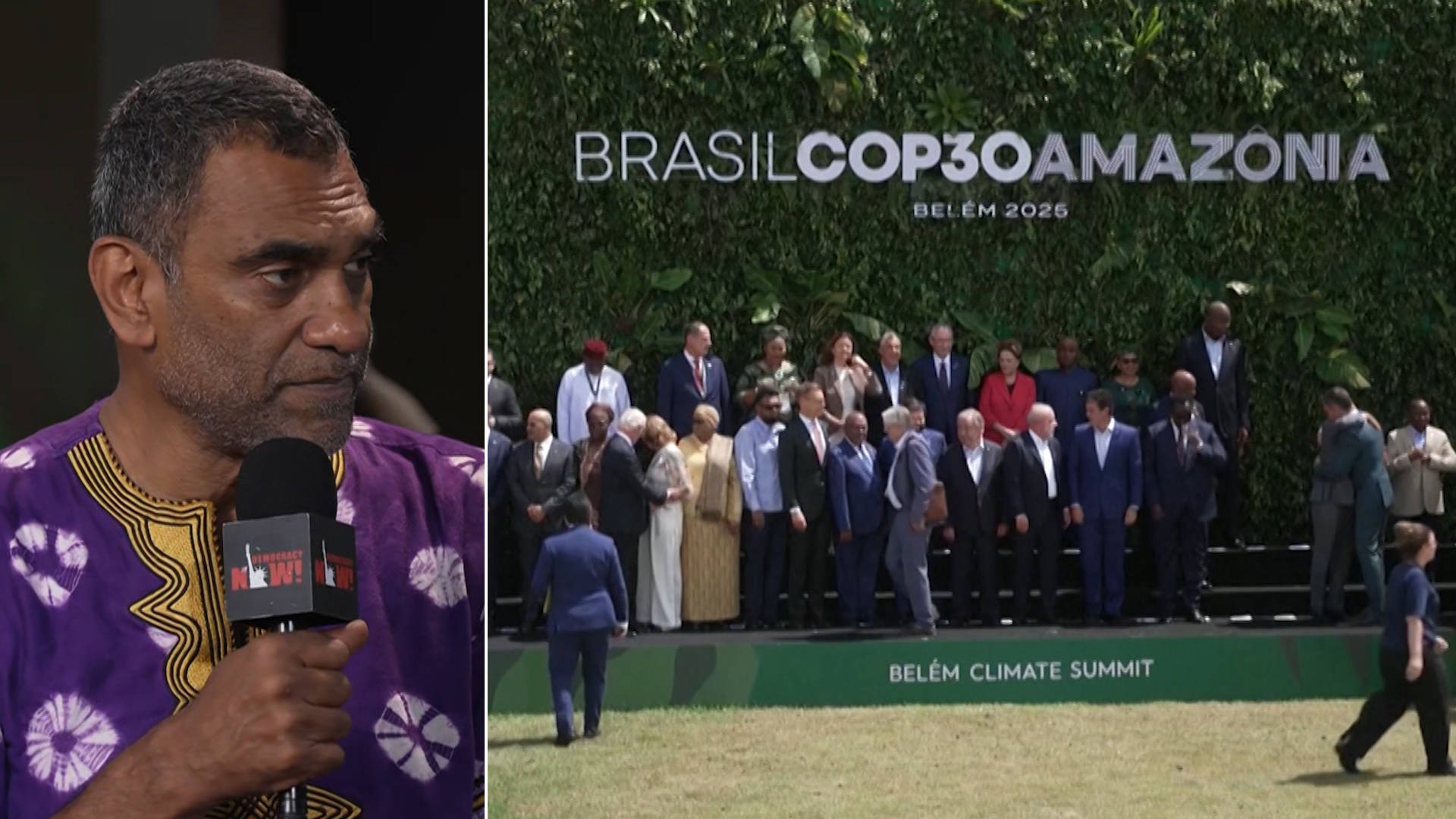
We’re joined now by Kumi Naidoo, the longtime South African human rights and environmental justice activist, former head of Greenpeace International and Amnesty International, now president of the Fossil Fuel Non-Proliferation Treaty Initiative, a global effort to accelerate a transition to renewable energy.
It’s great to have you back with us, Kumi. It seems that at these U.N. climate summits, that’s kind of the only time we get to talk right now or see each other in person. Can you talk about the significance of this moment when it comes to the climate catastrophe in the world?
KUMI NAIDOO: So, the reality is, the science told us in Paris that we need to be below 1.5 degrees. We are already pushing there. We are seeing that there is a big disconnect between the words that political and business leaders say and what actions happen on the ground.
So, for the last week, let’s just have a quick recap what’s happened. So, one, we see that there’s absolute corporate capture here again. There was 1,600 fossil fuel lobbyists. And even though it’s a struggle to get the F-word said here — by the “F-word,” we mean fossil fuels. It took 28 years before 86% of the primary cause of climate change would be even mentioned in a COP outcome document. That’s like Alcoholics Anonymous holding 28 years of conferences before they can get a backbone to mention alcohol, which is the problem. And so, that’s one challenge.
But the big debate is right now around finance. We’re really stuck on finance. So, there’s two blocs that have emerged. So, China and the G77 are talking about a seriously funded mechanism called the Belém Action Plan. And the EU has put an alternative proposal on the table, which is about — basically, developing countries are saying this will be another talk shop with no money. So, like, if you take — the money is really a big, big issue here, because, like, you’ll remember a couple of years ago we finally got a Loss and Damage Fund set up, right? And the governments have just committed $250 million to this fund, when what is needed is $400 billion a year, right? So, there’s such a big —
AMY GOODMAN: And talk about why you think — I mean, many people in the U.S., certainly Trump himself, the president, would say: Why should they be putting money into these countries?
KUMI NAIDOO: So, basically, first and foremost, it’s in self-interest, right? That in the end, if developing nation — if the rich nations of the world don’t support poor nations to transition and survive, the end result is that there will be growing emissions from the Global South,