



The opinions expressed here by Trellis expert contributors are their own, not those of Trellis.
Imagine a roulette wheel where only 20 percent of the spaces are black and 80 percent are red. Everyone is gathered around watching as you place your chips on black — but the chances the ball lands on red are quite high. If you were a chief sustainability officer, that’s how buying credits from today’s voluntary carbon market would feel. The roulette wheel is heavily biased towards low-quality, reputationally-risky credits.
Those of us in the carbon market industry often wonder why demand is so weak. Carbon credits are one tool that can help a company decarbonize. But many businesses are afraid to use them in the wake of numerous exposees about low-quality credits. Stories, such as The Great Cash-for-Carbon Hustle or John Oliver’s segment on carbon offsets, were the height of carbon market skepticism a few years ago. But we still haven’t managed to overcome the naysayers.
Why not? Because there’s an inconvenient truth: The overall quality of the market continues to be poor due to “legacy” credits issued by projects using older methodologies that have long fallen from grace that weigh the market down.
Lackluster legacy
Currently, there are over a billion credits looking for buyers. Over 60 percent of these are known to have deep flaws, like large-scale renewable energy projects that questionably need carbon finance, or forest protection projects that are vastly overstating their emission reduction claims. These two project types alone comprise over half a gigaton of credits of questionable quality — that’s more than the annual emissions from Brazil.
Quality problems in an unregulated market aren’t new. However, typical mechanisms to manage quality in such markets, such as building a reputation through positive branding, don’t work well for credence goods — products or services where quality is hard for consumers to detect. Furthermore, contractual mechanisms such as refunds and warranties aren’t generally offered by producers of carbon credits.
A few market watchers have offered other options, such as encouraging philanthropies to “mop up” and cancel bad credits, but no one has stepped up to do so. This would also create a perverse incentive, as buying such credits would financially reward actors that produced poor quality credits, sending the wrong market signal.
Quality control efforts
The Integrity Council for Voluntary Carbon Credits (ICVCM) is meant to serve as a quasi-regulator of voluntary carbon markets. Its coveted ‘core carbon principles’ label is meant to set a standard for quality across the market. However, despite its efforts over the past three years, we don’t see the market significantly improving. This could be due to commitments made for multi-year purchases or simply because companies continue to bottom-feed. Transactions of ICVCM rejected credits continue apace — last year nearly 90 million credits (over 50%) were retired that were clearly rejected by the council.
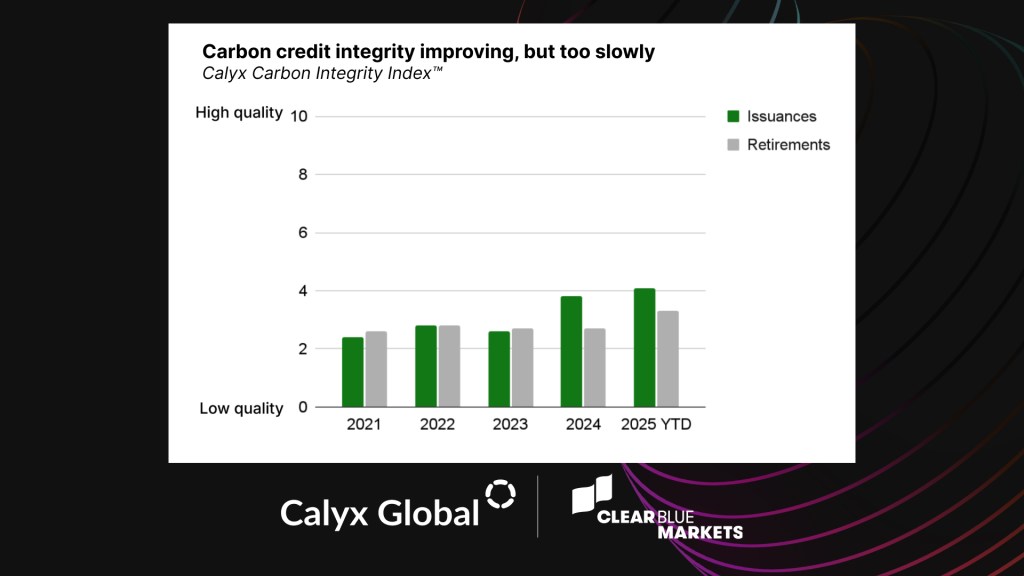
Supply side efforts
It’s said that transparency is the best disinfectant.