


Those who rise to power through a coup often fall by the same means.
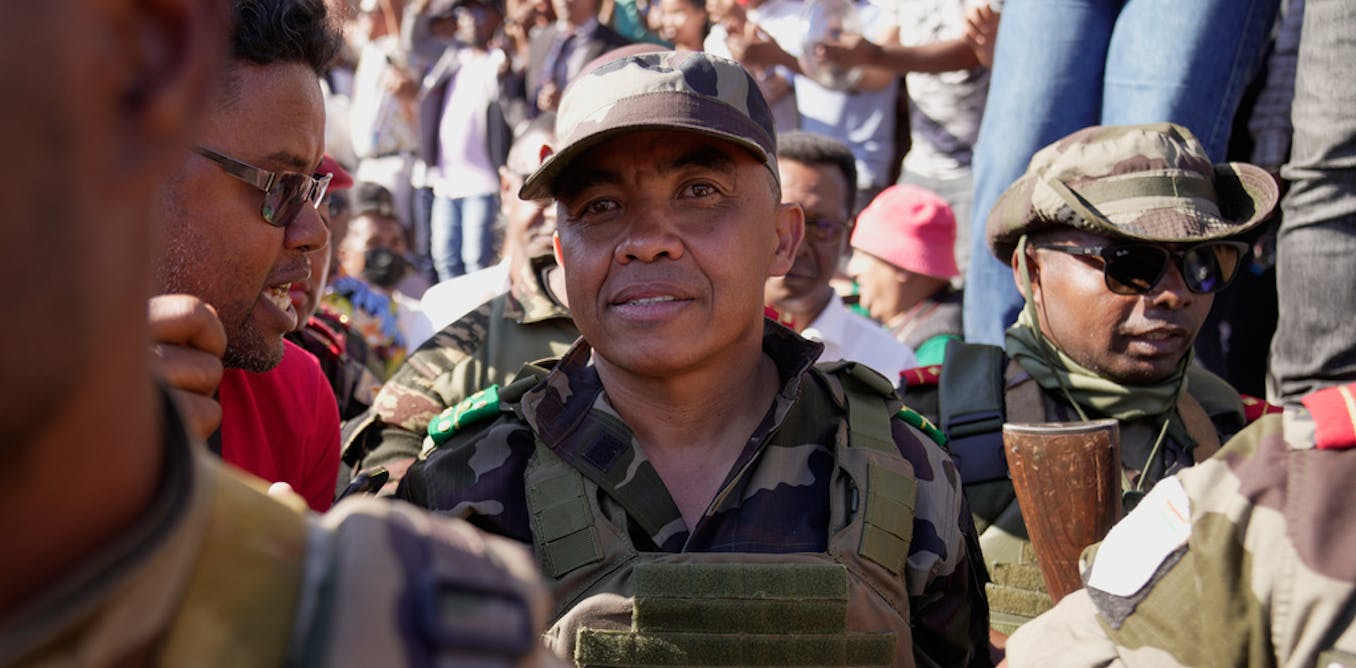
That is one of the takeaways from events in Madagascar, where on Oct. 14, 2025, the military seized power after weeks of protests largely driven by Gen Z. Ironically, it was the same elite military unit that helped bring Andry Rajoelina, former mayor of the capital Antananarivo, to power in a March 2009 coup that now supported anti-government protesters and ultimately forced the president to flee.
I lead a research team that compiles the Colpus Dataset of coup types and characteristics and have written on the history of coups d’état from 1946 through 2025.
Our data suggests that even as coups have declined globally overall, coup risk remains comparatively high in Africa. Since 2020, the continent has now seen 10 successful coups across eight countries.
But the military takeover in Madagascar marks only the second coup in that period to take place outside of the Sahel region, stretching from the Atlantic to the Horn of Africa – a signal that Africa’s coup problem is becoming a continental one.
But why do some coups succeed and others fail? And why do Madagascar and various states in Africa have trouble escaping so-called coup traps?
Our data provides some answers. But first it is worth exploring what we mean when we use the term coup.
What is a coup?
A coup d’état is a seizure of executive power involving one or more concrete, observable and illegal actions by security personnel or civilian officials.
Here, Madagascar’s military takeover appears to qualify. Despite claims by the country’s new military leader, Col. Michael Randrianirina, that he had an order from the High Constitutional Court legitimizing his seizure of power, this seemed to be contradicted by statements a day earlier that Randrianirina’s military council had suspended the high court’s powers.
That’s not to say that every political event that smells like a coup is, in fact, a coup.
Many coup plots never come to fruition. A bona fide plot may be preempted and the plotters arrested, or plotters may abandon their plan before taking any concrete action. Moreover, sometimes a leader falsely alleges a coup plot to purge members of the government suspected of disloyalty.
A plot without an attempt to oust the leader is not, in our book, a coup.
Conversely, attempts to target a leader without a plan to seize power are not coups. This includes leader assassination attempts by political opponents or lone wolves or mutinies by disgruntled soldiers who might even march on the presidential palace to demand higher pay, promotions or other policy concessions.
Nor do most civilian-led mass uprisings entail coups, even if they are successful in toppling the government. Take Nepal, where in September a Gen Z-led protest turned violent and ousted the government. But there was no coup insofar as the military remained quartered rather than actively joining the protests or issuing a threat to compel the prime minister to resign.