


McLaren F1’s Progress and Challenges for the Future
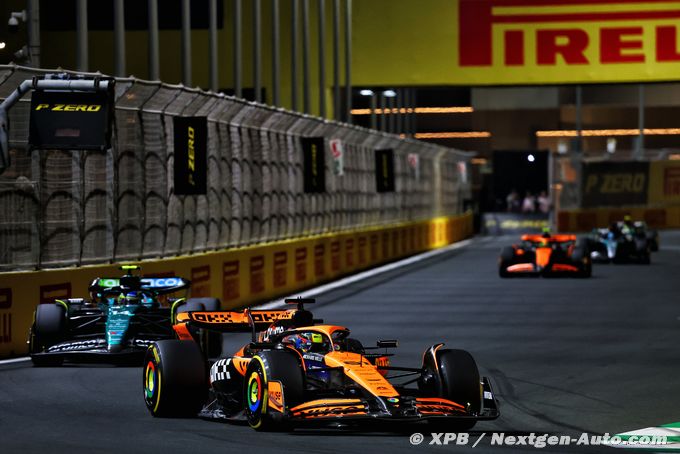
After scoring 16 points in Djeddah, Oscar Piastri and Lando Norris have helped McLaren F1 secure the third spot in the constructor’s championship, edging out Mercedes. This marks a significant improvement from last year when the team failed to score any points on the same circuit.
However, despite their strong start to the season, team director Andrea Stella acknowledges that there are still concerns regarding the MCL38’s balance. He believes that it may take until 2025 to address and resolve these issues completely.
Stella notes, “We have yet to address certain specific aspects of the car’s balance, but once we do, we can make a leap forward in terms of competitiveness. While this will improve some weaknesses, there is still work to be done.”
“We have two more years to implement these regulations, and I believe it will take at least another year to solve these balance issues. I hope this will make us highly competitive by 2025.”
“Moreover, I think this exercise will be crucial in understanding methodologically how you develop the cards and, from an objective standpoint, what you need to do to prevent these types of issues or weaknesses in 2026 as well.”
“It is, therefore, a very valuable effort currently underway at McLaren. I see it as both a short-term and long-term investment.”
Challenges for McLaren and Formula 1 in 2026 Regulations
As Stella highlights the remaining work to be done at McLaren, he also urges Formula 1 to learn from the current regulatory era to enhance the spectacle for 2026 and avoid undesirable side effects.
“In terms of technical and engineering aspects, I believe the 2022 regulations presented some unintentional challenges. We have made significant progress in understanding these challenges.”
“This is also why these cars are much more comfortable to drive today but can still be quite delicate. They still tend to bounce slightly, deform, and become quite twitchy. Comfort is not the only thing that matters; the car must be pushable to its limit as well.”
“All these lessons should definitely be taken into account in the design of the 2026 regulations, especially if it involves a derivation of the current ground-effect cars we are using.”
“It would be a drawback if in 2026, cars face similar issues to the 2022 generation. Or if we encounter unintentional problems again because we still have time to study and must start well in 2026.”
As McLaren continues its journey towards competitiveness and improvement, it is crucial for both the team and Formula 1 as a whole to address the existing challenges and pave the way for a more successful and exciting future in the sport.