

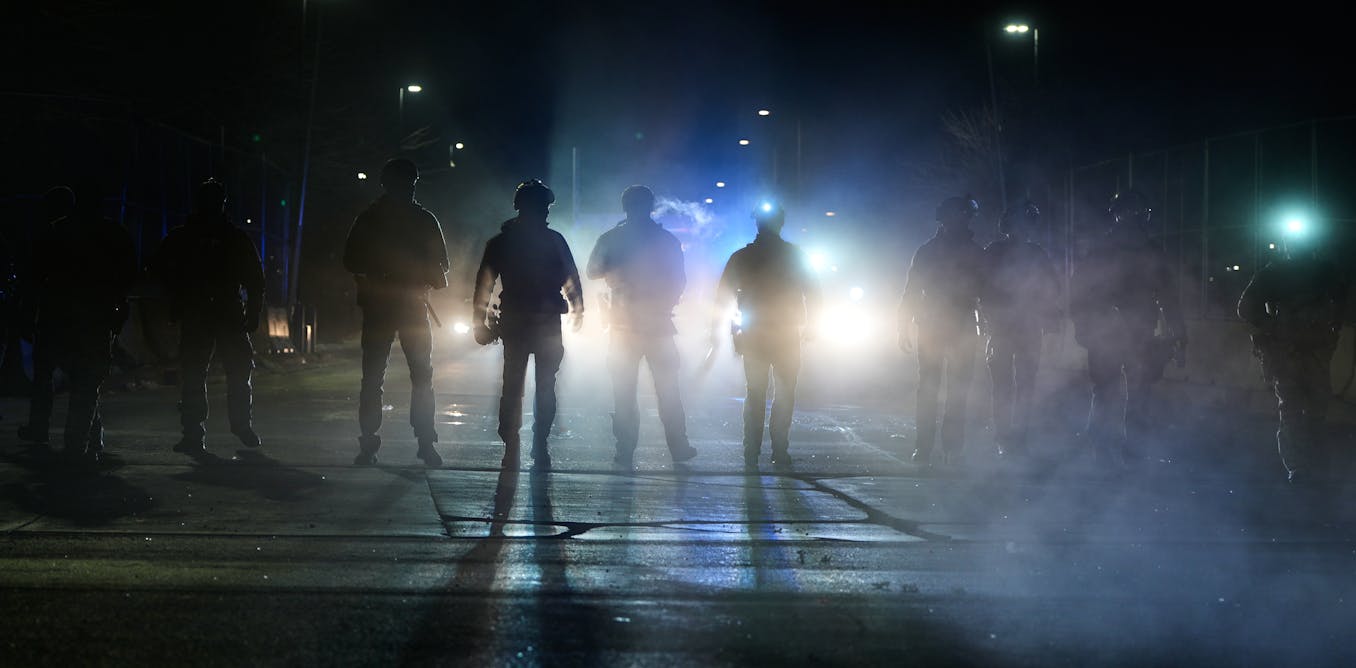

A federal judge heard arguments on Jan. 26, 2026, as the state of Minnesota sought a temporary restraining order to stop the Trump administration’s immigration enforcement operation in the state. The administration has sent some 3,000 immigration agents to Minnesota, and attorneys for the state have argued, in part, that it amounts to an unconstitutional occupation, on 10th Amendment grounds. Alfonso Serrano, a politics editor at The Conversation U.S., spoke with Andrea Katz, a law scholar at Washington University in St. Louis, about the Minnesota lawsuit and its possible legal implications.
What’s the legal issue at stake in this court case?
In Minnesota v. Noem, attorneys for the state are arguing that the federal government is acting illegally by intruding on a sphere of state power (the police power). They’re claiming violations of the 10th Amendment, which is this idea that under the U.S. Constitution, states are reserved powers that existed before the Constitution was drafted, powers that are not delegated to the federal government.
They’re also making this rather new claim under what’s called the equal sovereignty principle, which is that states all have to be treated equally by the federal government. There’s also a First Amendment claim, and an Administrative Procedure Act claim, which is that the government is acting illegally in an arbitrary and capricious way. I think the 10th Amendment arguments are ones that I would say are kind of unprecedented, rather untested waters.
On that note, when does a federal law enforcement response cross the line and violate the 10th Amendment? Is there precedent for this?
The question you just posed is one that the district judge, Kate M. Menendez, seems to be nervous about having to hear. This is essentially asking a federal judge to sift into different buckets that which is federal power and that which is state power. And I can say there’s not a lot of case law on this issue.
The most filled-out doctrine under the 10th Amendment is the anti-commandeering doctrine. It holds that the federal government cannot use the state government as a sort of puppet. The federal government can’t use state officers forcibly against the state’s will to enforce the law. Now that is not, strictly speaking, what’s going on here, because Minnesota is complaining about the presence of federal agents enforcing the laws in ways that it thinks are illegal.
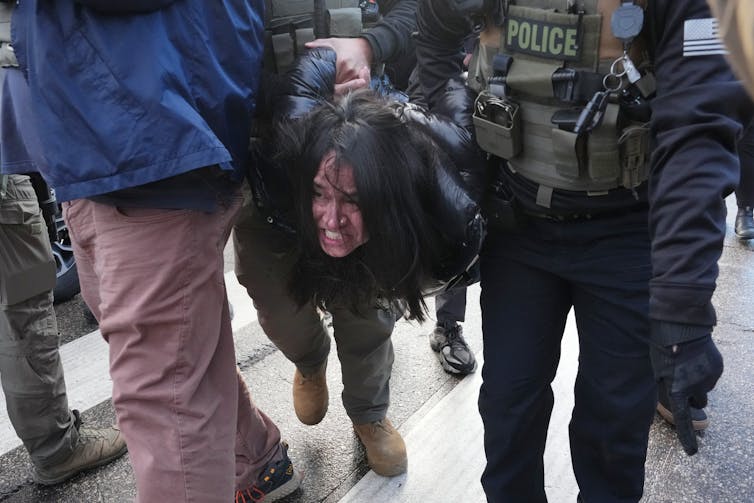
A woman is detained by federal agents in Minneapolis on Jan. 13, 2026.
AP Photo/Adam Gray
And so it seems to me that the 10th Amendment has been most developed in this area that Minnesota is not touching on, and so for that reason, I think their invocation of it is pretty unusual. They’re essentially claiming that the 10th Amendment protects their police powers and that the federal government is intruding on that. I think that’s a novel argument in court, and my suspicion is that it is not likely to be a winning argument in court.