

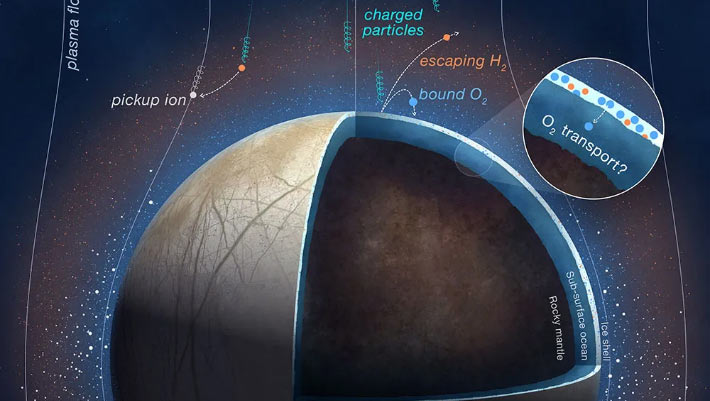

The Jovian Auroral Distributions Experiment (JADE) instrument aboard NASA’s Juno spacecraft has provided insights into the rate of oxygen production at Jupiter’s moon Europa, revealing a lower quantity than previously estimated.
Europa’s Composition and Characteristics
Europa, with an equatorial diameter of 3,100 km, is the smallest of Jupiter’s four Galilean moons. It harbors a subsurface liquid ocean beneath its icy shell, creating potentially habitable conditions.
Oxygen Production Mechanism
The surface of Europa is bombarded by radiation from Jupiter, causing the ice to break down into oxygen and hydrogen molecules. Most of these molecules either escape into space or remain in Europa’s atmosphere.
Research Findings
Previous studies of Europa’s oxygen production primarily relied on remote sensing observations, leading to substantial uncertainties in estimations. However, data from the Juno spacecraft’s flyby in 2022 provided new insights.
Using the JADE instrument, researchers determined that Europa produces approximately 12 kg of oxygen per second at its surface. This value is lower than previous estimates, which ranged from 5 to 1,100 kg per second.
Implications for Habitability
The reduced oxygen levels on Europa’s surface suggest a narrower range of habitable conditions in its subsurface ocean. This finding challenges previous assumptions about the moon’s potential for hosting life.
Scientific Contributions
Dr. Jamey Szalay from Princeton University and his colleagues conducted the analysis of Juno’s data, shedding light on Europa’s oxygen production dynamics. The research expands our understanding of the moon’s geophysical processes.
Juno’s principal investigator, Dr. Scott Bolton from the Southwest Research Institute, emphasized the significance of these findings in advancing the exploration of Europa’s habitability during the extended mission.
For more details on this research, you can visit the original article here.