

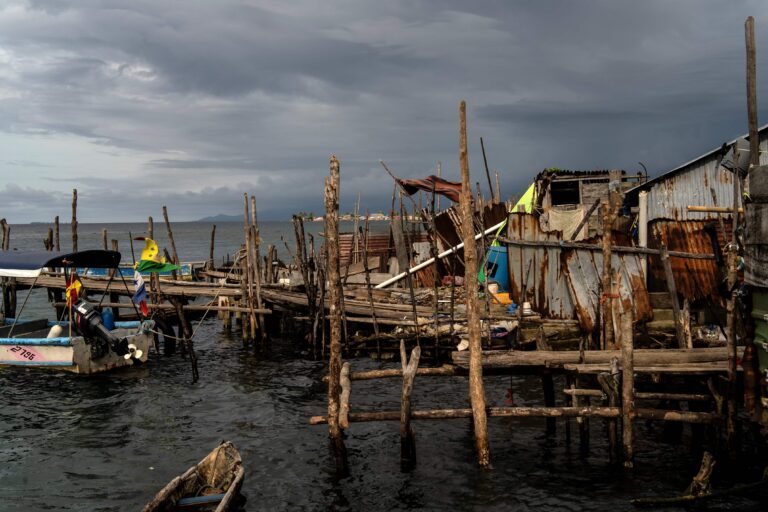

- The government of Panama continues to delay the process of relocating almost 1,300 Indigenous Guna inhabitants from an island experiencing rising sea levels due to climate change.
- The lack of space on the tiny Caribbean island of Gardi Sugdub means there’s no room to relocate, and a new site on the mainland for the community has been in the works since 2019.
- But plans for the relocation have been repeatedly delayed due to administrative issues, previous COVID-19 restrictions and poor budgeting, leaving residents skeptical that government promises will be upheld.
- Members of this fishing community have also expressed concern about the relocation site, which is a 30-minute walk from the coast, and about the design of the new homes, for which the government didn’t seek Guna input.
Plans to relocate an Indigenous community from a tiny Caribbean island off Panama to the country’s mainland to escape rising seas have been delayed due to administrative issues, previous COVID-19-related complications, and poor budgeting. Residents say the government has failed to integrate traditional and local knowledge in the relocation and site development plans.
President Laurentino Cortizo told residents of the Indigenous Guna that the new site would be completed by Sept. 25, 2023. But no one has been given keys yet and the site has no basic services, such as water or sewage disposal. According to Erica Bower, a climate displacement researcher at Human Rights Watch, the Panamanian Ministry of Housing and Territorial Planning (MIVOT) told HRW that the houses would be ready on April 4, but that deadline was not met.
The relocation project, which involves building 300 houses on Panama’s mainland for 1,300 Guna from Gardi Sugdub, one of 365 islands that form part of the Guna Yala archipelago, was first proposed by the island communities in the 1990s, when community leaders began to raise concerns about rising sea levels and overcrowding.
“Because of the climate changes taking place in the world, the islands of Guna Yala are more sensitive,” Atencio López Martínez, a Guna lawyer and adviser to the General Congress of Guna Yala, told Mongabay. “They are more prone to flooding and that’s why communities from Gardi Sugdub have decided to move before catastrophic events occur.”
 Overcrowding on Gardi Sugdub results in a lack of privacy and creates tensions between family members and neighbors. Image courtesy of Human Rights Watch.
 Gardi Sugdub residents have still not been given keys to their new homes on the mainland. Houses on the new site have a standard design using modern materials, such as concrete, unlike the traditional homes with thatched roofs on the island. Image courtesy of Human Rights Watch.
The Guna people of Gardi Sugdub aren’t alone. Thirty other communities in Panama and more than 400 communities around the world have planned relocations similar to this one due to hazards such as floods,